
Canyon Wren Identification Guide
A rusty, flat-headed wren of sheer rock cliffs and canyons, more often heard than seen thanks to its cascading, whistled song.
Read the full Canyon Wren encyclopedia entry →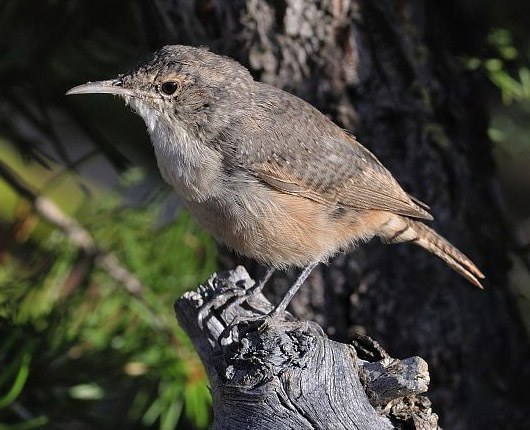
Key Field Marks
- Size & shape: A small wren with a notably long, slightly downcurved bill, a flattened head profile, and a body that appears flattened for slipping into rock crevices.
- Plumage: Rich chestnut-rufous body finely speckled with black and white on the upperparts, contrasting with a bright white throat and upper breast that fades into the rusty belly.
- Bill: Long and thin, more curved than other wrens, adapted for probing rock cracks for insects.
- Behavior: Clings to and hops across vertical rock faces and canyon walls with remarkable agility; bobs and dips while foraging in crevices; rarely far from bare rock, cliffs, or stone buildings.
Similar Species
- Rock Wren: Found in similar rocky habitat but is grayer-brown overall, lacks the bright white throat/rusty belly contrast, and has a shorter, straighter bill; Rock Wren also bobs constantly and has a buffy-tipped tail.
- House Wren: Smaller, plain brown overall without the white throat or bright rufous tones, and found in brushy/wooded habitat rather than sheer rock.
Where & When to See
A year-round resident of canyons, cliffs, rocky outcrops, and boulder-strewn slopes throughout the interior western United States and Mexico, from low desert canyons to higher elevation rock faces. Also sometimes found around old stone buildings and rocky road cuts. Non-migratory in most of its range, present all year where suitable rock habitat exists.
Voice
One of the most distinctive songs in North America: a loud, liquid, cascading series of clear whistled notes that tumble down the scale, often rendered as "tee-tee-tee-tew-tew-tew-tew" — this echoing song carries far across canyon walls and is frequently the first clue to the bird's presence before it is ever seen.
Frequently asked questions
How do you identify a Canyon Wren by song?
Listen for a loud, liquid, cascading series of clear whistles that descend the musical scale — a sound that echoes distinctively off canyon walls.
What is the difference between a Canyon Wren and a Rock Wren?
Canyon Wren has a bright white throat contrasting with a rich rusty belly and a longer curved bill, while Rock Wren is more uniformly grayish-brown with a shorter, straighter bill.
Where do Canyon Wrens live?
Sheer rock canyons, cliffs, boulder fields, and rocky outcrops across the interior western U.S. and Mexico; they rarely stray far from exposed rock.
Are Canyon Wrens migratory?
No, they are largely non-migratory residents that stay in their rocky territories year-round.