
Canvasback Identification Guide
A large diving duck with a sloping, wedge-shaped profile, chestnut-red head, and pale body that stands out among diving ducks on open water.
Read the full Canvasback encyclopedia entry →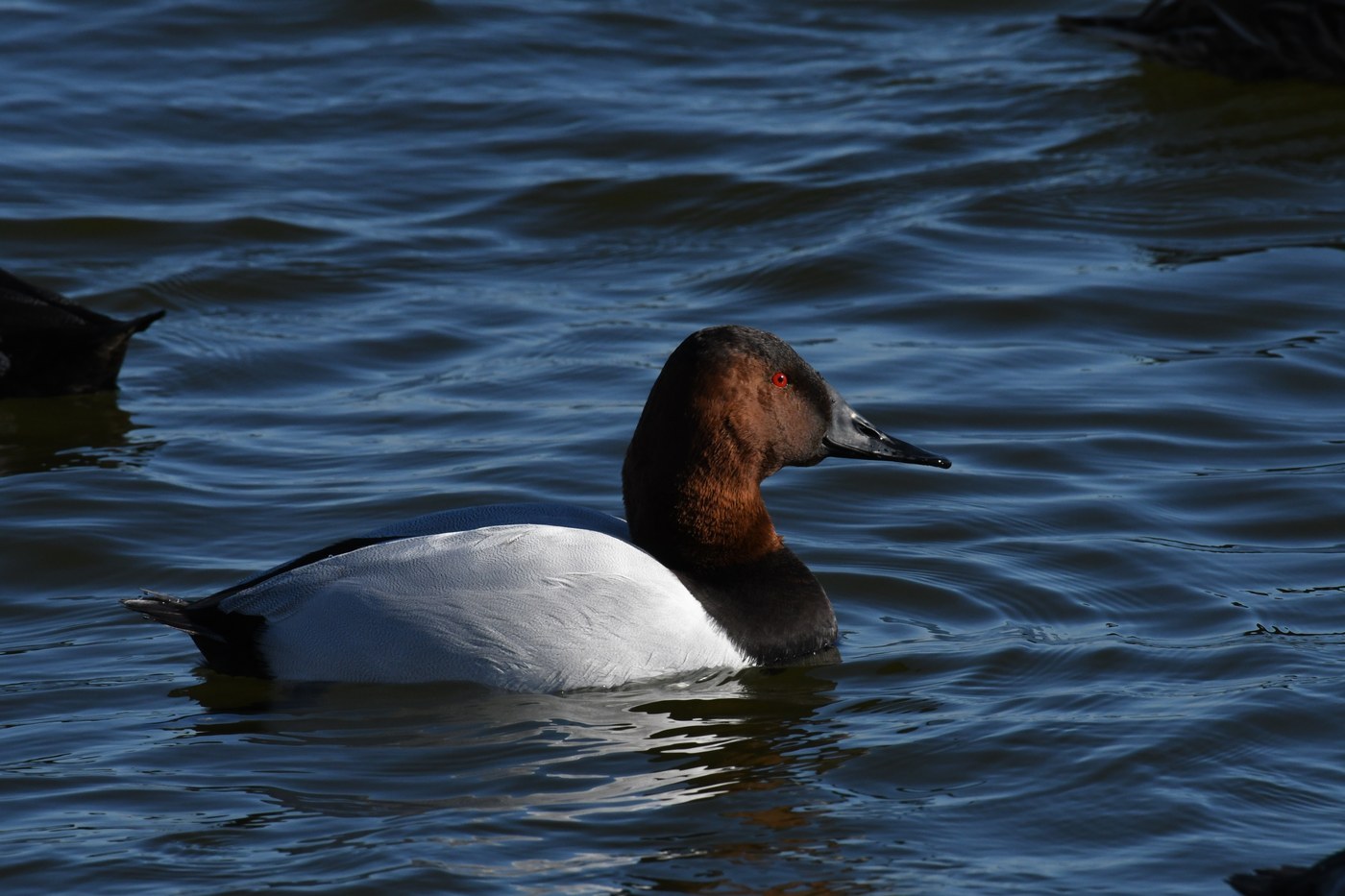
Key Field Marks
- Size & shape: The largest diving duck in North America (bulky, long-bodied), instantly recognizable by its distinctive sloping forehead that runs in a straight line from the crown to the tip of the long black bill, giving a wedge-shaped head profile unlike any other duck.
- Male (drake): Rich chestnut-red head and neck, black breast, and a pale gray-white to whitish body that can look almost white at a distance ("canvas" colored back and flanks). Bill is black, eye is red.
- Female (hen): Softer brown head and neck fading to a grayish-tan body, with the same diagnostic sloped head/bill profile as the male. Eye is dark.
- Bill and legs: Long, black, and sloped in line with the forehead — this head shape is the single most reliable mark in any light.
- Behavior: Diving duck that feeds by diving underwater (not tipping up like dabblers); often forms large rafts on open lakes, bays, and reservoirs; runs across the water to take flight.
Similar Species
- Redhead: Also has a chestnut head but the forehead is rounded/steep, not sloped, and the bill is shorter with a gray band near a black tip (not all-black). Redhead's back is grayer, less white.
- Ring-necked Duck: Smaller, with a peaked (not sloped) head, a bill with a white ring near the tip, and a dark back rather than pale.
- Greater/Lesser Scaup: Rounded head shape, blue-gray bill with a black nail, and lack the canvasback's sloped profile.
Where & When to See
Breeds on prairie marshes and pothole wetlands of the northern Great Plains and interior Canada/Alaska. Winters widely across the U.S. on large lakes, reservoirs, coastal bays, and estuaries, often in large single-species or mixed diving-duck flocks. Most numerous during migration (fall and spring) and winter on large open water bodies.
Voice
Generally quiet away from breeding grounds. Males give a soft, cooing "krrrr-krrrr" or growling notes during courtship; females give a harsher "quack" or growl. Most identification relies on shape and plumage rather than voice, since flocks on wintering grounds are often silent.
Frequently asked questions
What is the easiest way to identify a Canvasback?
Look for the sloping forehead that forms a straight line with the long black bill — no other North American duck has this wedge-shaped head profile.
How do you tell a Canvasback from a Redhead?
Canvasback has a long, sloped forehead/bill line and an all-black bill; Redhead has a rounded, steep forehead and a shorter bill with a gray band near the black tip.
Where can I see Canvasbacks in winter?
Look for large rafts on big open lakes, reservoirs, and coastal bays and estuaries, where they gather in large numbers to dive for aquatic vegetation and invertebrates.
Do male and female Canvasbacks look different?
Yes — males have a chestnut-red head, black breast, and pale whitish body, while females are uniformly brown-tan with the same distinctive sloped head shape.