
Calliope Hummingbird Identification Guide
The smallest breeding bird in the United States and Canada, a tiny, short-tailed hummingbird whose male shows a unique streaked, wine-red gorget rather than a solid patch.
Read the full Calliope Hummingbird encyclopedia entry →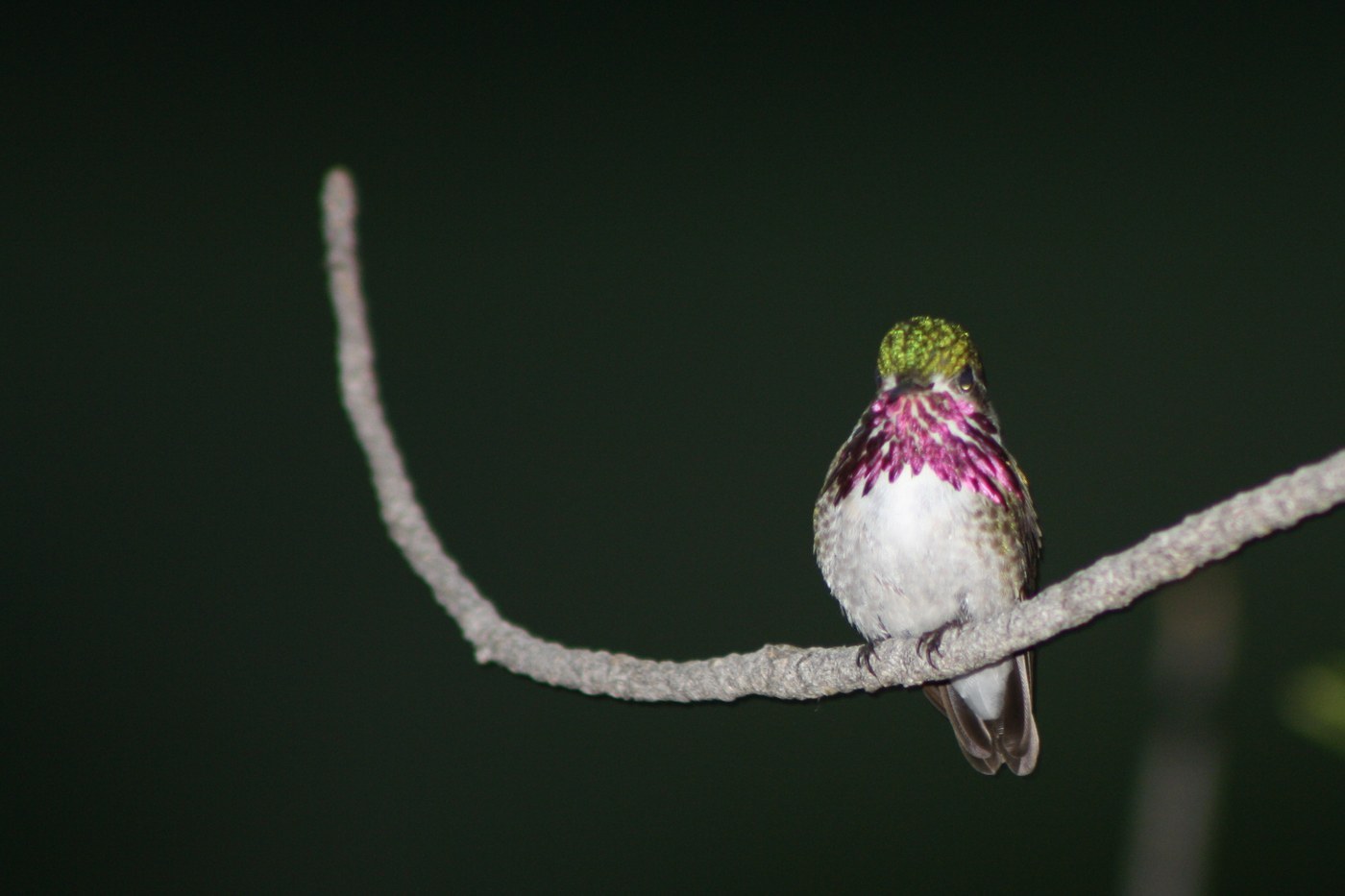
Key Field Marks
- Size & shape: Very small hummingbird, about 3-3.25 inches long - the smallest breeding bird in the U.S. and Canada - with a notably short tail that barely extends past the folded wingtips, giving a compact, stub-tailed look.
- Male plumage: Metallic green back and crown, whitish underparts, and a distinctive gorget of magenta-to-wine-red streaks radiating from the throat (rather than a solid iridescent patch as in most other hummingbirds).
- Female/immature plumage: Green above, whitish below with light buffy wash on the flanks, and fine dusky spotting on the throat; separated from other female hummingbirds mainly by small size and very short tail.
- Bill: Short, straight, and fine, proportionally shorter than in many other western hummingbirds.
- Flight: Fast, direct flight with rapid wingbeats; males perform a distinctive display dive with a buzzy, popping sound during courtship.
Separating from Similar Species
- Broad-tailed Hummingbird: Larger, with a longer tail extending past the wingtips at rest and a solid rose-pink (not streaked) gorget in males.
- Rufous/Allen's Hummingbird: Males show extensive rufous/orange coloring on the back, flanks, or tail, which Calliope lacks (Calliope is green-backed); female Rufous/Allen's are larger with more rufous in the tail and flanks.
- Broad-billed Hummingbird: Larger, with a longer, more strongly red-based bill and a blue (not streaked-red) throat in males.
- Overall: The tiny size, very short tail at rest, and streaked (not solid) gorget in males are the most reliable combination of marks.
Where & When to See It
- Habitat: Open montane meadows, mountain shrub, and streamside thickets during breeding, typically at mid to high elevations; uses lowland scrub and gardens during migration.
- Range: Breeds in the mountains of the Pacific Northwest and northern Rockies (British Columbia south through Washington, Oregon, Idaho, Montana, and parts of California/Nevada/Utah/Wyoming); winters mainly in Mexico.
- Season: Present on breeding grounds late spring through late summer; migrates through lower elevations and the Southwest in spring and again (via a more easterly route through the Rockies) in late summer/fall.
Voice & Song Cues
- Relatively quiet for a hummingbird; gives soft, high chip and buzzy chase calls rather than a developed song.
- Males perform a dramatic J-shaped or U-shaped display dive from height, producing a buzzy, insect-like popping sound at the bottom of the dive - a strong behavioral clue during breeding season.
Frequently asked questions
How do you identify a male Calliope Hummingbird?
Look for a very small hummingbird with a short tail and a gorget made of magenta-wine streaks radiating from the throat rather than a solid iridescent patch, which is unique among North American hummingbirds.
What is the smallest hummingbird in the United States?
The Calliope Hummingbird, at about 3-3.25 inches long, is the smallest breeding bird species in both the United States and Canada.
How do you tell a female Calliope Hummingbird from other females?
Size and tail length are key: Calliope is notably tiny with a very short tail that barely extends past the wingtips at rest, whereas similar female hummingbirds like Broad-tailed or Rufous are larger with longer tails.
Where do Calliope Hummingbirds breed?
They breed in mountain meadows and shrubby habitat of the Pacific Northwest and northern Rocky Mountains, generally at middle to high elevations.
What is distinctive about a male Calliope's courtship display?
Males perform a steep dive from height, ending in a buzzy, popping sound produced mechanically, which is a strong behavioral clue for identification during the breeding season.