
California Scrub-Jay Identification Guide
A crestless blue-and-gray jay of West Coast chaparral and oak woodland, told from other blue jays by its white throat outlined in a blue "necklace" and brown back patch.
Read the full California Scrub-Jay encyclopedia entry →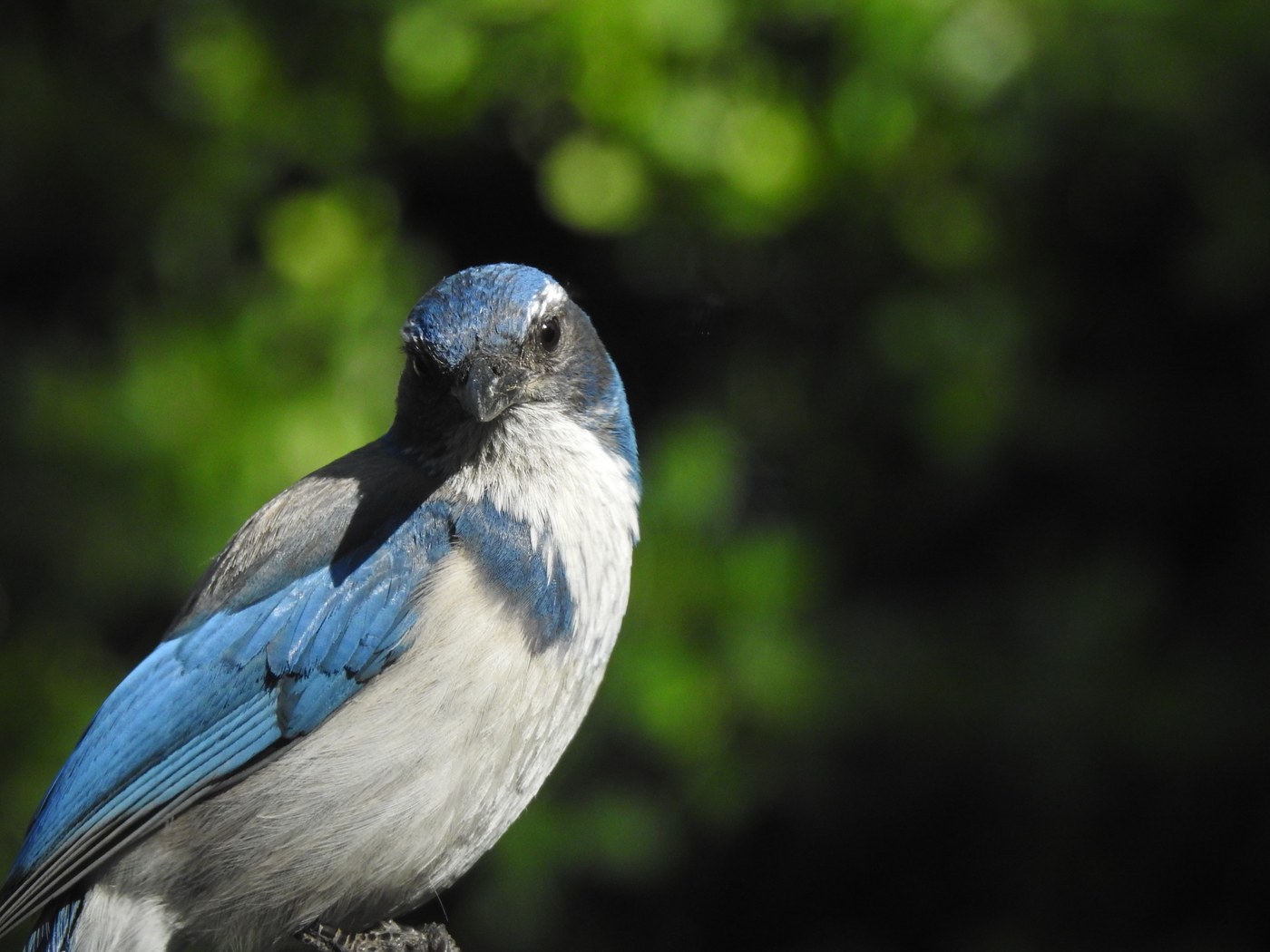
Key Field Marks
- Size & shape: Medium-sized jay, about 11-12 inches long, with a long tail, fairly long bill, and no crest - the head is smoothly rounded, unlike crested jays.
- Plumage: Blue head, wings, and tail contrast with a grayish-brown patch on the back (mantle) and pale gray-white underparts.
- Face and throat: Whitish throat bordered below by an incomplete blue "necklace" band across the upper breast; a whitish eyebrow stripe is often visible over a dark eye-line.
- Underparts: Pale gray belly and grayish-white flanks with a dingy, unstreaked appearance.
- Behavior: Often perches conspicuously atop shrubs or fence posts, hops on the ground while foraging, and caches acorns and seeds - look for birds carrying and burying food items.
Separating from Similar Species
- Woodhouse's Scrub-Jay (formerly combined with this species as "Western Scrub-Jay"): Found in the interior Great Basin/Southwest rather than along the coast; shows a less contrasting back patch and duller, less vivid blue overall, with limited range overlap.
- Steller's Jay: Has a prominent black crest and much darker overall plumage (blackish head and back, deep blue body), easily separated by the crest alone.
- Blue Jay (eastern species, rare vagrant in the West): Shows a crest, white wing bars, and a black necklace/bridle across a white face, quite different from the crestless Scrub-Jay.
- Pinyon Jay: Overall uniform dull blue with no white throat or contrasting back patch, and a shorter tail; forms large nomadic flocks unlike the more solitary/pair-based Scrub-Jay.
Where & When to See It
- Habitat: Oak woodland, chaparral, pinyon-juniper edges, and increasingly parks, gardens, and suburban yards with oak or pine cover.
- Range: Resident along the Pacific Coast and coastal ranges from southern Washington through California into northern Baja California.
- Season: Present year-round; non-migratory and territorial, so the same pair can often be found on a consistent territory across seasons.
Voice & Song Cues
- Common call is a harsh, rising shreep or check note, plus a scolding, raspy chatter when agitated or mobbing predators.
- Pairs often duet with harsh, scratchy calls, and the species lacks a musical song, relying instead on varied harsh calls for communication.
Frequently asked questions
How do you identify a California Scrub-Jay?
Look for a crestless blue jay with a brown-gray back patch, a whitish throat bordered by an incomplete blue necklace, and pale grayish underparts, typically seen in oak or chaparral habitat along the West Coast.
What is the difference between a California Scrub-Jay and a Steller's Jay?
Steller's Jay has a tall black crest and much darker plumage, while California Scrub-Jay is crestless with a brighter blue head and a contrasting brown back patch.
Is California Scrub-Jay the same as Western Scrub-Jay?
The former Western Scrub-Jay was split into two species in 2016: the coastal California Scrub-Jay and the interior Woodhouse's Scrub-Jay, which differ subtly in color saturation and range.
What does a California Scrub-Jay sound like?
It gives harsh, raspy calls such as a rising shreep and scolding chatter rather than a musical song, often heard before the bird is seen.
Where do California Scrub-Jays live?
They are year-round residents of oak woodland, chaparral, and increasingly suburban yards along the Pacific Coast from Washington to Baja California.