
California Quail Identification Guide
A plump, ground-dwelling quail easily recognized by the forward-drooping black head plume and intricately scaled belly, common in West Coast scrub and suburbs.
Read the full California Quail encyclopedia entry →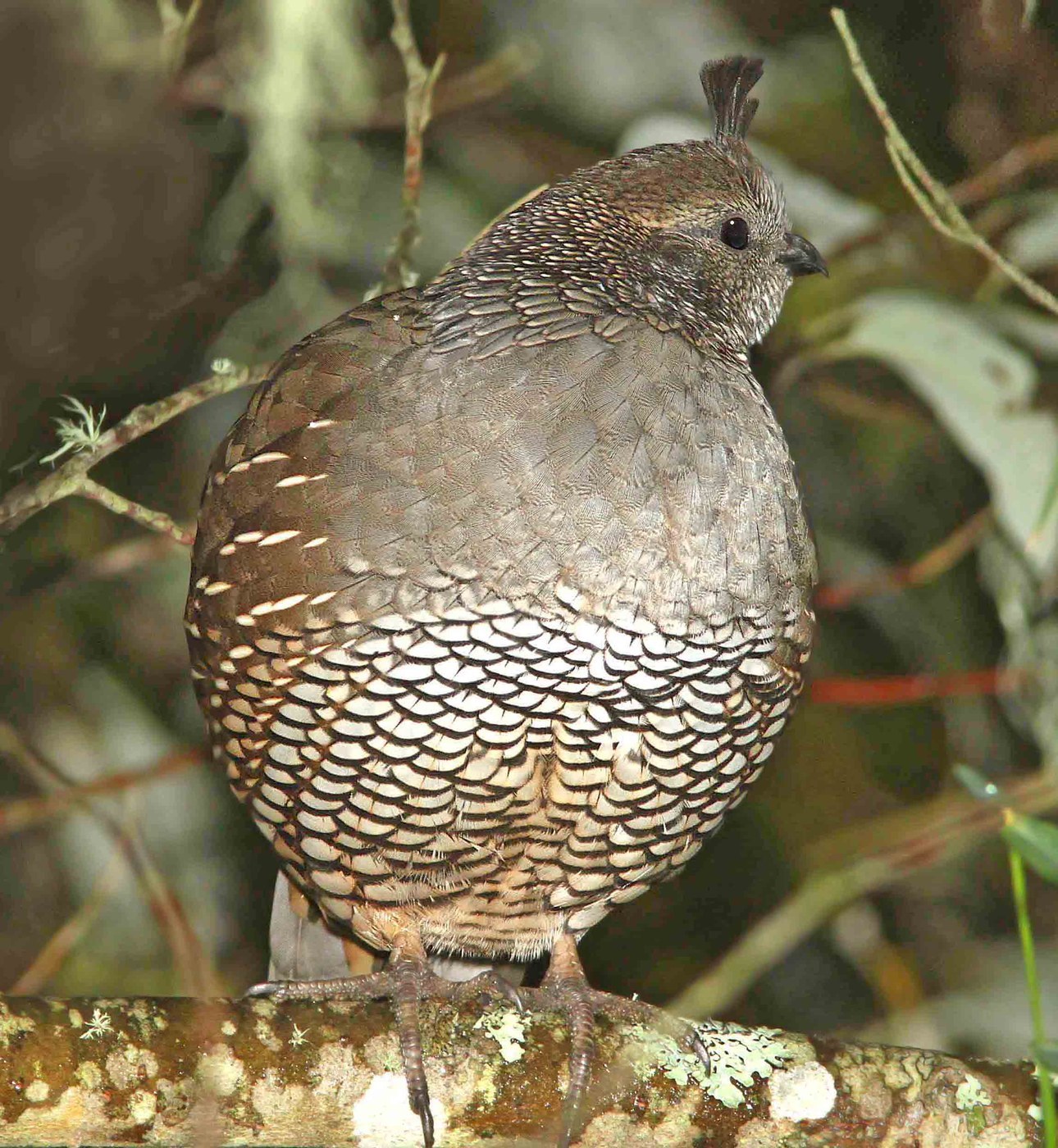
Key Field Marks
- Size & shape: Small, round-bodied game bird about 9-11 inches long, with a short neck, short rounded wings, and a distinctive comma-shaped topknot of feathers curving forward from the crown.
- Male plumage: Blue-gray breast, brown back and streaked flanks, a black face and throat outlined with bold white borders, and a scaly "chain mail" pattern on the belly.
- Female plumage: Duller overall grayish-brown with a shorter, less prominent topknot and a plainer face lacking the male's black-and-white pattern, but sharing the scaled belly.
- Legs and gait: Short, sturdy gray legs adapted for running rather than flying; birds typically scurry into cover rather than take flight when disturbed.
- Social structure: Usually seen in coveys (groups) outside of breeding season, often walking in a line across open ground or roadsides.
Separating from Similar Species
- Gambel's Quail: Very similar shape and topknot, but male Gambel's Quail has a plain buffy (unscaled) belly with a black belly patch, chestnut sides, and ranges mainly in the desert Southwest with limited range overlap.
- Mountain Quail: Larger, with a long, straight (not curved) plume and rich chestnut throat patch bordered in white, found in denser mountain chaparral and forest edge at higher elevations.
- Overall: The forward-curving black topknot combined with the scaled belly pattern is diagnostic for California Quail where ranges don't overlap with Gambel's Quail.
Where & When to See It
- Habitat: Chaparral, oak woodland edges, brushy foothills, farmland hedgerows, and increasingly suburban parks and gardens with dense shrub cover.
- Range: Resident along the Pacific Coast from southern Oregon through California into Baja California, with introduced populations in parts of Washington, Nevada, Utah, and Hawaii.
- Season: Present year-round; coveys are most conspicuous in fall and winter, while pairs separate out and become more territorial during the spring breeding season.
Voice & Song Cues
- The advertising call is a loud, three-syllable chi-CA-go (sometimes rendered qua-quer-go), given by males from an elevated perch.
- Coveys also give a variety of soft contact clucks and sharp alarm notes when flushed, often exploding into short, whirring flight before dropping back into cover.
Frequently asked questions
What is the easiest way to identify a California Quail?
Look for a plump ground bird with a forward-curving black topknot plume and, in males, a scaled belly pattern and black-and-white face - the topknot shape is the quickest giveaway.
How do you tell a California Quail from a Gambel's Quail?
Male California Quail has a scaled belly, while male Gambel's Quail has a plain buffy belly with a black patch and chestnut sides; the two species' ranges mostly don't overlap (California Quail on the coast, Gambel's in the desert).
What does a California Quail sound like?
Its signature call is a loud, three-note chi-CA-go, given by males from a fence post, rock, or shrub top to advertise territory.
Do California Quail fly much?
They prefer to run for cover on their strong legs and only fly in short, explosive bursts when flushed or to reach a roost, rather than making long sustained flights.
Where do California Quail live?
They favor brushy chaparral, oak woodland edges, and increasingly parks and gardens along the Pacific Coast from Oregon to Baja California.