
Caique Identification Guide
Small, stocky, brilliantly colored Amazonian parrots known for their bold orange, yellow, green, and white plumage and energetic, hopping behavior in the forest canopy.
Read the full Caique encyclopedia entry →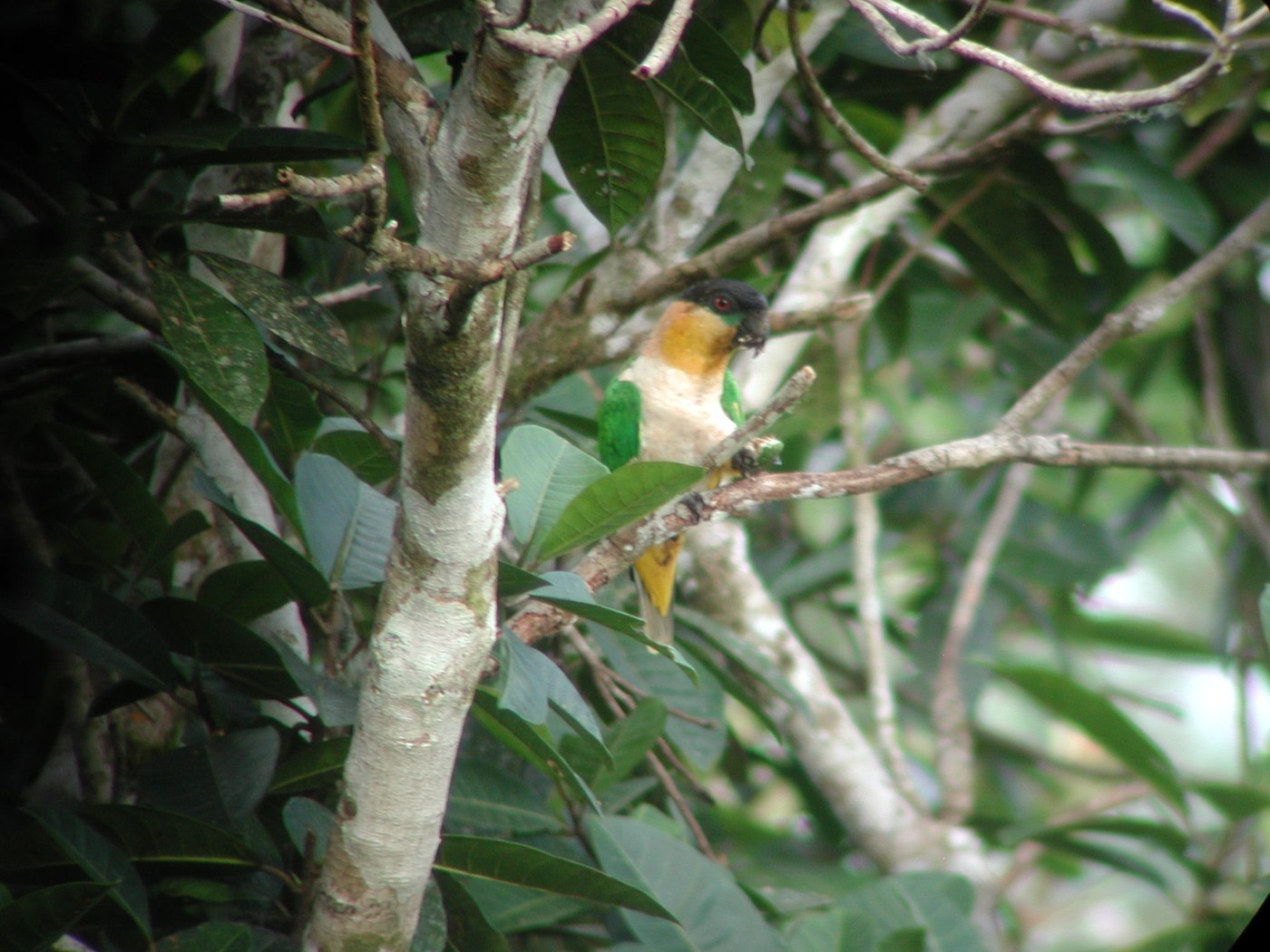
Key Field Marks
- Size & shape: Compact, short-tailed parrots roughly 9-10 inches long, with a large head, short square tail, and a stocky, "clumsy" flight silhouette typical of short-tailed parrots.
- Plumage: The two main species show striking color-blocking - bright green wings and back paired with a contrasting head and underparts, giving a bold, almost painted appearance.
- Black-headed Caique (Pionites melanocephalus): Black crown, orange cheeks and thighs, yellow-orange breast, and a white belly.
- White-bellied Caique (Pionites leucogaster): Orange-yellow crown and nape, orange thighs, and a clean white belly and lower breast.
- Bill: Short, strongly hooked, pale horn-colored bill typical of parrots.
- Behavior: Often seen hopping sideways along branches rather than walking, and pairs or small groups perch and forage together in the mid- to upper canopy.
Separating from Similar Species
- Between caique species: Head color is the key mark - solid black on Black-headed Caique versus orange/yellow on White-bellied Caique; both share the white belly and orange thighs.
- From Amazon parrots: Amazon parrots (genus Amazona) are considerably larger, mostly green overall, and lack the sharply contrasting white-and-orange underparts of caiques.
- From lorikeets/lories (outside range overlap in captivity but useful for comparison): Caiques have a stockier, shorter-tailed shape and a heavier hooked bill rather than the slender bill of nectar-feeding lories.
- In flight: Caiques fly with fast, whirring wingbeats and a direct, low flight path through the canopy, typically in pairs or small flocks giving sharp, high-pitched calls.
Where & When to See It
- Habitat: Humid lowland and terra firme rainforest, forest edge, and river-edge (varzea) forest in the canopy and subcanopy.
- Range: Amazon Basin - Black-headed Caique occurs from the Guianas and northeastern Amazonia; White-bellied Caique occurs south of the Amazon River across Brazil, Peru, Bolivia, and Ecuador. The two species' ranges do not naturally overlap.
- Season: Present year-round as a resident species; most active and vocal in early morning and late afternoon when foraging on fruit, seeds, and flowers.
Voice & Song Cues
- Calls are high-pitched, sharp screeches and chattering notes given in flight and while perched, often in duet between paired birds.
- Small groups foraging in fruiting trees produce a steady chorus of chirps and squeaks, audible well before the birds are seen.
Frequently asked questions
What is a caique?
Caique refers to two closely related South American parrot species in the genus Pionites - the Black-headed Caique and the White-bellied Caique - both known for bold, contrasting plumage.
How do you tell a Black-headed Caique from a White-bellied Caique?
The crown color is the giveaway: Black-headed Caiques have a solid black cap, while White-bellied Caiques have an orange-yellow crown; both share white bellies and orange thighs.
Where are caiques found in the wild?
They live in the canopy of humid Amazonian rainforest, with Black-headed Caiques north of the Amazon River and White-bellied Caiques to the south, so their ranges do not overlap.
How can you tell a caique from other small parrots?
Caiques have a distinctive short, square tail and a stocky build, plus sharply blocked color patterns of green, orange, yellow, and white rather than the more uniform coloring of many other small parrots.
What sound does a caique make?
Caiques give sharp, high-pitched screeches and chattering calls, often exchanged between paired birds or small foraging groups in the canopy.