
Cackling Goose Identification Guide
A small, compact look-alike of the Canada Goose, told by its stubby triangular bill, short neck, steep forehead, and often noticeably smaller size.
Read the full Cackling Goose encyclopedia entry →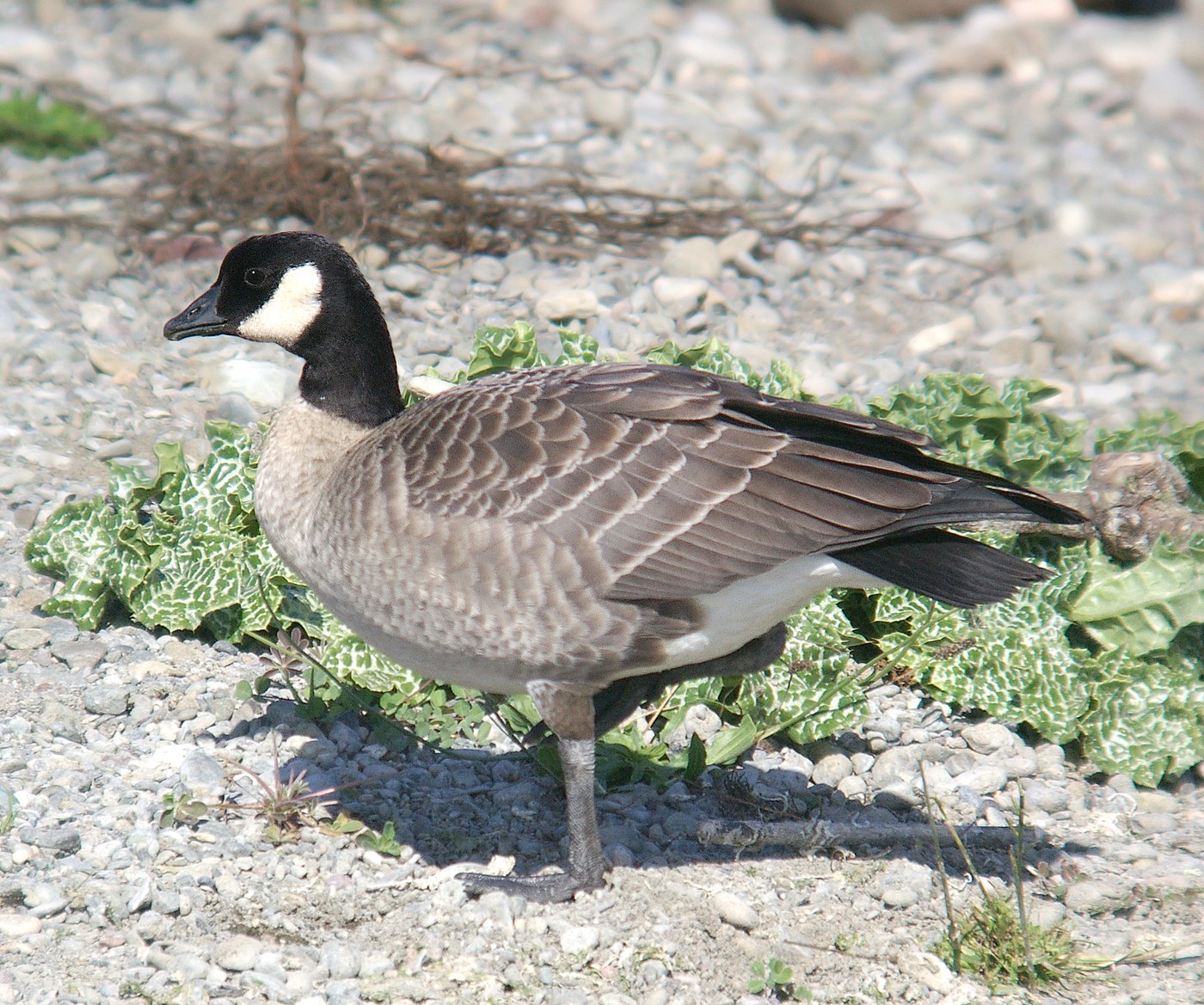
Key Field Marks
- Small to very small goose (depending on subspecies), ranging from about the size of a large duck up to roughly Mallard- or crow-sized in the smallest forms — always distinctly smaller than a typical Canada Goose.
- Black head and neck with a white "chinstrap" cheek patch, mirroring the classic Canada Goose pattern.
- Short, stubby, triangular bill (rather than the longer, more tapered bill of Canada Goose) and a shorter neck overall.
- Steep, rounded forehead giving a more compact, "cute" head shape compared to the sloping forehead of Canada Goose.
- Plumage color varies by subspecies from pale grayish-brown to quite dark, sooty brown on the breast in some forms (e.g., "minima").
- Overall proportions look stubbier and more compact — shorter neck, rounder body, smaller bill — than Canada Goose at every size.
Separating It From Similar Species
- Canada Goose: larger overall (though size overlaps with the largest Cackling Goose subspecies and smallest Canada Goose subspecies, making bill shape and head shape the most reliable marks), with a longer neck and a longer, more sloped bill.
- Best identified in mixed flocks by direct comparison: Cackling Geese look noticeably smaller, shorter-necked, and small-billed next to nearby Canada Geese.
- Voice differs too — Cackling Goose gives higher-pitched, more yelping or cackling calls compared to the deeper honking of Canada Goose.
- Because of significant size variation among Cackling Goose subspecies (and among Canada Goose subspecies too), no single measurement is foolproof; the bill/head shape combination plus voice are the most consistent clues.
Habitat, Range & Season
- Breeds on Arctic and subarctic tundra in Alaska and northern Canada, well north of most Canada Goose breeding areas.
- Winters in flocks across parts of the western, central, and southern United States, often mixing directly with wintering Canada Geese in agricultural fields, wetlands, and open grassy areas such as parks and golf courses.
- Migrates in large flocks, often detected first by their higher-pitched calls overhead.
- Present in the US mainly from fall through spring; breeding occurs far to the north, out of view for most birders.
Voice
- Calls are higher-pitched, more yelping, and more cackling than the deep, resonant honk of Canada Goose — often the quickest way to pick out Cackling Geese within a large mixed flock before even getting a good visual comparison.
Frequently asked questions
How do you tell a Cackling Goose from a Canada Goose?
Look for a stubby, triangular bill, a short neck, and a steep, rounded forehead on Cackling Goose, versus a longer bill, longer neck, and more sloped forehead on Canada Goose; size alone is unreliable since the largest Cackling Geese overlap with the smallest Canada Geese.
Is Cackling Goose always smaller than Canada Goose?
Usually, but not always — the largest Cackling Goose subspecies can approach the size of the smallest Canada Goose subspecies, so bill and head shape are more reliable than size alone.
What does a Cackling Goose sound like?
It gives higher-pitched, more yelping or cackling calls compared to the deeper, more resonant honk of Canada Goose, which can help pick it out of a mixed flock by ear.
Where do Cackling Geese breed and winter?
They breed on Arctic and subarctic tundra in Alaska and northern Canada, then winter in flocks across the western, central, and southern United States, often alongside Canada Geese.