Bufflehead Identification Guide
North America's smallest diving duck, with males showing a bold white bonnet-shaped patch on an iridescent black-and-green puffy head.
Read the full Bufflehead encyclopedia entry →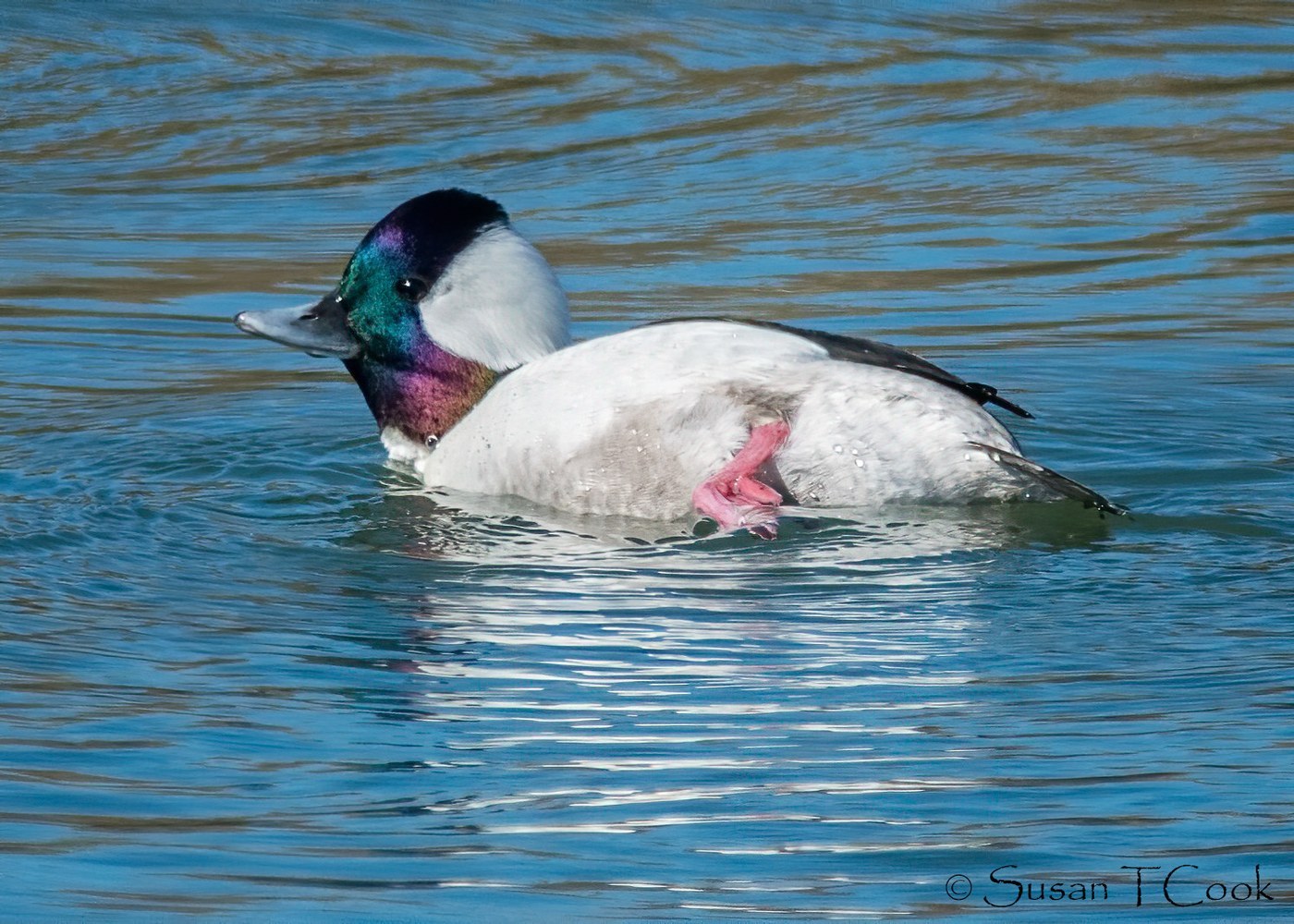
Key Field Marks
- Very small diving duck, about 32–40 cm (13–16 in), with a compact body and a distinctively large, puffy (bulbous) head relative to body size.
- Adult male: mostly white body with a black back, and a dark head that shows iridescent green and purple in good light, marked with a large white patch sweeping from the eye around the back of the head like a bonnet.
- Adult female and immature: dull grayish-brown overall with a smaller, oval white patch on the cheek behind the eye; head shape is less puffy than the male's but still rounded.
- Small, thin gray bill.
- Dives frequently and rapidly while foraging, often popping back to the surface like a cork.
Separating It From Similar Species
- Common Goldeneye / Barrow's Goldeneye: both are notably larger with a rounder white cheek spot (not a sweeping bonnet patch) on males, and females have a mostly brown head without the neat oval cheek patch of a female Bufflehead.
- Hooded Merganser: male has a fan-shaped white crest bordered in black and a long thin serrated bill, quite different from the Bufflehead's stubby bill and bonnet pattern; female Hooded Merganser has a shaggy cinnamon-brown crest rather than a simple oval cheek patch.
- Bufflehead is noticeably the smallest of these species, with the proportionally largest-looking head for its body size.
Habitat, Range & Season
- Breeds in the boreal forest zone of Canada and Alaska, nesting in tree cavities — almost always old Northern Flicker holes, since the duck is small enough to use them.
- Winters widely across the US on lakes, ponds, rivers, and sheltered coastal bays and estuaries, often in small, tight-knit groups.
- Migrates relatively late in fall and early in spring compared with many other waterfowl.
- Typically the tamest and most approachable of the small diving ducks, often seen close to shore.
Voice
- Generally quiet; males give a soft, guttural growling or squealing note during courtship displays.
- Females give a harsh, low "cuk-cuk-cuk" alarm/contact call, mainly on the breeding grounds.
Frequently asked questions
How can you tell a male Bufflehead from a male Common Goldeneye?
Bufflehead is much smaller with a large, puffy head showing a broad white patch that sweeps around the back of the head, while goldeneyes are larger with a smaller, rounder white cheek spot.
Why does the Bufflehead have such a big-looking head?
Its head feathers are naturally puffy/bulbous, giving it a disproportionately large-headed silhouette compared to its small, compact body — a helpful shape cue at a distance.
Where do Buffleheads nest?
They nest in tree cavities in the boreal forest of Canada and Alaska, almost always reusing old Northern Flicker nest holes since they are small enough to fit.
When and where can you see Buffleheads in winter?
From fall through spring, Buffleheads winter widely across the lower US and southern Canada on lakes, ponds, rivers, and sheltered coastal waters, often close to shore.
Bufflehead identified by the community
Recent Bufflehead sightings identified with Bird Identifier.