
Buff-banded Rail Identification Guide
A boldly patterned rail of Australasia and the Pacific with chestnut nape, black-and-white barred underparts, and a buff breast band, often surprisingly bold for a rail.
Read the full Buff-banded Rail encyclopedia entry →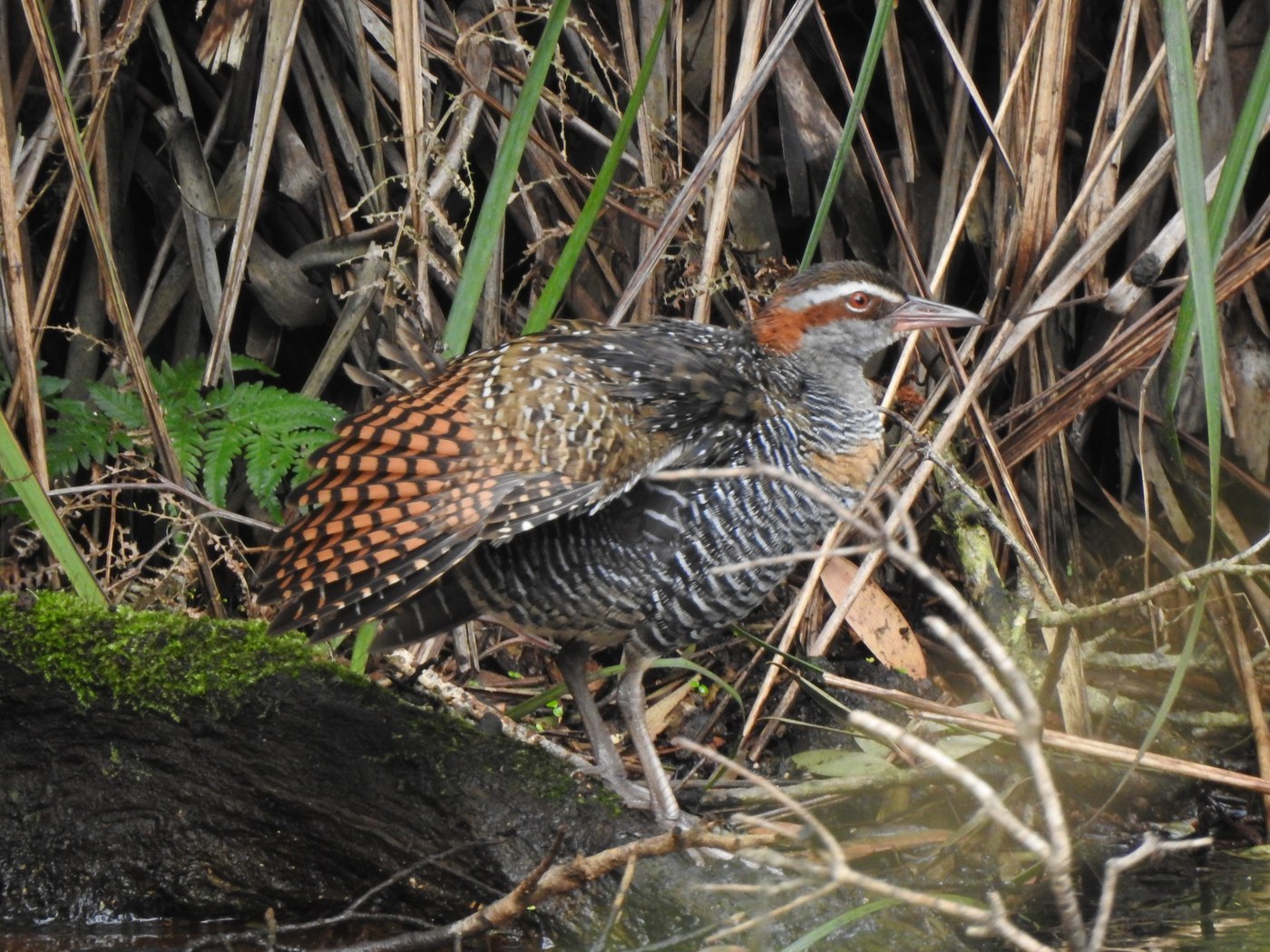
Key Field Marks
- Medium-sized rail, roughly 30 cm (12 in) long, with a plump body, long pinkish-orange legs, and a relatively short, slightly downcurved bill (orange-red at the base, darker at the tip).
- Chestnut-rufous crown and hindneck contrast with a gray face and breast.
- A broad buffy-orange band crosses the upper breast, giving the species its name.
- Belly and flanks show crisp black-and-white barring.
- Upperparts are olive-brown streaked with black and white.
- Often flicks or cocks its short tail while walking, and bobs its head as it moves.
Separating It From Similar Species
- Purple Swamphen: much larger, all deep blue-purple with a massive red bill and frontal shield — no barring or buff breast band.
- Buff-banded Rail vs. other Gallirallus/native rails: the combination of chestnut nape, gray face/breast, buff breast band, and bold black-and-white barred flanks is distinctive across its range; few other rails share all four features together.
- Compared to typically shy, skulking rails, Buff-banded Rail is often bolder, walking in the open at forest edges, gardens, and even urban parks, which helps confirm identification through longer, clearer views than most rails allow.
Habitat, Range & Season
- Widespread across Australia, New Zealand, and many Pacific islands, as well as parts of Southeast Asia.
- Uses a broad range of wetland and semi-wetland habitats: swamps, mangroves, wet grassland, reedbeds, and also drier vegetated areas such as parks, gardens, and pastures near water.
- Largely resident/sedentary where established, though some island populations show local movements.
- Often seen walking in the open at dawn and dusk, and sometimes during the day in areas with little disturbance.
Voice
- A sharp, explosive "kek" or "krek" alarm/contact call, often repeated.
- Also gives a range of grunting, squealing, and chattering notes, especially at dawn and dusk or when disturbed.
Frequently asked questions
What is the easiest field mark for a Buff-banded Rail?
Look for the combination of a chestnut crown and nape, gray face and breast, an orange-buff band across the upper breast, and bold black-and-white barring on the belly and flanks.
Is the Buff-banded Rail shy like most rails?
It can be, but compared with many skulking rails it is often noticeably bolder, walking in the open in parks, gardens, and grassy edges, especially in areas with little disturbance.
Where does the Buff-banded Rail live?
It occurs across Australia, New Zealand, many Pacific islands, and parts of Southeast Asia, using wetlands, mangroves, wet grassland, and vegetated areas near water.
How can you tell a Buff-banded Rail from a Purple Swamphen?
Purple Swamphen is much larger and entirely deep blue-purple with a huge red bill, while Buff-banded Rail is smaller, patterned, and shows a buff breast band with black-and-white barring below.