
Budgerigar Identification Guide
A small, slender Australian parakeet — wild-type birds are bright green with fine black scalloping on the back and a long tapered blue-green tail.
Read the full Budgerigar encyclopedia entry →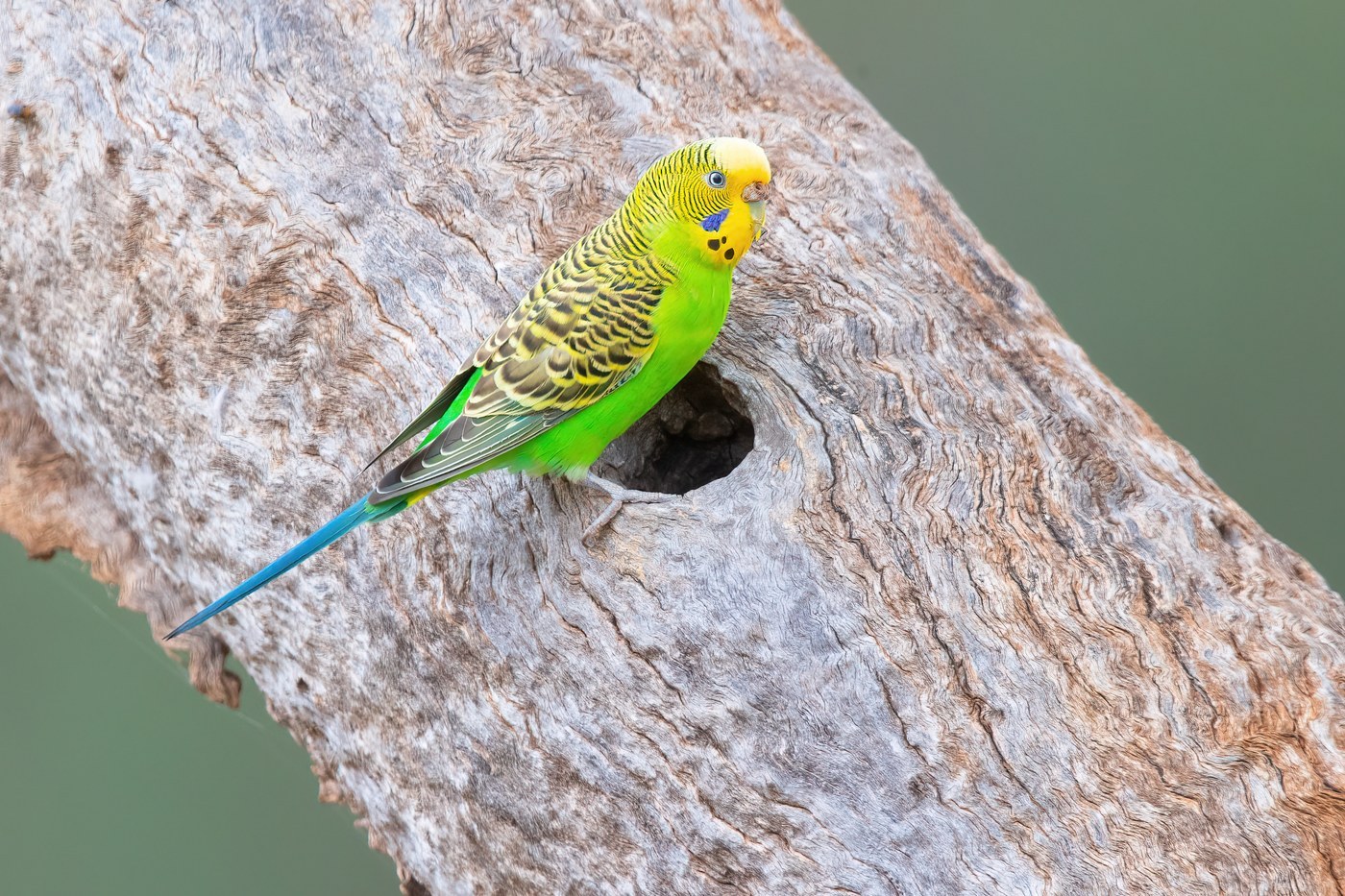
Key Field Marks
- Small, slim parrot, about 18 cm (7 in) long including a long, tapered tail, with a compact body and a short, hooked pale bill.
- Wild-type coloring: bright grass-green underparts and rump, yellow face and forehead, and black-and-yellow scalloped (barred) pattern across the back, nape, and wings.
- A row of small purple-blue spots crosses the lower throat, with a black spot on each side ("cheek patch").
- Long, pointed blue-green tail feathers extend well beyond the folded wings.
- The bare skin above the bill (cere) differs by sex in adults: blue-purple in males, brown-tan (often crusty-looking) in breeding females.
- Domesticated/aviary budgies come in many colors (blue, white, yellow, violet), but escaped or feral birds are usually the green wild-type pattern or close to it.
Separating It From Similar Species
- No native North American parakeet shares the combination of tiny size, long tapered tail, and yellow-and-black scalloped back; confusion is mainly with other escaped cage birds.
- Monk Parakeet: much larger, stockier, with a plain gray face and chest and a shorter, broader tail — no yellow face or black scalloping.
- Lovebirds (occasional escapees): much shorter, stubby tails and lack the scalloped back pattern.
- Any small, slender, long-tailed green-and-yellow parrot-type bird seen outside of captivity in North America is almost certainly an escaped or feral Budgerigar.
Habitat, Range & Season
- Native to the arid interior of Australia, where wild flocks are nomadic, following rainfall and seed availability across grasslands, scrub, and open woodland.
- In North America, Budgerigars are not naturally occurring; sightings are almost always escaped pets, and small feral populations have existed historically in parts of Florida around bird feeders and residential areas.
- Highly social — wild and feral birds are typically seen in flocks, sometimes numbering in the hundreds in Australia.
Voice
- Constant soft warbling chatter and chirping notes, often given while perched in a group.
- Capable of mimicking sounds and words in captivity, though wild/feral birds mainly give natural contact chatter and short warbles.
Frequently asked questions
Are Budgerigars native to the United States?
No. Budgerigars are native to Australia; any Budgerigar seen in North America is an escaped or feral pet bird, not a naturally occurring wild population.
What color are wild Budgerigars?
Wild-type Budgerigars are bright green below with a yellow face and black-and-yellow scalloped markings on the back and wings; the many solid colors seen in pet stores are selectively bred varieties.
How can you tell a male from a female Budgerigar?
Look at the cere (fleshy patch above the bill): it's blue-purple on adult males and brown to tan, often with a crusty texture, on breeding females.
How big is a Budgerigar compared to other parakeets?
Budgerigars are quite small and slender, about 18 cm long including the tail — noticeably smaller and slimmer-bodied than a Monk Parakeet.
Budgerigar identified by the community
Recent Budgerigar sightings identified with Bird Identifier.
