
Brown-crested Flycatcher Identification Guide
The largest and biggest-billed of the southwestern Myiarchus flycatchers, best separated from the similar Ash-throated Flycatcher by size, bill, and voice.
Read the full Brown-crested Flycatcher encyclopedia entry →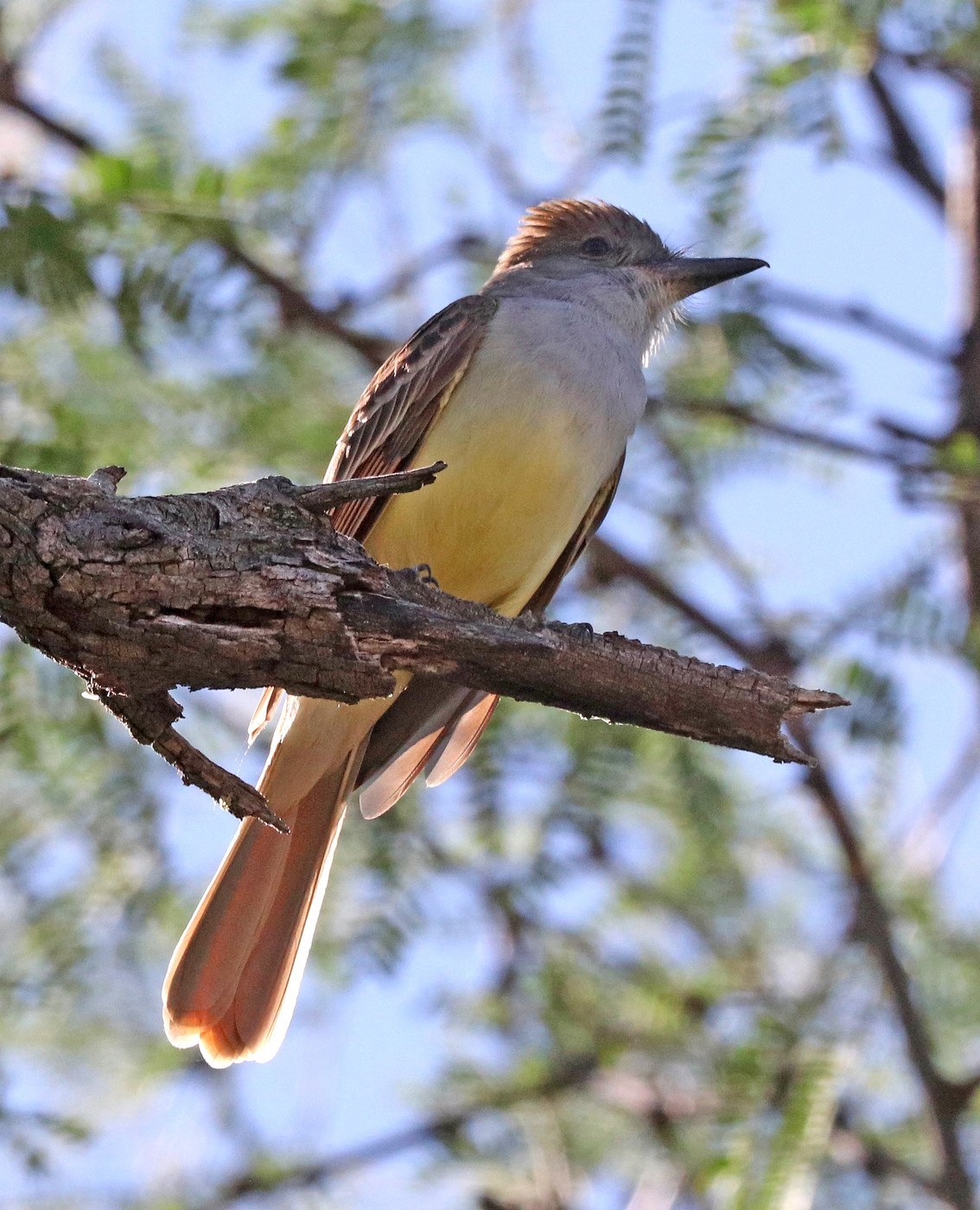
Key Field Marks
- A large, robust Myiarchus flycatcher with a notably heavy, broad bill.
- Gray-brown upperparts, pale gray throat and breast, and a fairly rich lemon-yellow belly.
- Rufous coloring is visible in the wings (edging the primaries) and especially in the tail, which shows extensive rufous on the inner webs.
- Has a shaggy, slightly bushy crest on the crown, typical of the Myiarchus genus.
Separating It From Similar Species
- Ash-throated Flycatcher: smaller overall with a noticeably smaller, thinner bill and a paler, less saturated yellow belly; the two species overlap widely in the Southwest and are best told apart by size/bill and voice.
- Great Crested Flycatcher: brighter yellow belly and more olive-toned back, but ranges barely overlap (Great Crested is an eastern species).
- Dusky-capped Flycatcher: much smaller with a small bill, dark cap, and a distinctive mournful whistled call, lacking the bold rufous tail pattern.
- Nutting's Flycatcher: very similar but smaller-billed and rare; best separated by voice.
- Voice is often the most reliable field mark among Myiarchus species when views are brief.
Habitat, Range & Season
- Breeds in desert riparian woodlands, saguaro cactus deserts, and mesquite brushlands of southern Arizona, southern New Mexico, and southern Texas.
- A cavity nester, often using old woodpecker holes in saguaros or trees.
- Present on breeding grounds spring through summer; winters mainly in Mexico and Central America.
Voice
- Gives a sharp, whistled "whit" call and a distinctive rolling, burry "prrrreeet" or "whee-eep," lower and harsher than the calls of Ash-throated Flycatcher.
Frequently asked questions
How do you tell a Brown-crested Flycatcher from an Ash-throated Flycatcher?
Brown-crested Flycatcher is larger and heavier-billed with a richer yellow belly, while Ash-throated Flycatcher is smaller, smaller-billed, and paler yellow below; their calls also differ.
Where do Brown-crested Flycatchers nest?
They nest in cavities, often old woodpecker holes in saguaro cacti or trees, in desert riparian and brush habitats of the southwestern United States.
What does a Brown-crested Flycatcher sound like?
It gives a sharp whistled 'whit' and a rolling, burry 'prrrreeet' call that is lower and harsher than the similar calls of Ash-throated Flycatcher.
When can you see Brown-crested Flycatchers in the U.S.?
They're present on breeding territories in Arizona, New Mexico, and Texas from spring through summer, then migrate to Mexico and Central America for winter.