
Brown-capped Rosy-Finch Identification Guide
A chunky, high-alpine finch of the southern Rockies with an all-brown cap that separates it from its two gray-crowned relatives.
Read the full Brown-capped Rosy-Finch encyclopedia entry →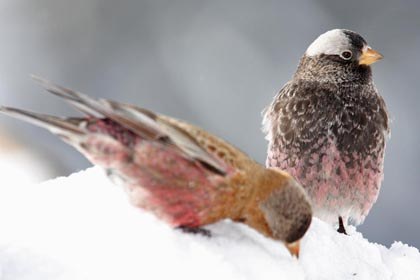
Key Field Marks
- Small, chunky finch with a short, conical bill and a fairly short, notched tail.
- Adult: warm chocolate-brown body overall, with rosy-pink wash on the belly, wing coverts, and rump.
- The cap is uniformly brown with no contrasting gray patch; breeding males show a black forehead just above the bill.
- Sexes are similar, with females slightly duller and browner than males.
Separating It From Similar Species
- Gray-crowned Rosy-Finch: shows a distinct pale gray patch across the back of the head/nape, contrasting with a darker brown face — Brown-capped lacks this gray patch entirely.
- Black Rosy-Finch: overall body plumage is blacker and less warm brown, with only a small gray patch restricted to the hindcrown; Brown-capped is browner overall with more extensive pink.
- Range helps too: Brown-capped Rosy-Finch has the most restricted range of the three rosy-finches, largely confined to the higher peaks of Colorado and adjacent northern New Mexico/southern Wyoming.
Habitat, Range & Season
- Breeds on alpine tundra, rocky slopes, and cliffs above treeline in the Colorado Rockies and immediately adjacent ranges — among the highest-elevation breeding birds in North America.
- Forages on snowfields and rocky alpine turf for insects blown or stranded on snow, as well as seeds.
- In winter, descends to lower elevations and can form large mixed flocks with other rosy-finch species at feeders and along mountain roadsides, particularly in Colorado towns.
Voice
- Calls include high-pitched chirping notes and soft twittering given in flight and while foraging in flocks.
- Flight call is a sharp, high "chew" note.
Frequently asked questions
How do you tell a Brown-capped Rosy-Finch from a Gray-crowned Rosy-Finch?
Brown-capped Rosy-Finch has a uniformly brown head with no gray, while Gray-crowned Rosy-Finch shows a clear pale gray patch on the back of the head.
Where is the best place to see a Brown-capped Rosy-Finch?
It's largely restricted to high alpine terrain in Colorado and adjacent northern New Mexico and southern Wyoming, above treeline in summer and at lower-elevation feeders in winter.
Why do rosy-finches gather at snowfields?
They forage on insects that become stranded or chilled on the surface of alpine snowfields, an important food source at high elevation.
Do Brown-capped Rosy-Finches migrate?
They don't undertake long migrations but do move altitudinally, descending from alpine breeding areas to lower elevations and feeders in winter.