
Broad-winged Hawk Identification Guide
A compact forest buteo best known for forming enormous migrating kettles, identified by its pointed wingtips and boldly banded tail.
Read the full Broad-winged Hawk encyclopedia entry →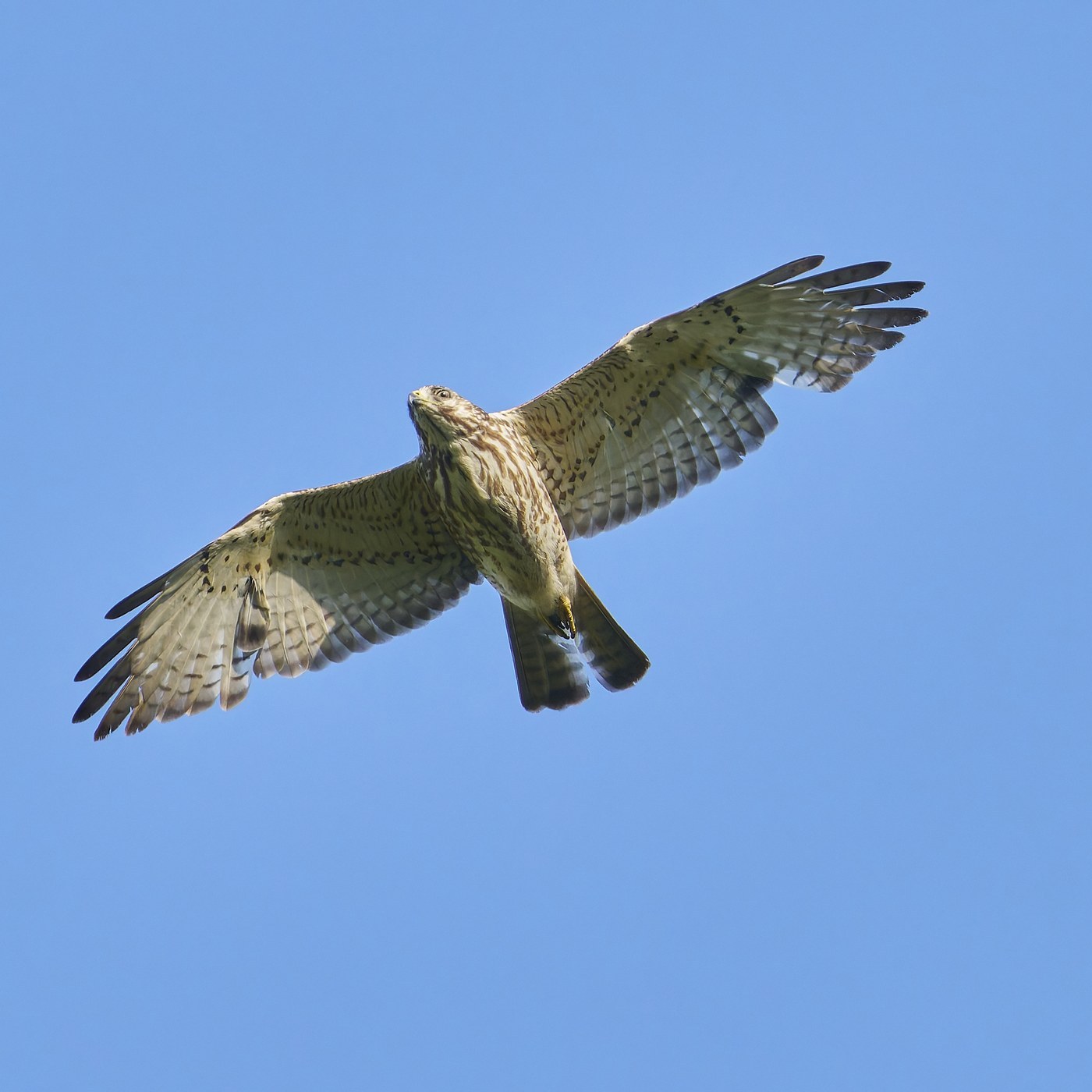
Key Field Marks
- Small, stocky buteo, roughly crow-sized (around 34–44 cm), noticeably smaller and more compact than a Red-tailed Hawk.
- Adult: reddish-brown barring across the breast, a dark brown back, and a black tail crossed by broad white bands (typically 2–3 bands visible).
- Juvenile: brown streaking on the underparts rather than barring, with thinner, more numerous tail bands.
- In flight, the wings appear relatively short and pointed at the tip compared to other buteos, and are often held flat or slightly drooped while soaring.
Separating It From Similar Species
- Red-shouldered Hawk: shows translucent pale "windows" near the wingtips, warm rufous shoulders, and a longer tail with narrower, more numerous white bands; also proportionately longer-winged.
- Red-tailed Hawk: considerably larger and bulkier with broader, more rounded wings and (in adults) a plain rusty-red tail rather than banded black-and-white.
- Cooper's Hawk / Sharp-shinned Hawk: accipiters have longer tails and shorter, rounder wings, and fly with quick flaps and glides rather than soaring on flat wings like a buteo.
- Migrating Broad-wingeds are famous for forming huge circling flocks called "kettles," sometimes numbering in the thousands, which is itself a strong identification clue during fall migration.
Habitat, Range & Season
- Breeds in mature deciduous and mixed forests across eastern North America, from the Great Lakes and New England south through the Appalachians.
- One of the most concentrated raptor migrants in North America; huge kettles pass over well-known hawkwatch sites (e.g., Hawk Mountain, Pennsylvania; Corpus Christi, Texas) in September and early October en route to wintering grounds in Central and South America.
- Prefers forest interiors and edges near water during the breeding season; less often seen in open country except while migrating.
Voice
- A high, thin, two-note whistle that descends in pitch, often rendered as "pee-teeeee," given from perches and occasionally in flight.
Frequently asked questions
What is the easiest way to identify a Broad-winged Hawk in flight?
Look for a small, compact buteo with pointed wingtips and a tail with broad black-and-white bands; in migration, large circling flocks called kettles are a strong clue.
How do you tell a Broad-winged Hawk from a Red-shouldered Hawk?
Red-shouldered Hawks are longer-winged with pale translucent wingtip patches and rufous shoulders, while Broad-wingeds are stockier with shorter, more pointed wings and fewer, broader tail bands.
Where can I see large numbers of migrating Broad-winged Hawks?
Traditional hawkwatch sites such as Hawk Mountain in Pennsylvania and the Texas Gulf Coast see huge kettles of migrating Broad-wingeds, especially in mid-to-late September.
What does a Broad-winged Hawk sound like?
Its call is a high, thin, descending two-note whistle, often described as 'pee-teeeee.'