
Broad-billed Hummingbird Identification Guide
A jewel-toned hummingbird of southwestern canyons, with males showing an all-blue-green body and a distinctive broad red bill tipped in black.
Read the full Broad-billed Hummingbird encyclopedia entry →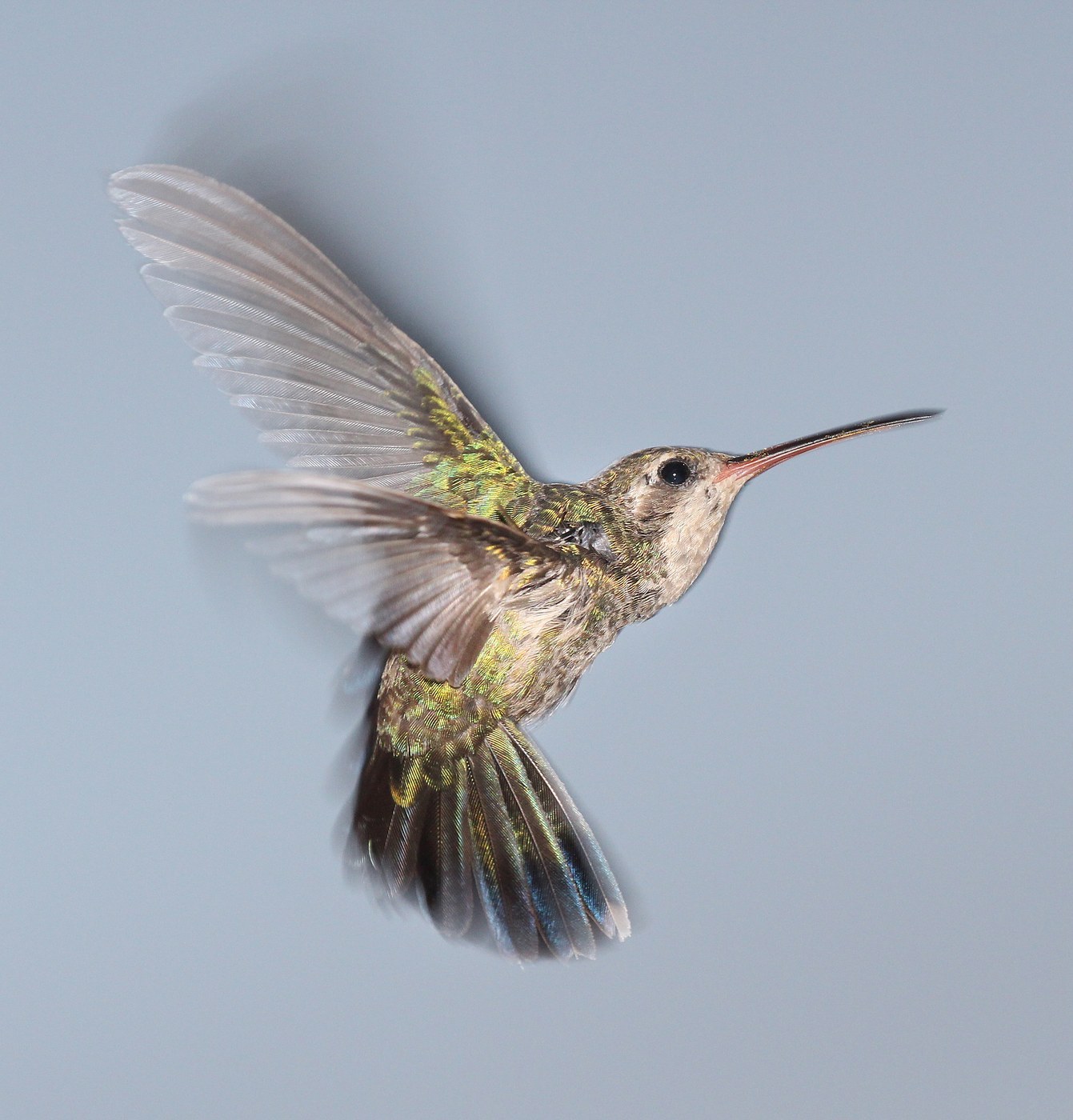
Key Field Marks
- Size & shape: A small hummingbird, about 9 cm, with a relatively broad, straight bill (giving the species its name) and a notched, dark blue-black tail.
- Male: Brilliant metallic blue-green throat and body, a red bill with a black tip, and a forked, dark tail — one of the most vividly colored hummingbirds in its US range.
- Female: Duller grayish-green above and pale gray below, with a distinct white postocular stripe behind the eye and a red base to an otherwise dark-tipped bill.
Separating from Similar Species
- White-eared Hummingbird: Shares a red bill but has a bold white ear stripe and a more contrastingly patterned face; Broad-billed's face is comparatively plain aside from the female's postocular stripe.
- Male Broad-tailed or Black-chinned Hummingbird: Both lack the extensively blue-green body and bright red-based bill of male Broad-billed; the broad red bill is the quickest confirming feature.
- Female Broad-billed's white eyestripe and reddish bill base help separate her from similarly plain female hummingbirds of other species in the region.
Habitat, Range & Season
- Found in wooded canyons with sycamores, streamside vegetation, and mesquite thickets in southeastern Arizona, southwestern New Mexico, and west Texas.
- Present as a breeding species spring through fall; most of the population withdraws into Mexico for winter, though a few linger at feeders.
- Favors riparian corridors more than open desert, often near permanent water.
Voice
- Gives a dry, chattering rattle call, distinct from the sharper chip notes of many other hummingbirds.
- Males give buzzy, scolding notes during chases and territorial disputes at flowers or feeders.
Frequently asked questions
What is the best field mark for a male Broad-billed Hummingbird?
An all-blue-green body combined with a broad red bill tipped in black — a distinctive combination not shared by other hummingbirds in its range.
How do you identify a female Broad-billed Hummingbird?
Look for a plain grayish-green back, pale gray underparts, a white stripe behind the eye, and a reddish base to the bill.
Where is the best place to see Broad-billed Hummingbird in the US?
Wooded canyons with sycamores and streamside vegetation in southeastern Arizona, such as popular canyon birding sites, during the spring-to-fall breeding season.
Does Broad-billed Hummingbird stay in the US year-round?
Most of the population migrates into Mexico for winter, though small numbers occasionally overwinter at well-stocked feeders in the southwestern US.