
Brandt's Cormorant Identification Guide
A large, all-dark Pacific coast cormorant told from similar species by its buffy throat patch, straighter bill, and strongly marine habits.
Read the full Brandt's Cormorant encyclopedia entry →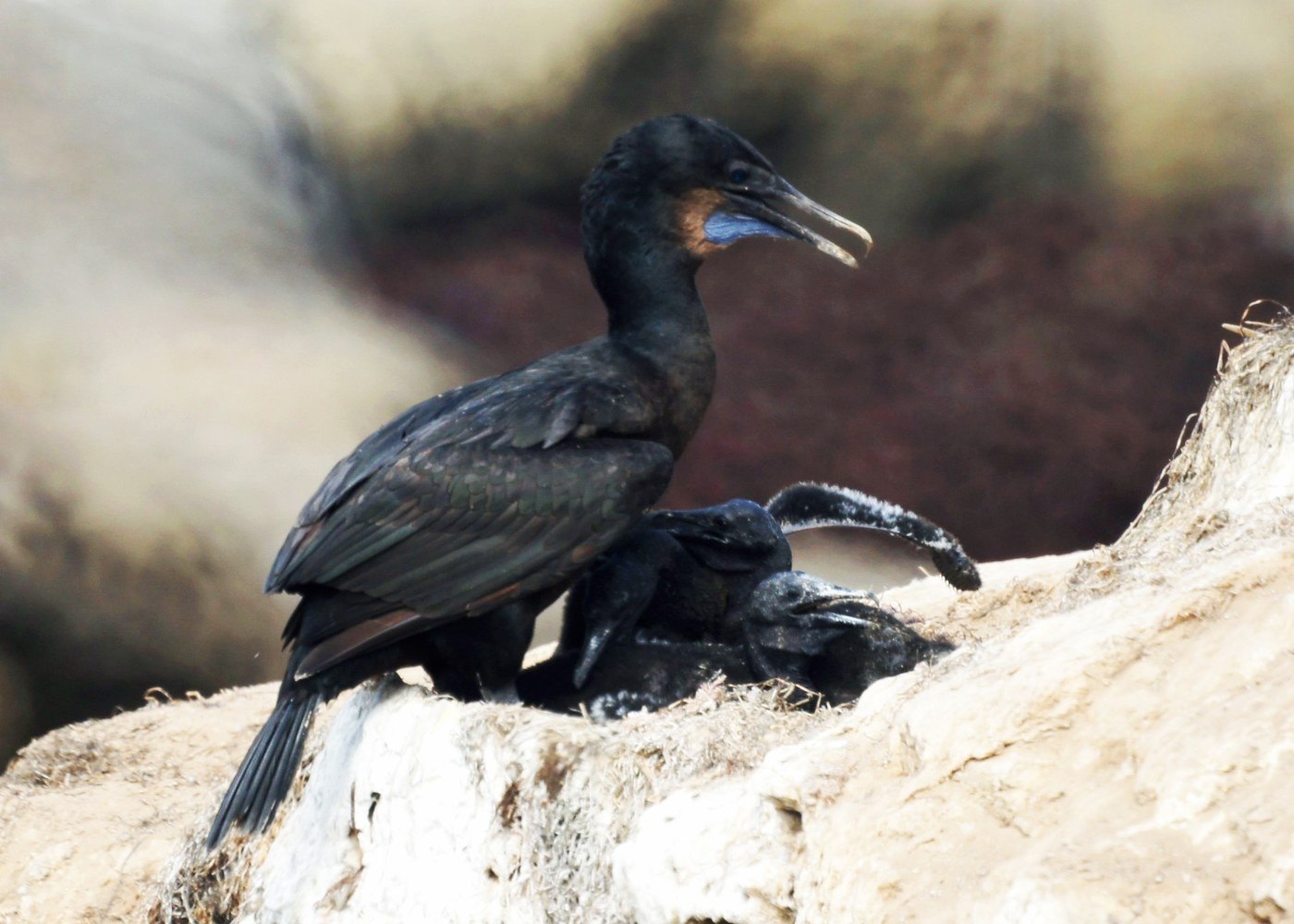
Key Field Marks
- Size & shape: A large cormorant (about 84 cm) with a thick neck, moderately long tail, and a comparatively straight, slender bill with only a slight hook at the tip.
- Plumage: Overall blackish, showing bronzy-brown scaling on the back and wing coverts in good light, especially in breeding condition.
- Breeding adults: Develop a bright blue throat patch (gular pouch) bordered by pale buffy or straw-colored feathering, plus fine blue-black plumes on the face and neck.
- Bare parts: Dark facial skin year-round, lacking the bright orange-yellow throat pouch of Double-crested Cormorant.
Separating from Similar Species
- Double-crested Cormorant: Has an orange-yellow throat pouch and a more strongly hooked, thicker bill; Double-crested is also more likely inland and on calmer waters, while Brandt's is almost exclusively marine.
- Pelagic Cormorant: Smaller and slimmer with a thinner neck, glossier all-black plumage, a red facial patch in breeding season, and white flank patches — features Brandt's lacks.
- Brandt's Cormorant typically forms large, tight flocks on the water and in flight, often flying low in long lines over the ocean surface, unlike the looser groupings typical of Double-crested Cormorant.
Habitat, Range & Season
- Strictly a coastal and marine species, found along rocky shorelines, offshore islands, kelp beds, and open ocean near shore.
- Range extends along the Pacific coast of North America from British Columbia south to Baja California.
- Resident year-round through much of its range, breeding colonially on coastal cliffs and islands in spring and summer; some post-breeding dispersal occurs along the coast.
Voice & Behavior
- Largely silent away from breeding colonies.
- At colonies, gives low, guttural croaking and grunting notes during display.
- Dives from the surface to forage on small fish and invertebrates, often foraging in coordinated groups.
Frequently asked questions
How can I tell Brandt's Cormorant from Double-crested Cormorant?
Look at the throat: Brandt's has a dark facial patch with a buffy border and (in breeding plumage) a blue throat, while Double-crested Cormorant shows a bright orange-yellow throat pouch year-round.
Is Brandt's Cormorant ever found away from the ocean?
Rarely — it is one of the most strictly marine cormorants in North America and is almost never seen on inland lakes, unlike Double-crested Cormorant.
What does a breeding Brandt's Cormorant look like?
It develops a bright cobalt-blue throat patch bordered with pale buffy feathering, along with fine plume-like feathers on the head and neck.
Where does Brandt's Cormorant breed?
On rocky coastal cliffs and offshore islands along the Pacific coast from British Columbia to Baja California, nesting in dense colonies.