
Boreal Owl Identification Guide
A small, elusive owl of northern conifer forests with a large square head, no ear tufts, and a black-bordered facial disc.
Read the full Boreal Owl encyclopedia entry →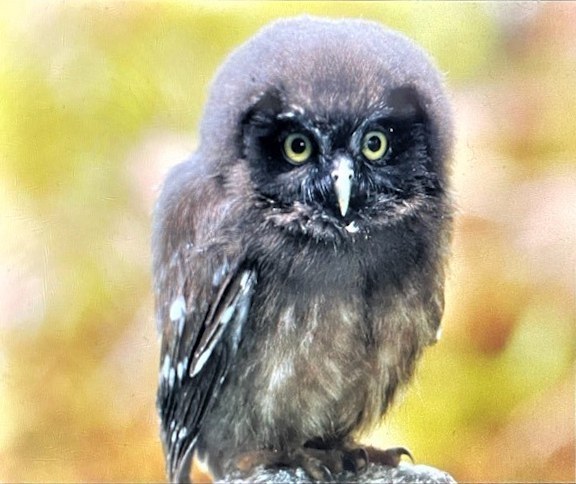
Key Field Marks
- Size & shape: A small owl, larger and bulkier than Northern Saw-whet Owl, with a distinctly large, square-looking head and no ear tufts.
- Face: Pale, whitish facial disc bordered by a bold black frame, giving a strikingly "framed" facial appearance; bright yellow eyes.
- Plumage: Brown upperparts marked with numerous white spots, including a spotted (not streaked) crown; underparts whitish with rusty-brown streaking.
- Behavior: Strictly nocturnal, roosting by day tucked tight against the trunk in dense conifer cover, making it very difficult to locate outside the breeding season; hunts small mammals, especially voles, from a perch.
Separating It From Similar Species
- Northern Saw-whet Owl: Smaller and daintier, with a streaked (not spotted) crown, and a facial disc that lacks Boreal Owl's bold black border — the black-rimmed facial disc and spotted crown are the most reliable marks to confirm Boreal Owl over the more common and widespread Saw-whet.
- Northern Pygmy-Owl / other small owls: Different habitat and much smaller size with a proportionally longer tail; Boreal Owl's large, blocky head shape and facial disc pattern are distinctive.
- Overall structure — big square head with no ear tufts plus the black facial disc border — is the quickest way to rule out confusion with other small forest owls.
Where & When to See One
- Habitat: Mature coniferous and mixed boreal forest with old woodpecker cavities (especially old Pileated or flicker holes) required for nesting; often in dense spruce or fir stands.
- Range: Circumpolar in the boreal zone — across Canada and Alaska, and through Scandinavia, Siberia, and other northern parts of Eurasia; in mountainous regions of the western US it occurs locally at high elevation in suitable spruce-fir forest.
- Season: Resident year-round across most of its range, though some individuals move southward or downslope in years of prey scarcity; most detectable in late winter and early spring when males sing to attract mates.
Voice
- Male's song is a rapid, evenly spaced series of low, hollow, whistled "poop" notes, often accelerating and continuing for extended bouts, given primarily at night near the nest cavity during late winter and early spring — the most reliable way to detect this notoriously secretive owl.
Frequently asked questions
How do you tell Boreal Owl from Northern Saw-whet Owl?
Boreal Owl is larger with a bigger, blockier head, a spotted (not streaked) crown, and a facial disc bordered by a bold black rim, while Saw-whet Owl is smaller, has a streaked crown, and lacks that strong black facial-disc border.
Why is the Boreal Owl so hard to see?
It is strictly nocturnal and spends the day roosting tight against a tree trunk in dense conifer cover, remaining motionless and well camouflaged, which makes daytime detection extremely difficult.
What is the best way to find a Boreal Owl?
Listen at night in late winter and early spring for the male's song — a rapid, evenly paced series of low, hollow whistled 'poop' notes given near potential nest cavities in mature spruce-fir forest.
What kind of nest sites does Boreal Owl need?
It nests in cavities, typically old woodpecker holes such as those made by Pileated Woodpeckers or flickers, within mature coniferous or mixed boreal forest.