
Booted Racket-tail Identification Guide
A small Andean hummingbird instantly recognizable by the male's long wire-thin tail streamers ending in racket-shaped tips and fluffy white leg puffs.
Read the full Booted Racket-tail encyclopedia entry →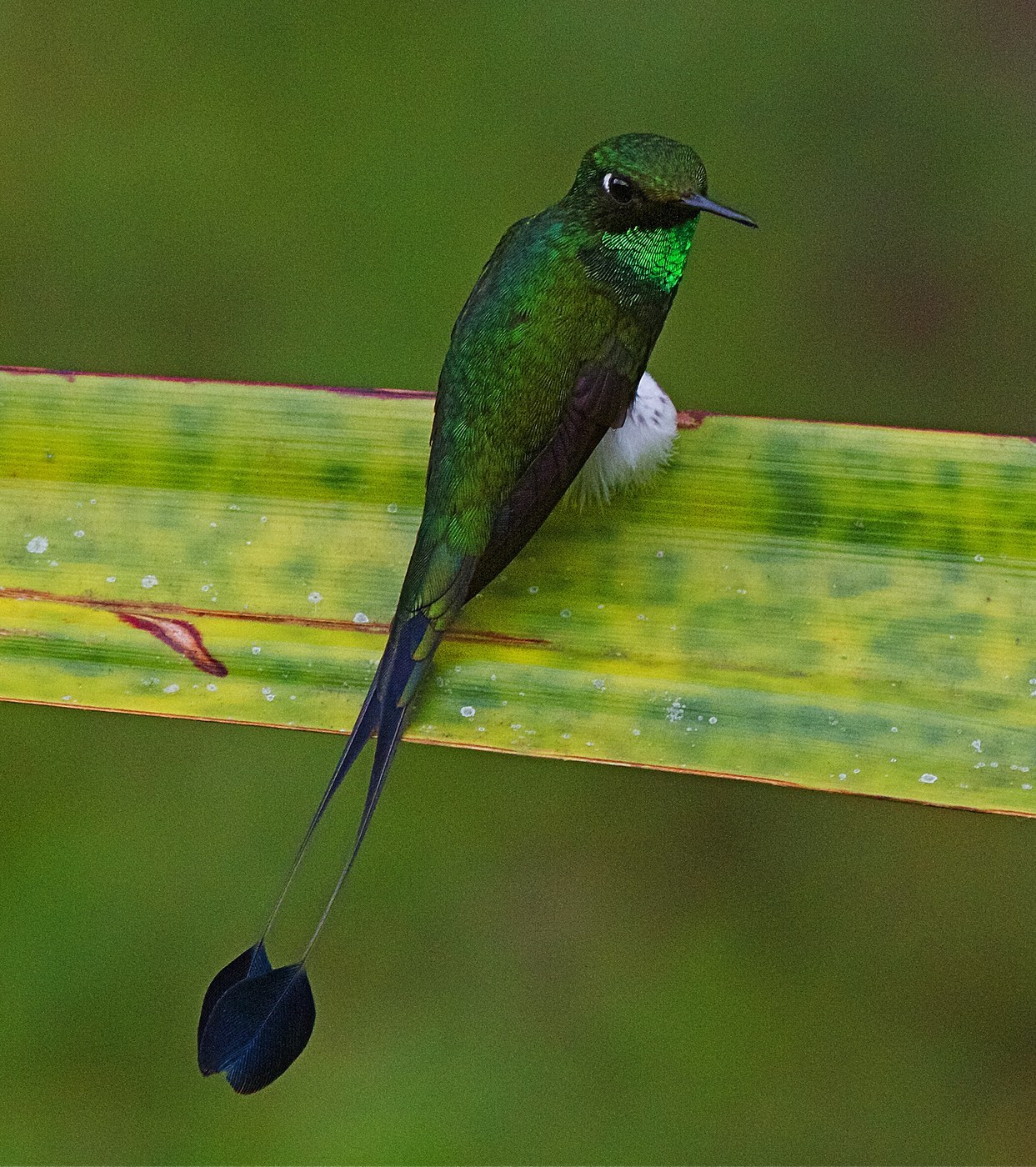
Key Field Marks
- Size & shape: A tiny hummingbird with a short, straight bill; the male's tail is dramatically elongated into two thin, wire-like feathers tipped with small racket-shaped (spatula) blades.
- Leg puffs: Both sexes show conspicuous fluffy white "boots" or leg puffs at the top of the legs, a distinctive feature giving the species its name.
- Male plumage: Iridescent green upperparts, whitish to buffy underparts (variable by subspecies), some populations showing a violet-blue throat patch or gorget.
- Female plumage: Lacks the long racket tail (shorter, more normally proportioned tail), but retains the white leg puffs; underparts typically show green spotting on a whitish background.
- Behavior: Feeds at flowering shrubs and trees at forest edge and in clearings; males perform tail-pumping and display flights, and the long tail streamers are often visible trailing behind during flight.
Separating It From Similar Species
- Other Andean hummingbirds with white leg puffs (e.g., puffleg species) lack the long racket-tipped tail streamers of the male Booted Racket-tail; the combination of leg puffs plus wire-thin racket tail is unique to this species among males.
- Female Booted Racket-tail vs. other small green hummingbirds: The white leg puffs are the most reliable mark since the female's tail is unremarkable and could otherwise suggest several similar-looking species.
Where & When to See One
- Habitat: Montane cloud forest edges, secondary growth, and forest clearings, typically at mid-elevations.
- Range: Found along the Andes from Colombia and Venezuela south through Ecuador, Peru, and into Bolivia, generally between roughly 1,000 and 2,300 meters elevation.
- Season: Resident year-round within its elevational range, though some local altitudinal movement may occur in response to flowering seasons.
Voice
- Gives thin, high-pitched chip and chatter notes typical of small hummingbirds, most often heard during territorial disputes at flowering shrubs.
Frequently asked questions
What makes the male Booted Racket-tail so distinctive?
It has two long, wire-thin tail feathers ending in small racket- or spatula-shaped tips, combined with fluffy white leg puffs — a combination found in no other hummingbird in its Andean range.
How do you identify a female Booted Racket-tail, which lacks the long tail?
Look for the fluffy white leg puffs ('boots'), which both sexes share, along with green spotting on whitish underparts and iridescent green upperparts, since her tail is much shorter and unremarkable compared to the male's.
Where is the best place to find Booted Racket-tail?
Search mid-elevation cloud forest edges and clearings along the Andes from Colombia and Venezuela south to Bolivia, generally between about 1,000 and 2,300 meters, near flowering shrubs and trees.
Is Booted Racket-tail migratory?
No, it is essentially resident year-round within its elevational range, though individuals may shift slightly in elevation following the availability of flowering plants.