
Bonaparte's Gull Identification Guide
A small, buoyant, tern-like gull with a black hood in breeding plumage and a distinctive white wedge on the leading edge of the wing.
Read the full Bonaparte's Gull encyclopedia entry →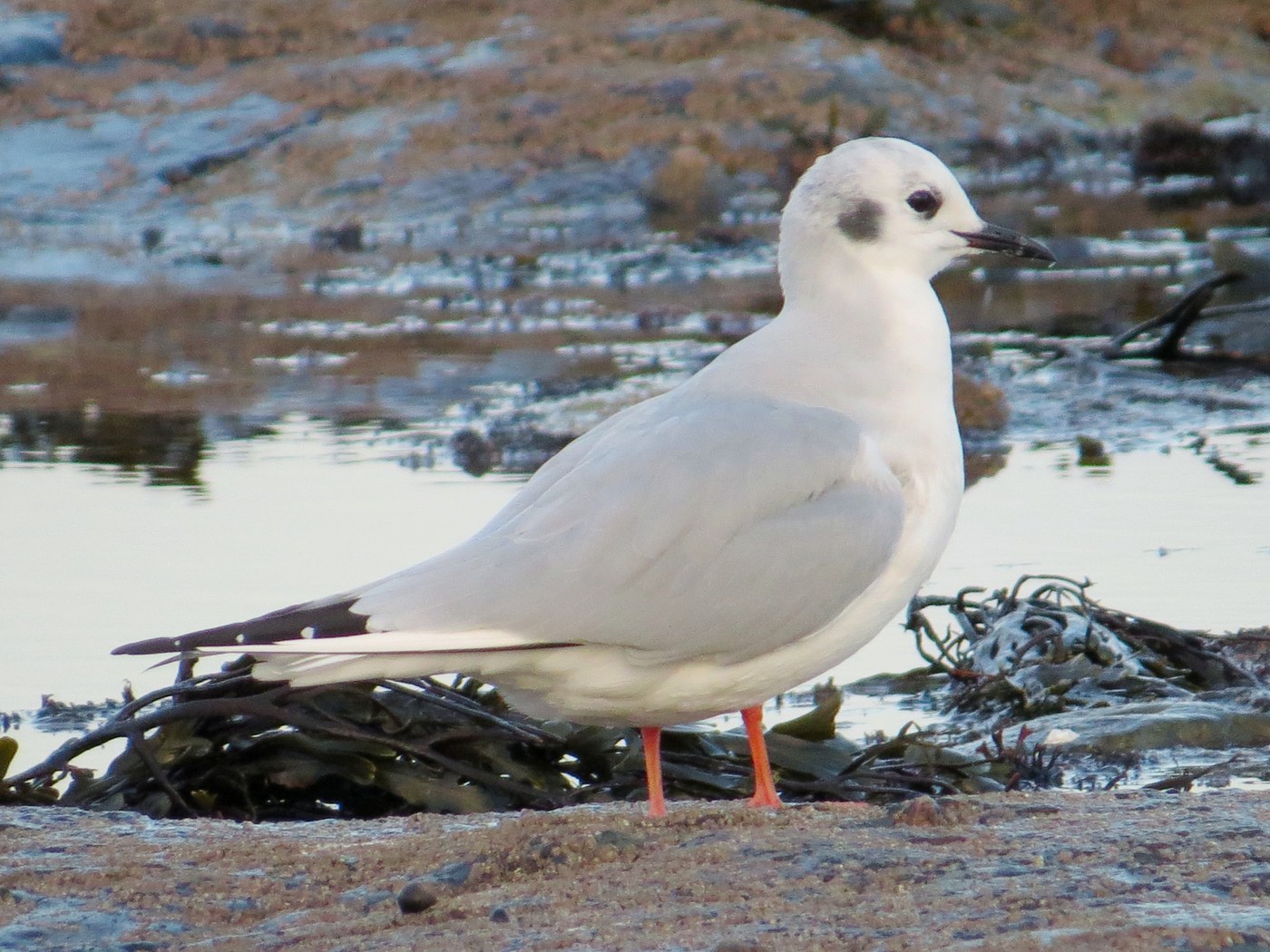
Key Field Marks
- Size & shape: One of the smallest gulls in North America, with a light, buoyant, almost tern-like flight; slender black bill and pink-orange to reddish legs.
- Breeding adult: Full black or slaty-black hood, white eye crescents above and below the eye, pale gray upperparts, and white underparts.
- Nonbreeding/winter adult: White head with a small, neat black spot behind and around the eye (ear spot); otherwise pale gray above, white below.
- In flight: A bold white wedge along the leading edge of the outer primaries is diagnostic and visible at a distance, contrasting with darker gray inner wing and black wingtips.
- Behavior: Buoyant, tern-like flight; often forages by picking food from the water's surface in flight or making shallow dives, and gathers in loose flocks over lakes, bays, and offshore waters.
Separating It From Similar Species
- Black-headed Gull: Similar hooded pattern but larger, with a red (not black) bill and duller underwing pattern lacking Bonaparte's crisp white leading-edge wedge; a rare but regular visitor from Eurasia, often found among Bonaparte's Gull flocks.
- Little Gull: Smaller still, with rounder wings, a dark (not white) underwing in adults, and lacks the white wing wedge of Bonaparte's.
- Larger gulls in winter head pattern: The small size, thin black bill, and pink legs quickly rule out Ring-billed or Herring Gulls, which are much bigger with heavier bills.
Where & When to See One
- Habitat: Breeds unusually for a gull — in trees near small boreal forest ponds and muskeg. Outside the breeding season found on large lakes, reservoirs, coastal bays, and nearshore ocean waters, often in sizable flocks.
- Range: Breeds across the boreal forest of Canada and Alaska; winters along both US coasts, the Gulf Coast, and on large inland lakes and rivers, with migration concentrations at staging areas such as the Great Lakes.
- Season: Common migrant and winter visitor away from the breeding range, typically present from fall through spring in wintering areas.
Voice
- A soft, nasal, tern-like "cheer" or "kree" note, much quieter and less raucous than the calls of larger gulls.
Frequently asked questions
What is the most reliable field mark for Bonaparte's Gull in flight?
A bold white wedge along the leading edge of the outer wing, visible from above and below, combined with its small size and light, buoyant, tern-like flight style.
How does Bonaparte's Gull differ from Black-headed Gull?
Bonaparte's Gull has a black bill and legs that are pink to reddish, while Black-headed Gull is larger with a red bill; the underwing pattern also differs, with Bonaparte's showing a cleaner white leading-edge wedge.
Where does Bonaparte's Gull nest?
Unusually among gulls, it nests in coniferous trees near small ponds and muskeg wetlands in the boreal forest of Canada and Alaska, rather than on the ground or cliffs like most gulls.
What does a nonbreeding Bonaparte's Gull look like?
In winter plumage the black hood is lost, leaving a white head with just a small black spot behind and around the eye, while the pale gray upperparts and white wing wedge remain useful identification features.