
Bluethroat Identification Guide
A robin-relative of northern scrub and tundra, identified by the male's brilliant blue throat patch and rufous tail flashes.
Read the full Bluethroat encyclopedia entry →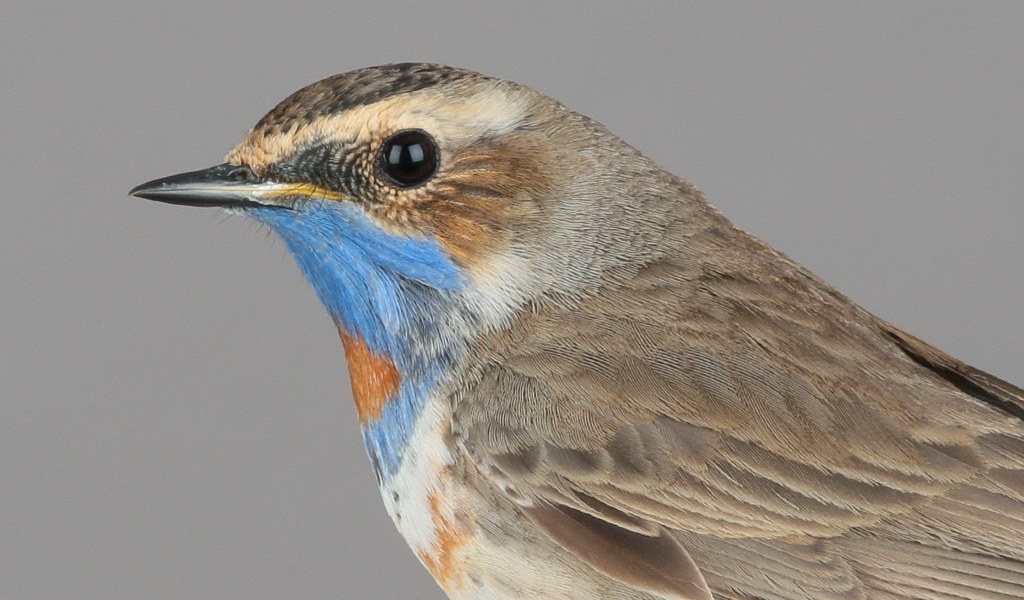
Key Field Marks
- Size & shape: A small, plump chat about the size of a European Robin, with a slim dark bill, longish legs, and a habit of cocking and fanning its tail.
- Male plumage: Vivid blue throat and upper breast bordered below by black and chestnut bands, with a small central spot in the blue that is red or white depending on subspecies; bold white or buffy supercilium above the eye.
- Female/immature plumage: Much duller — a buffy-white throat crossed by a dark necklace of streaks/spots, with only a hint of blue or none at all.
- In flight: Both sexes flash bright rufous-chestnut patches at the base of the tail, obvious as the bird flicks or fans its tail.
- Behavior: Skulking and often on or near the ground, running mouse-like through dense low cover; frequently cocks its tail upward like a robin or wren.
Separating It From Similar Species
- European Robin: Has an orange (not blue) breast and lacks the rufous tail-base flashes.
- Female/winter Bluethroat vs. other chats: The combination of a dark necklace on a pale/buffy throat plus rufous tail-base patches is diagnostic even when the blue is minimal or absent.
- Red-spotted vs. White-spotted races: North American (Alaskan) breeders are the red-spotted form (small red or rust spot in the blue); the white-spotted form breeds in western Europe — useful for pinning down subspecies/origin in vagrant records.
Where & When to See One
- Habitat: Dense low scrub — willow and dwarf birch thickets, tundra edges near water, and wet shrubby ground cover.
- Range: Breeds across northern Eurasia and locally in western Alaska; a highly sought migrant/breeder in Alaska's Seward Peninsula and Brooks Range foothills. Winters in Africa and southern Asia.
- Season: Best found on Alaskan breeding grounds from late May through July; a rare but regular vagrant elsewhere in North America, especially in fall along the West Coast.
Voice
- Song is rich, fast, and highly varied, frequently incorporating mimicry of other birds, often delivered from an exposed perch or in a brief song-flight.
- Call is a short, hard "tac" or "chack."
Frequently asked questions
How do you identify a female or non-breeding Bluethroat without blue on the throat?
Look for a buffy-white throat crossed by a dark necklace of spots or streaks, combined with rufous-chestnut patches at the base of the tail visible when the tail is flicked or fanned.
Where in North America can you find Bluethroats?
The only regular breeding population is in western Alaska (e.g., Seward Peninsula), where red-spotted Bluethroats nest in willow and dwarf birch tundra scrub in late spring and summer.
What's the difference between red-spotted and white-spotted Bluethroats?
Both show a blue throat patch, but red-spotted birds (the Alaskan/Siberian form) have a small rusty-red spot in the center of the blue, while white-spotted birds (western European form) show a white spot instead.
Is the Bluethroat closely related to robins?
Yes, it's in the same family (Muscicapidae, Old World flycatchers/chats) as the European Robin and shares similar ground-foraging behavior and tail-cocking habits.