
Blue-throated Mountain-gem Identification Guide
One of North America's largest hummingbirds, a dark, robust mountain species with a bold white eye stripe and, in males, an iridescent blue throat.
Read the full Blue-throated Mountain-gem encyclopedia entry →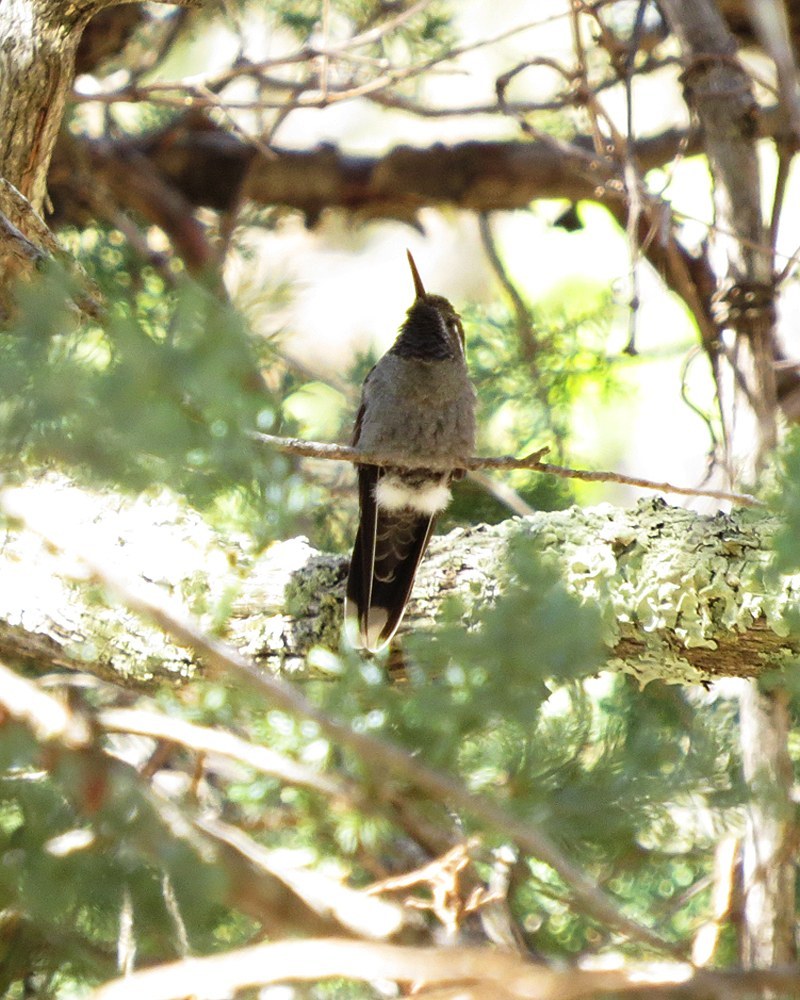
Key Field Marks
- Size & shape: A large hummingbird, about 11-13 cm (4.3-5 in), notably bigger and more robust than most North American hummingbirds, with a long, slightly decurved bill and a broad, rounded tail.
- Plumage: Overall dark bronzy-green to grayish-green upperparts and grayish underparts; note the bold facial pattern of a white postocular (behind-eye) stripe and a dark stripe below it bordered by more white, giving a distinctly striped face.
- Throat (male): Iridescent, deep blue gorget (the source of the name), which can look black in poor light and only flashes vivid blue at the right angle.
- Tail: Broad, dark tail with prominent white corners/tips, especially visible when the tail is fanned or the bird is perched with tail flicking.
- Behavior: Often perches for extended periods on low branches with a fairly upright posture, fanning and flicking its large tail; feeds at flowers and sap wells, and is notably aggressive, often dominating feeders over smaller hummingbird species.
Similar Species
- Magnificent (Rivoli's) Hummingbird: Also large and dark, but male shows a green (not blue) throat and a purple crown, and lacks the bold white facial stripes of Blue-throated Mountain-gem.
- Female/immature Magnificent Hummingbird: Both lack strong gorget color, but Blue-throated shows more contrasting white face stripes and larger white tail corners.
- Broad-billed Hummingbird: Smaller, with a mostly red bill and blue throat in males, but much smaller overall size and a different tail pattern separate it.
- The large size, bold white facial striping, and broad tail with big white corners are the most reliable marks distinguishing this species from other regional hummingbirds.
Where & When to See It
- Range: Found from the mountains of the southwestern United States (southeastern Arizona, New Mexico, west Texas) south through the highlands of Mexico to Nicaragua.
- Habitat: Shady mountain canyons with running water, sycamore and oak woodland, and streamside vegetation, typically at middle to higher elevations.
- Season: In the U.S. portion of its range, present mainly from spring through fall (roughly April-September/October), withdrawing south for winter, though a few may linger; more consistently resident in Mexico and Central America.
Voice & Song Cues
- Gives a distinctive, loud, sharp seek or peek call note, often repeated persistently and audible well before the bird is seen.
- Also produces a variety of chip and squeak notes during interactions at feeders or flowers, often used in aggressive encounters with other hummingbirds.
- The insistent, penetrating call note is often the quickest way to detect this species in shaded canyon habitat.
Frequently asked questions
What is the best field mark for a Blue-throated Mountain-gem?
Its large size combined with bold white stripes on the face and large white corners on a broad dark tail are the most reliable marks, since the blue throat of the male can look black in poor light.
How does it differ from the Magnificent (Rivoli's) Hummingbird?
Blue-throated Mountain-gem has stronger white facial striping and a blue (not green) throat in males, while Magnificent Hummingbird has a plainer face and a purple crown with a green throat.
Where in the U.S. can I find this species?
It occurs in shady mountain canyons of southeastern Arizona, New Mexico, and west Texas, generally from spring through fall.
What habitat does it prefer?
Shaded canyons with running water and sycamore or oak woodland at middle to higher elevations.