
Blue-headed Vireo Identification Guide
A crisp, spectacled songbird of eastern woodlands with a blue-gray head, bold white spectacles, and bright yellow-green flanks.
Read the full Blue-headed Vireo encyclopedia entry →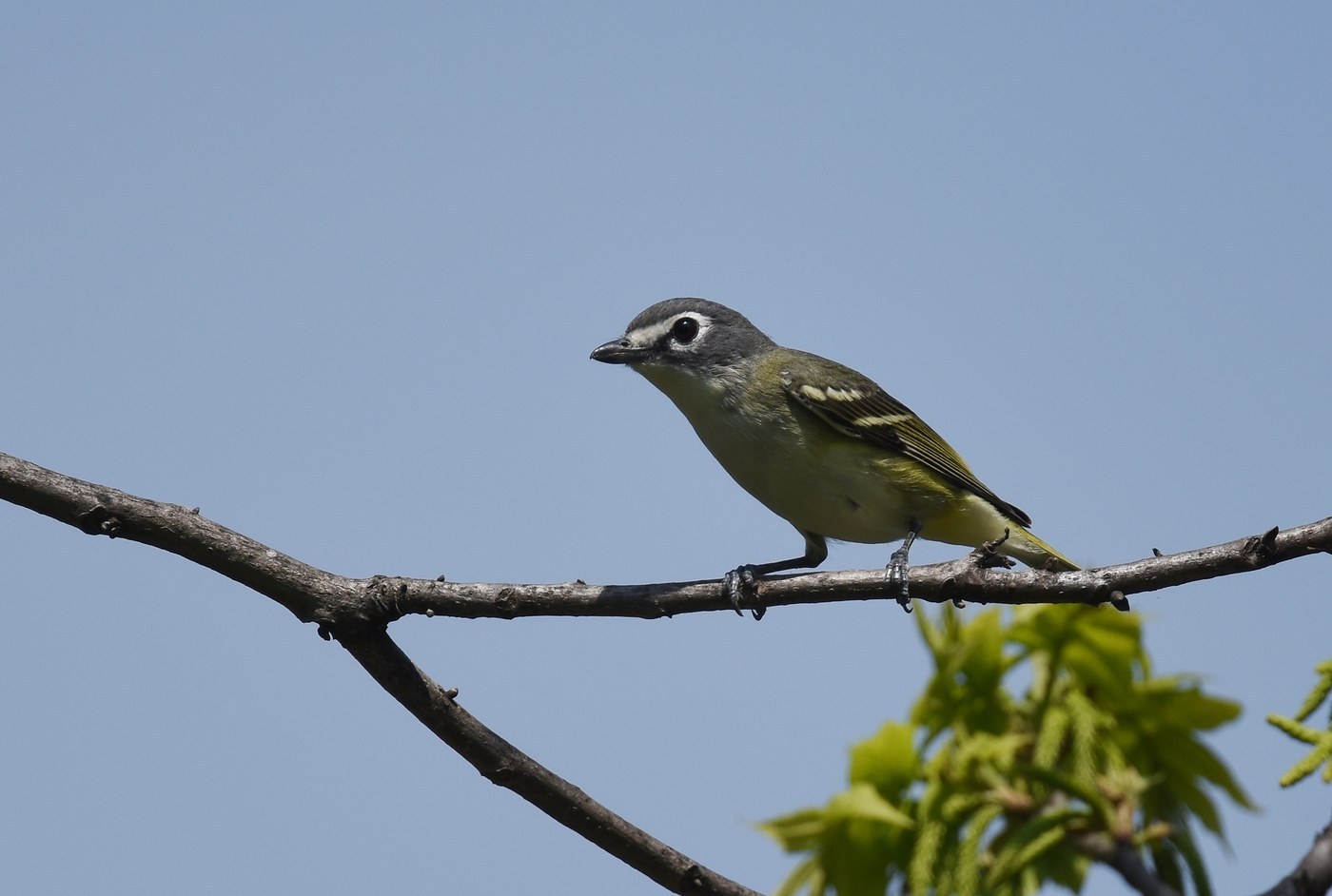
Key Field Marks
- Size & shape: A stocky, medium-sized vireo about 12-14 cm (5-5.5 in), with a fairly thick, slightly hooked bill typical of vireos.
- Plumage: Blue-gray head contrasting with an olive-green back, bold white "spectacles" (eye-ring plus lores) that stand out clearly against the darker head, and white underparts with yellow-green flanks and sides.
- Wings: Two crisp white wing bars and yellow-green edging on the flight feathers, giving a bright, contrasty look to the folded wing.
- Behavior: Deliberate and somewhat sluggish compared to warblers, moving slowly through mid-story foliage while foraging; often pauses between short hops, giving good looks.
- Sexes: Similar in appearance; no strong seasonal or sex-based plumage differences.
Similar Species
- Cassin's Vireo: Paler, more muted head-to-back contrast (grayer overall, less blue-gray vs. olive contrast) and duskier spectacles; ranges mostly separate (Cassin's is western).
- Plumbeous Vireo: Grayer overall with little to no yellow-green in the plumage, and duller wing bars; found in the interior West.
- Yellow-throated Vireo: Has a yellow throat and breast (not white), with yellow spectacles rather than white.
- Warbling Vireo and Red-eyed Vireo: Lack bold white spectacles and wing bars, appearing plainer-headed overall.
- Blue-headed, Cassin's, and Plumbeous Vireos were formerly considered one species ("Solitary Vireo") and are best separated by range, head-to-back contrast, and overall color saturation.
Where & When to See It
- Range: Breeds across the northeastern and north-central United States, the Appalachians, and much of Canada's boreal and mixed forest; winters in the southeastern U.S., Mexico, Central America, and the Caribbean.
- Habitat: Mixed and coniferous forest, especially with hemlock or pine components, during breeding; more varied wooded and shrubby habitats on migration and in winter.
- Season: Breeds spring through summer; among the earliest vireos to arrive in spring and among the latest to depart in fall, with some individuals lingering into early winter in the southern U.S.
Voice & Song Cues
- Song is a series of slow, deliberate, sweetly whistled phrases with rising and falling inflection, delivered with distinct pauses between phrases — "here-I-am... where-are-you... over-here" — slower-paced than most other vireo songs.
- Call is a harsh, scolding, chattering chee-chee-chee or nasal mewing note, often given when agitated.
- The unhurried pace and clear whistled quality of the song, combined with pauses between phrases, help distinguish it from the more continuous songs of Red-eyed or Warbling Vireo.
Frequently asked questions
How do I separate Blue-headed Vireo from Cassin's and Plumbeous Vireo?
Blue-headed shows the strongest contrast between its blue-gray head and olive-green back plus the brightest yellow-green flanks; Cassin's is intermediate, and Plumbeous is grayest with little yellow-green, and their ranges mostly don't overlap.
What is the easiest field mark for a Blue-headed Vireo?
Bold white spectacles set against a contrasting blue-gray head, combined with white wing bars and yellow-green flanks.
When is the best time to see a Blue-headed Vireo?
During spring and fall migration across much of the eastern U.S., or in summer within its breeding range in mixed and coniferous forests of the Northeast, Appalachians, and Canada.
How does its song differ from other vireos?
Its song is slower and more deliberate, with clear pauses between short whistled phrases, unlike the more continuous, run-on songs of Red-eyed Vireo.