
Blue-headed Parrot Identification Guide
A small green Amazonian parrot with a striking cobalt-blue head and red-and-blue undertail, often seen in fast, noisy flocks over forest canopy.
Read the full Blue-headed Parrot encyclopedia entry →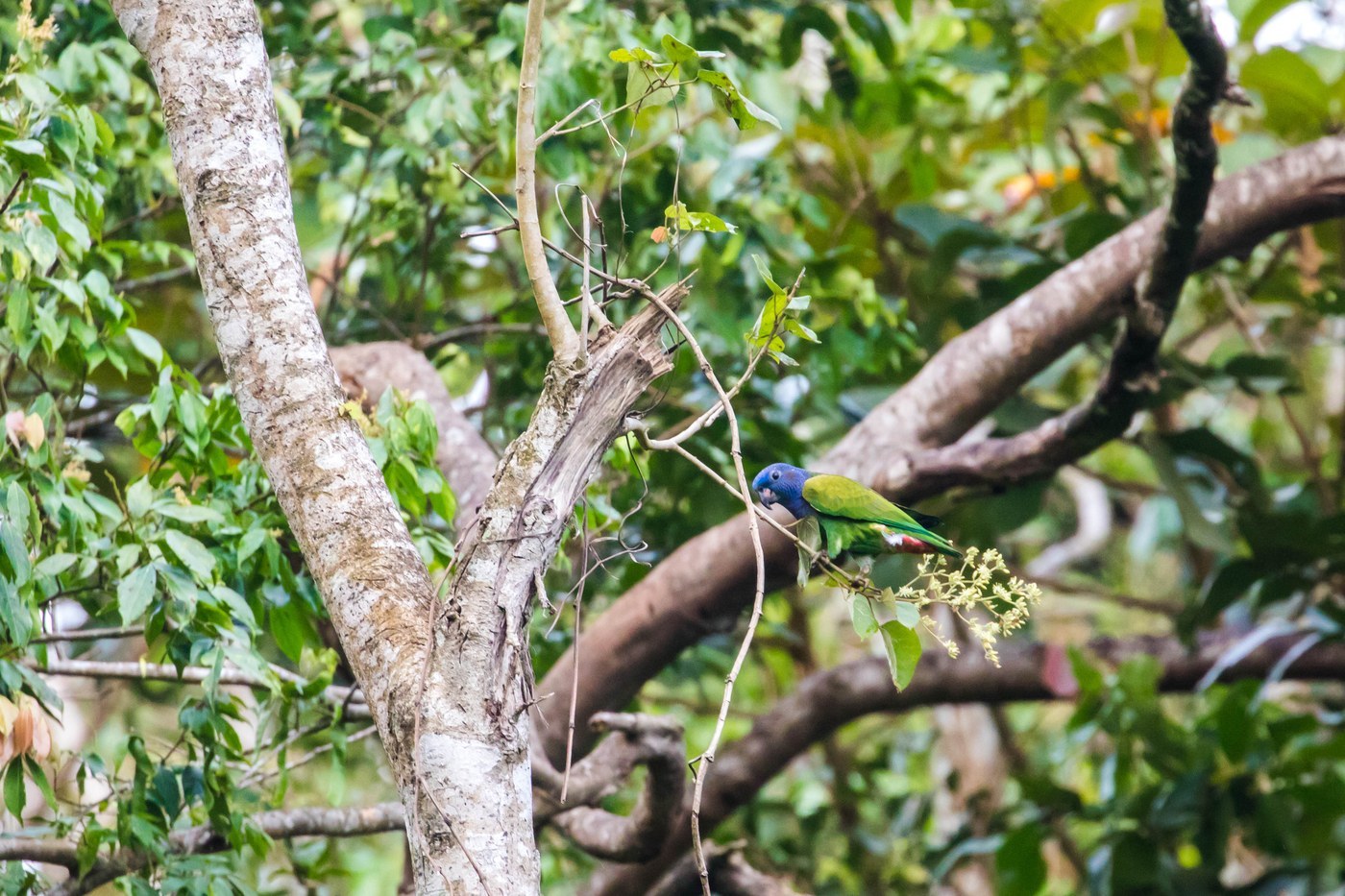
Key Field Marks
- Size & shape: A relatively small, compact parrot, about 24-28 cm (9.5-11 in), with a short square tail and stocky build typical of Pionus parrots.
- Plumage: Bright green body contrasting sharply with a deep blue-violet head extending from the crown down over the throat and upper breast.
- Bare parts: Pale pinkish-horn bill with a darker tip, bare pinkish-white skin around the eye, and a reddish undertail visible in flight or when the tail is fanned.
- Wings/tail: Green wings often show a bronzy tinge on the shoulder; the tail is green above with red at the base of the undertail coverts, a helpful mark in flight.
- Behavior: Flies in fast, direct flight with rapid, shallow wingbeats, typically in pairs or small flocks; often glimpsed flying over canopy calling loudly, or perched quietly and inconspicuously while feeding on fruit.
Similar Species
- Other Pionus parrots (e.g., Bronze-winged, White-crowned): Differ in head color and pattern — Blue-headed is the only one with an entirely deep blue head rather than a partial cap or different color.
- Amazona parrots (Amazons): Larger and bulkier, with different flight silhouette (broader wings, slower wingbeats) and no all-blue head.
- Blue-headed Macaw or Hyacinth-type macaws: Much larger, with long pointed tails, unlike this short-tailed, compact parrot.
- The clean cobalt-blue head against green body, plus reddish undertail coverts, is diagnostic among Amazonian parrots.
Where & When to See It
- Range: Widespread in the Amazon Basin and adjacent lowlands, from Colombia, Venezuela, and the Guianas south through Brazil, Peru, Bolivia, and into parts of Central America (Panama, Costa Rica).
- Habitat: Humid lowland and foothill forest, forest edge, secondary growth, and river-edge woodland; usually below about 1,000-1,500 m elevation.
- Season: Resident year-round with local movements tied to fruiting seasons; not a long-distance migrant.
Voice & Song Cues
- High-pitched, shrill, screechy calls given in flight, often a repeated kee-kee-kee or squealing chatter distinct from the harsher calls of Amazon parrots.
- Flocks are typically noisy in flight but become quiet and hard to detect once settled to feed in fruiting trees.
- Listen for the higher, thinner quality of Pionus calls compared to the deeper squawks of larger Amazon parrots sharing the same habitat.
Frequently asked questions
What is the most distinctive feature of the Blue-headed Parrot?
Its solid cobalt-blue head contrasting with an otherwise green body is unique among the Amazonian parrots it shares habitat with.
How can I tell it from an Amazon parrot in flight?
Blue-headed Parrot is smaller and more compact with faster, shallower wingbeats, and shows a reddish undertail, unlike the broader-winged, slower-flying Amazons.
What habitat does the Blue-headed Parrot prefer?
Humid lowland and foothill forest, forest edges, and secondary growth across the Amazon Basin and parts of Central America.
Is the Blue-headed Parrot loud?
Yes, it gives high-pitched, screechy calls in flight, though it becomes quiet and easy to overlook once feeding in a fruiting tree canopy.