
Blue-gray Tanager Identification Guide
A common, powder-blue songbird of Neotropical gardens and edges, easily told by its pale blue-gray body and darker blue wing panel.
Read the full Blue-gray Tanager encyclopedia entry →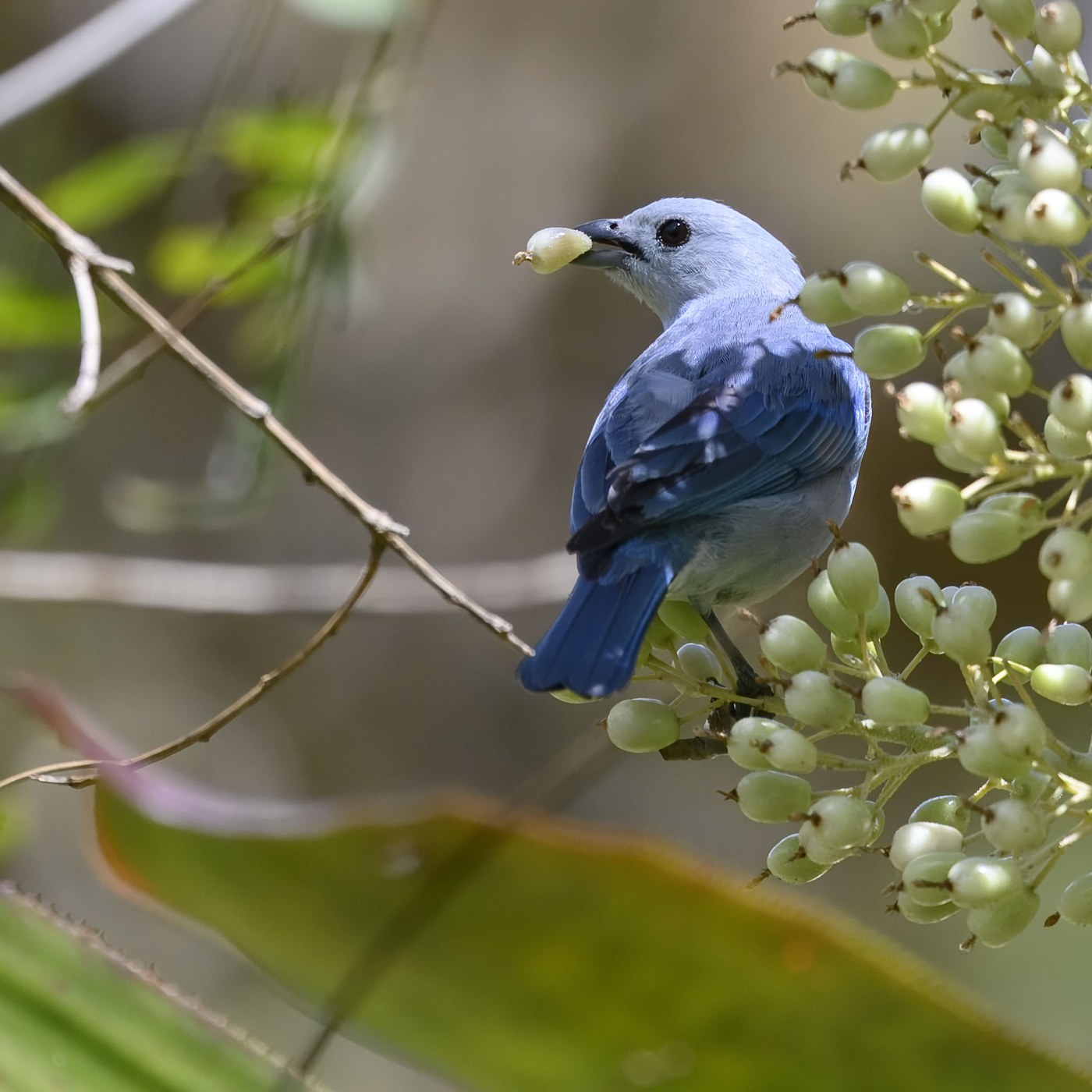
Key Field Marks
- Size & shape: A medium-sized tanager, about 16-18 cm (6-7 in), with a fairly stout, short, conical bill and a moderately long tail.
- Plumage: Overall pale, powdery blue-gray body, slightly paler and grayer on the head and underparts, with a brighter, more vivid blue panel on the shoulder (lesser coverts) and blue-tinged flight feathers.
- Bare parts: Dark gray to blackish bill and legs; dark eye without an obvious eye-ring.
- Sexes: Sexes look similar, though females can average slightly duller than males; juveniles are duskier and less blue overall.
- Behavior: Conspicuous, tame, and often in pairs; forages at all levels from mid-story to canopy for fruit and insects, frequently visiting garden feeders and fruiting trees; often perches in the open on wires, fence posts, and treetops.
Similar Species
- Palm Tanager: Similar shape but olive-brown to grayish-olive overall rather than blue, with a dark mask-like wing panel instead of blue.
- Glaucous Tanager: Paler, more grayish-white overall with a very pale, washed-out appearance; found in drier habitats in a more limited range.
- Blue-necked Tanager and other multicolored tanagers: Much more boldly patterned with contrasting colors, unlike the fairly uniform pale blue-gray of this species.
- Overall, the combination of pale blue-gray body plus a brighter blue wing patch is fairly distinctive within its range, especially given its tameness and frequent occurrence near people.
Where & When to See It
- Range: Widespread from Mexico south through Central America and much of northern and central South America to Bolivia, Paraguay, and Brazil; also found on Trinidad and Tobago.
- Habitat: Highly adaptable — gardens, parks, forest edges, second growth, plantations, and semi-open areas, generally avoiding deep unbroken forest interior.
- Season: Resident year-round throughout its range; not migratory.
Voice & Song Cues
- A thin, high, squeaky tsee or tsi-tsi call note, often given while foraging or in flight between perches.
- The song is a simple, unmusical series of thin, squeaky notes and short buzzy phrases, repeated somewhat monotonously.
- Pairs often duet or call back and forth softly while foraging together in the canopy.
Frequently asked questions
What makes the Blue-gray Tanager easy to identify?
Its overall soft, powdery blue-gray plumage combined with a brighter blue shoulder patch is distinctive and shared by few other tanagers in its range.
Is the Blue-gray Tanager common in cities and gardens?
Yes, it is one of the most familiar and tame tanagers in Central and South American towns, readily visiting gardens, parks, and fruit feeders.
Do male and female Blue-gray Tanagers look different?
They are similar, with females averaging just slightly duller than males; the sexes are not easily separated in the field.
What does the Blue-gray Tanager eat?
Primarily fruit, supplemented with insects and nectar, and it readily comes to feeders offering bananas or other soft fruit.