
Blue-gray Gnatcatcher Identification Guide
A tiny, long-tailed, blue-gray songbird that flicks and fans its black-and-white tail while gleaning insects from foliage.
Read the full Blue-gray Gnatcatcher encyclopedia entry →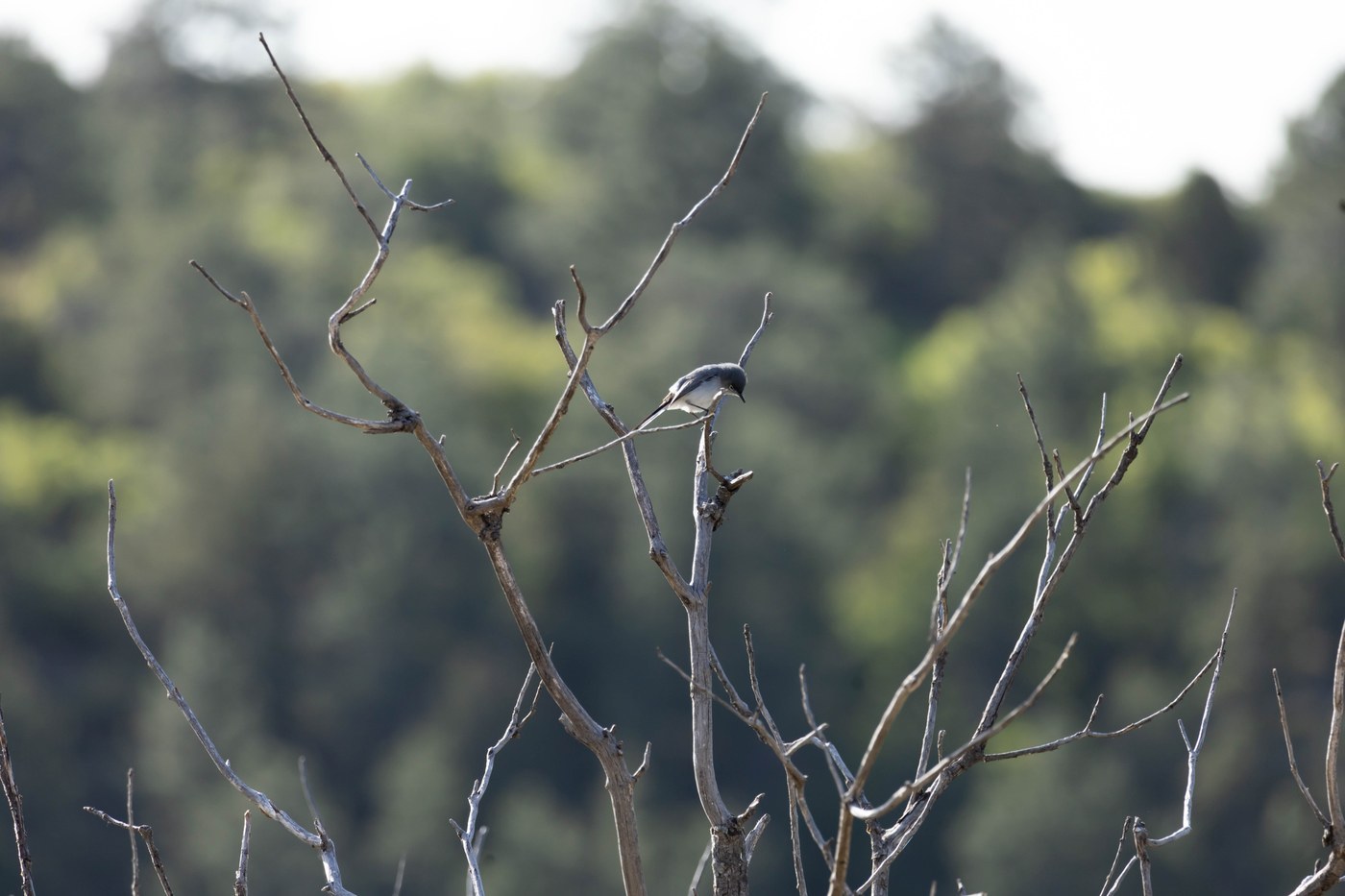
Key Field Marks
- Size & shape: Very small (10-13 cm/4-5 in), slender warbler-like bird with a proportionally long, narrow tail and a thin, straight bill.
- Plumage: Blue-gray upperparts (brighter and bluer in breeding males), pale gray-white underparts, and a bold white eye-ring giving a spectacled look.
- Tail: Black tail with white outer feathers, constantly flicked upward and fanned open — one of its most distinctive behavioral traits.
- Seasonal variation: Breeding males show a thin black eyebrow/forehead line above the eye-ring; this is absent in females and winter birds.
- Behavior: Restless and active, hopping and flitting through outer branches and shrubs, often hovering briefly to glean insects from leaves; frequently cocks and wags its tail side to side and up over its back.
Similar Species
- Black-tailed Gnatcatcher: Range overlaps in the arid Southwest; male Black-tailed has a full black cap in breeding plumage (vs. thin brow line) and shows less white in the tail from below.
- California Gnatcatcher: Darker gray overall, browner-gray below, with a mostly dark tail lacking extensive white; found only in coastal sage scrub of southern California/Baja.
- Kinglets: Similarly tiny but shorter-tailed, with wing bars and (in Ruby-crowned) a stubbier tail that is not habitually flicked in the same exaggerated way.
- Warblers (e.g., gray-plumaged ones): Lack the long, white-edged tail and constant tail-fanning behavior.
Where & When to See It
- Range: Breeds across the southern half and eastern United States north into the lower Midwest and Mid-Atlantic, and south through Mexico into Guatemala; the westernmost populations are more resident, while northern/eastern breeders migrate to Mexico and the Gulf Coast/southern U.S. and Central America in winter.
- Habitat: Open deciduous and mixed woodland, scrub, chaparral, riparian corridors, and woodland edges; in the West, also pinyon-juniper and desert wash vegetation.
- Season: Present in the breeding range from spring through summer (roughly March-September in northern areas); resident year-round in the Deep South, Southwest, and Mexico.
Voice & Song Cues
- A thin, wheezy, nasal speee or zpeee call, often the first clue to its presence in dense foliage.
- The song is a soft, squeaky, rambling series of thin notes and imitations of other birds, delivered quietly and easy to overlook.
- Frequently detected by voice before being seen, given its small size and habit of staying in leafy cover.
Frequently asked questions
What is the easiest way to spot a Blue-gray Gnatcatcher?
Listen for its thin, wheezy 'spee' call and watch for a tiny, long-tailed bird constantly flicking its black-and-white tail while foraging in outer branches.
How can I tell a male from a female Blue-gray Gnatcatcher?
Breeding males show a thin black line above the white eye-ring (like eyebrows); females and non-breeding birds lack this mark and look plainer blue-gray.
Does the Blue-gray Gnatcatcher migrate?
Northern and eastern populations are migratory, wintering in the southern U.S., Mexico, and Central America, while southwestern populations are largely resident year-round.
What does a Blue-gray Gnatcatcher eat?
It feeds almost entirely on small insects and spiders gleaned from leaves and twigs, occasionally hovering to snatch prey from foliage.