
Blue-fronted Amazon Identification Guide
A stocky green Amazon parrot with a blue forehead and yellow-and-blue face, native to South America's dry woodlands and gallery forests.
Read the full Blue-fronted Amazon encyclopedia entry →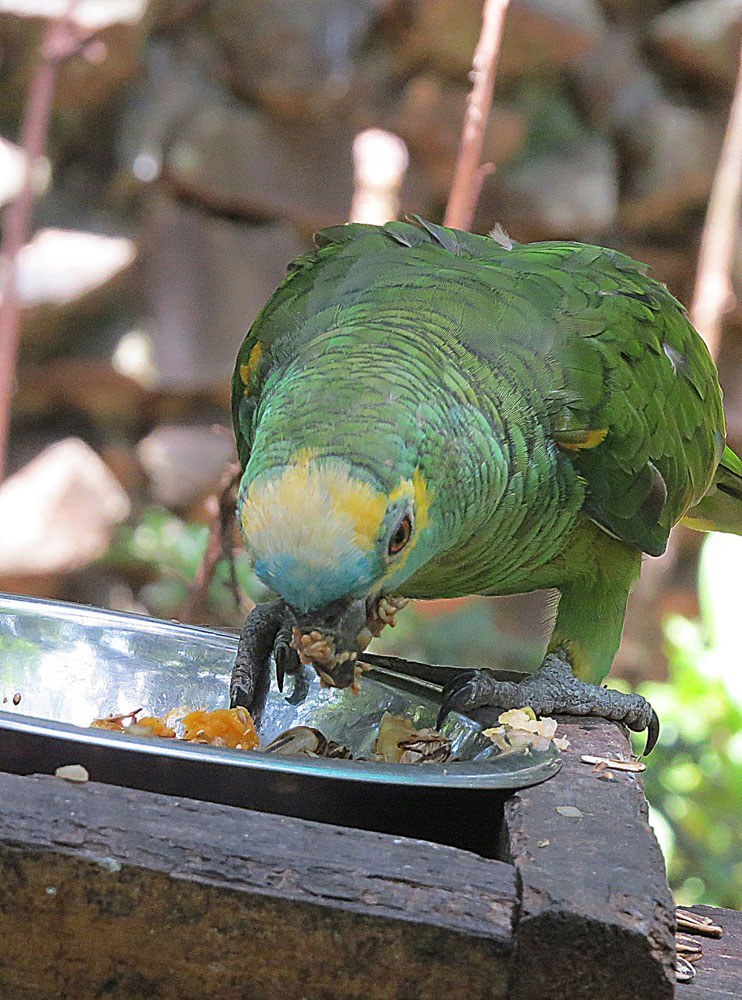
Key Field Marks
- Size & shape: A medium-large, heavy-bodied parrot roughly 37-40 cm (14.5-16 in) long, with a short square tail typical of Amazon parrots and a large hooked pale-horn bill.
- Plumage: Overall bright grass-green body with a diagnostic pale blue patch across the forehead and crown, and a yellow patch on the face bordering the blue (extent of yellow is variable and increases with age).
- Wings: Green with a red speculum (patch) visible in flight on the secondaries, and often some red at the bend of the wing (carpal edge) in adults.
- Bare parts: Pale horn-colored bill, white bare eye-ring, and yellow-orange iris in adults (dark eye in juveniles).
- Behavior: Flies in fast, direct, shallow-wingbeat flight in pairs or small flocks; forages in tree canopy for fruit, seeds, and blossoms; very vocal, especially at dawn and dusk when flying to and from communal roosts.
Similar Species
- Yellow-crowned Amazon / Turquoise-fronted relatives: Told from other Amazons by the combination of blue forehead plus yellow face (rather than an all-yellow crown or head).
- Mealy Amazon: Larger, duller green with a whitish eye-ring and lacks the blue forehead patch.
- Orange-winged Amazon: Shows a yellow crown and orange (not red) wing speculum, and lacks the blue forehead.
- In flight, the red-and-green wing pattern combined with a short tail separates Amazons from macaws (long pointed tails) and conures/parakeets (smaller, slimmer, long tails).
Where & When to See It
- Range: Native to central South America, including Bolivia, Paraguay, Brazil, and northern Argentina; long-established feral populations occur in parts of Europe and the southern United States (e.g., California, Florida, Puerto Rico) from escaped or released birds.
- Habitat: Dry deciduous woodland, gallery forest, palm savanna, and agricultural edge habitat; increasingly found in parks and urban plantings within its feral range.
- Season: Resident year-round; noisiest and most conspicuous around dawn and dusk roost flights.
Voice & Song Cues
- Loud, raucous, far-carrying screeches and squawks typical of Amazon parrots, often given in flight or before flushing.
- A range of harsh chattering and whistled notes from roosting flocks at dawn and dusk; some individuals in captivity mimic human speech, but wild calls are mostly harsh and unmusical.
Frequently asked questions
How do you tell a Blue-fronted Amazon from other green Amazon parrots?
Look for the combination of a pale blue forehead and a yellow patch on the face; most other Amazons show either an all-yellow head/crown or no blue at all.
Are Blue-fronted Amazons found outside South America?
Yes. Besides their native range in Bolivia, Paraguay, Brazil, and Argentina, self-sustaining feral populations exist in cities in Spain, Portugal, and parts of the U.S. from escaped birds.
What color is the wing patch in flight?
A red speculum on the secondaries, visible as a flash of red in an otherwise green wing during flight.
Do males and females look different?
No reliable plumage differences separate the sexes in the field; the species is not sexually dimorphic.