
Blue Dacnis Identification Guide
A small, brilliant turquoise-blue tanager relative of Neotropical forests, with males showing a bold black back patch and throat.
Read the full Blue Dacnis encyclopedia entry →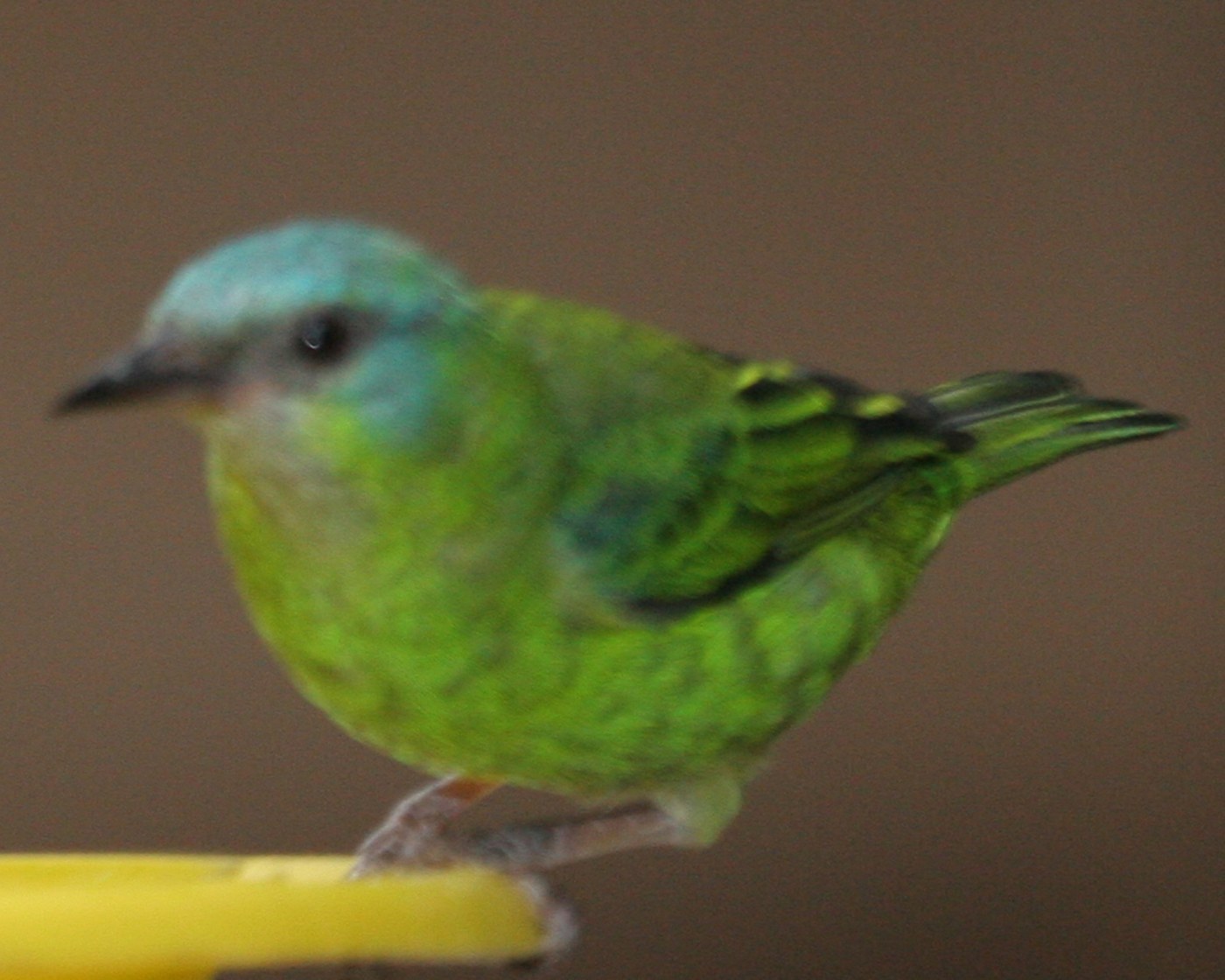
Key Field Marks
- Size & shape: A small bird, about 12–14 cm, with a short, thin, slightly decurved bill typical of the honeycreeper-like tanagers in family Thraupidae.
- Male: Bright turquoise-blue overall, with a contrasting black patch on the back, a black face and throat (lores through chin), and black wings and tail; red eyes add a fine detail visible at close range.
- Female: Entirely different from the male — green overall, with a bluish tinge to the head, and paler, more yellow-green underparts; lacks any black markings.
- Bill: Short, pointed, and slightly downcurved, suited to picking fruit and gleaning insects.
Separating It from Similar Species
- Turquoise Tanager is more heavily patterned with a yellow shoulder patch and black scaling, distinct from the Blue Dacnis male's cleaner black-and-blue pattern.
- Swallow Tanager shares a turquoise-blue tone in males but has a different, more flattened bill shape, a stockier body, and lacks the Blue Dacnis's black face/throat patch.
- Female Blue Dacnis (all green) can be confused with various female tanagers and honeycreepers; the bluish head tinge and slim decurved bill are the best supporting clues.
Where & When to See It
- Range: From southern Central America (Costa Rica, Panama) south through much of tropical South America to northern Argentina.
- Habitat: Forest canopy, forest edges, and second growth; frequently joins mixed-species foraging flocks moving through the canopy.
- Season: A non-migratory resident across most of its range, present year-round.
Voice
- Calls are thin and high-pitched, often a simple "tsee" or "seet" note.
- The song is a weak, buzzy, unremarkable series, easily overlooked amid the calls of other canopy species in a mixed flock.
Frequently asked questions
How do you identify a male Blue Dacnis?
Look for an overall bright turquoise-blue body with a contrasting black patch on the back and a black face and throat, plus red eyes visible at close range.
Why does the female Blue Dacnis look so different from the male?
Like many tanagers, Blue Dacnis shows strong sexual dimorphism — females are green with only a bluish tinge on the head, entirely lacking the male's black markings.
Where does the Blue Dacnis live?
Tropical forest canopy, forest edge, and second growth from southern Central America south through much of tropical South America to northern Argentina.
Does the Blue Dacnis join other species while foraging?
Yes, it commonly forages in mixed-species flocks moving through the forest canopy alongside other tanagers and honeycreepers.