
Blue-crowned Trogon Identification Guide
A brightly colored South American trogon that sits so still it is often heard before it is seen, marked by a red belly and yellow eye-ring.
Read the full Blue-crowned Trogon encyclopedia entry →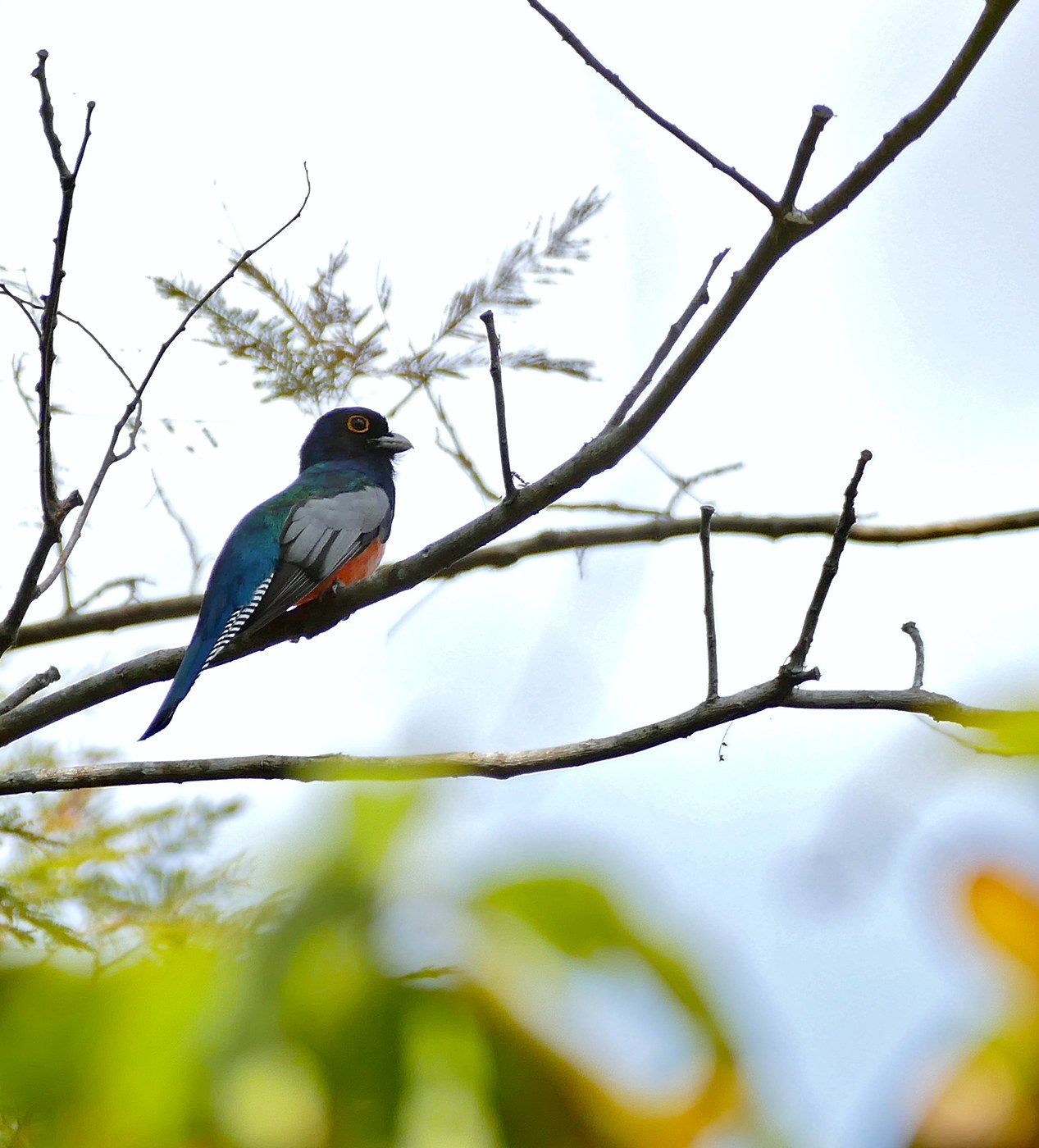
Key Field Marks
- Size & shape: A medium-sized trogon, about 23–25 cm, with the stocky body, short neck, and short bill typical of the family; sits upright and motionless for long periods.
- Male: Iridescent green head, back, and breast; a subtle blue sheen on the crown visible mainly at close range or in good light; a black face and throat; a bold yellow eye-ring; a bright red belly; and a blue-black tail showing fine white barring on the underside.
- Female: Gray-brown head and breast in place of the male's green iridescence, but retains the bright red belly and the barred tail pattern, making the belly color a reliable mark in both sexes.
- Behavior: Perches quietly and upright in the mid-canopy, making short sallying flights to pluck fruit or catch insects before returning to a perch — often surprisingly hard to spot despite bright plumage because it sits so still.
Separating It from Similar Species
- Black-throated Trogon also shows a yellow eye-ring but has a more solidly blue-black throat/face pattern and different underside tone; range and voice help confirm identification.
- Amazonian Trogon and Surucua Trogon are similar in general pattern within overlapping or adjacent ranges; voice and precise geographic range are the most reliable separators where these species' ranges approach each other.
- The combination of yellow eye-ring, red belly, and barred blue-black tail is the most useful quick combination within the Blue-crowned Trogon's specific range.
Where & When to See It
- Range: South America, centered on the Amazon basin and its edges, including Bolivia, Brazil, Paraguay, and northern Argentina.
- Habitat: Forest interior and forest edge, including secondary growth, generally in the lower and middle levels of the forest rather than the high canopy.
- Season: A non-migratory resident, present year-round throughout its range.
Voice
- A soft, evenly paced series of low, hollow notes, often rendered as "cow cow cow cow", repeated at a steady pace.
- Because the bird sits so still, this call is frequently the first — and sometimes only — clue to its presence before it is located visually.
Frequently asked questions
What is the easiest way to identify a Blue-crowned Trogon?
Look for a bright red belly combined with a bold yellow eye-ring and a blue-black tail with fine white barring underneath; males also show iridescent green upperparts.
How do male and female Blue-crowned Trogons differ?
Males have iridescent green upperparts and a black face/throat, while females have gray-brown upperparts instead of green, but both sexes share the red belly and barred tail.
Why is the Blue-crowned Trogon hard to spot despite its bright colors?
It perches quietly and motionless for long stretches in the forest mid-story, so it often blends into dappled light and is detected first by its call.
What does a Blue-crowned Trogon sound like?
A soft, steady series of low, hollow notes repeated evenly, often described as a mellow "cow cow cow cow."