
Blue-crowned Motmot Identification Guide
A striking Central and South American forest bird known for its turquoise crown band, rufous underparts, and pendulum-swinging racket tail.
Read the full Blue-crowned Motmot encyclopedia entry →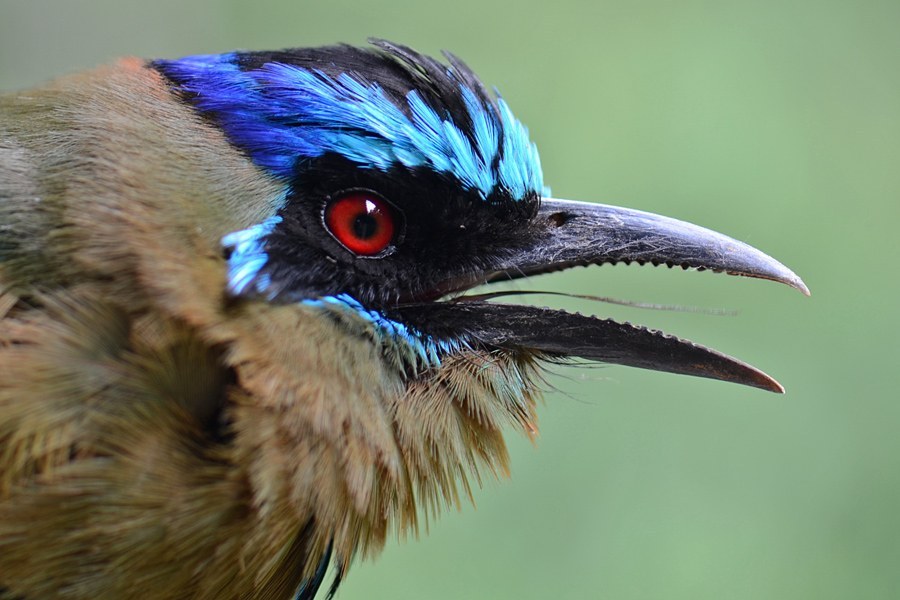
Key Field Marks
- Size & shape: A medium-sized bird, roughly 38–43 cm long, much of which is the elongated tail with a distinctive bare shaft ending in a racket-shaped tip (created by the bird itself preening away weakly attached barbs).
- Plumage: Green-blue body overall, with rufous (reddish-brown) underparts on the chest and belly (extent and depth of rufous varies somewhat across its range); a turquoise-blue band across the crown; a bold black mask through the eye bordered above by blue.
- Bare parts: A fairly long, slightly downcurved black bill; red eyes.
- Diagnostic behavior: Swings its long racket tail side to side in a slow, pendulum-like motion while perched — one of the most useful behavioral clues to the whole motmot family.
Separating It from Similar Species
- Several closely related motmots (sometimes treated as a single species complex, sometimes split, e.g., Lesson's Motmot, Whooping Motmot) look extremely similar; crown color and pattern, and precise range, are the best ways to separate them.
- Overall shape, racket tail, and pendulum-swinging behavior are shared across the motmot family, so voice and geographic range are often the most reliable ways to confirm identification where ranges approach one another.
- The combination of a turquoise crown band, black mask, and rufous underparts is the most useful quick combination for this species within its specific range.
Where & When to See It
- Range: From Mexico south through Central America into South America, occupying a broad swath of the Neotropics.
- Habitat: Forest edges, woodland, shaded gardens, and shaded plantations (such as coffee or cacao under canopy); tends to favor semi-open, wooded habitats over deep unbroken forest interior.
- Season: A non-migratory resident throughout its range, present year-round.
Voice
- A low, resonant, owl-like hooting call, often rendered as "hoot-hoot" or "whoop-whoop", typically given around dawn and dusk.
- Because the bird often perches quietly and motionless for long periods, it is frequently detected first by its call or by the motion of its swinging tail rather than by sight.
Frequently asked questions
Why does the Blue-crowned Motmot swing its tail?
It regularly swings its long, racket-tipped tail side to side in a slow, pendulum-like motion while perched, a behavior thought to signal alertness to predators.
How did the motmot's racket-tipped tail form?
The bare shaft and racket tip are created by the bird itself, as weakly attached feather barbs near the tail tip wear off or are preened away over time.
What habitat does the Blue-crowned Motmot prefer?
Forest edges, woodland, and shaded gardens or plantations, generally favoring semi-open wooded habitat over dense unbroken forest interior.
What does a Blue-crowned Motmot sound like?
A low, resonant, owl-like hooting call, often given as a repeated "hoot-hoot" around dawn and dusk.