
Blue-crowned Conure Identification Guide
A mostly green South American parakeet distinguished by its namesake blue crown and long, pointed, blue-tipped tail.
Read the full Blue-crowned Conure encyclopedia entry →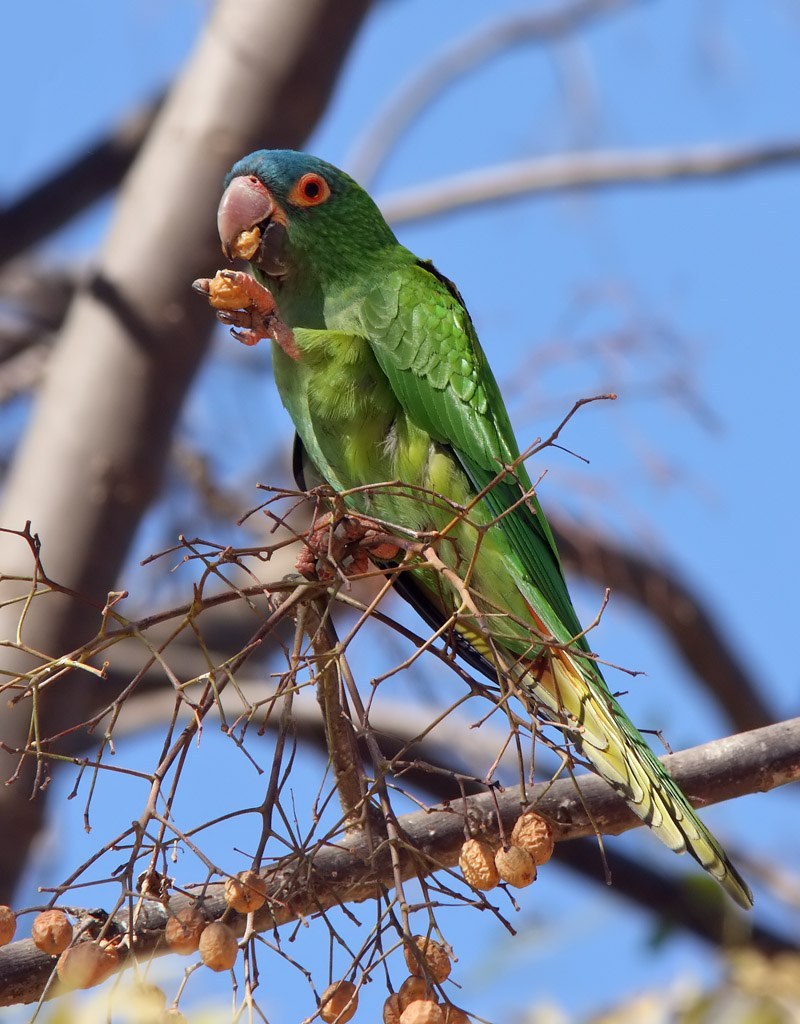
Key Field Marks
- Size & shape: A medium-sized parakeet, about 37–38 cm long, with a substantial portion of that length made up of a long, pointed tail — typical of Aratinga-type conures.
- Plumage: Predominantly green body; a blue crown and forehead that extends back over the top of the head toward the nape, giving the bird its name.
- Face & bill: A pale to whitish, fairly bold eye-ring; a dark, blackish bill; pale grayish legs.
- Tail: Long and pointed, green with blue tips on the outer/underside, visible well in flight and at rest.
Separating It from Similar Species
- Compared to other Aratinga-type conures, the extent and clean edges of the blue crown are the best mark — many similar species show red, not blue, on the head (e.g., Mitred Parakeet and Red-masked Parakeet both show red on the face/crown).
- Nanday Parakeet has a solid black head and throat rather than a blue crown on an otherwise green head, and shows red "thighs," both good differences.
- General green body plus a clean blue cap and whitish eye-ring is the quickest combination for this species.
Where & When to See It
- Native range: South America — dry woodlands, palm groves, and savanna-like habitats across Brazil, Bolivia, Paraguay, Argentina, and Uruguay.
- Introduced/feral populations: Established self-sustaining feral populations occur in urban and suburban areas of Florida and California, often in parks and neighborhoods with fruiting and flowering trees.
- Season: Non-migratory; present year-round wherever established, whether in native range or as feral populations.
Behavior & Voice
- Highly gregarious, typically seen in noisy flocks that forage together on seeds, fruit, and blossoms and roost communally at night.
- Flight is fast and direct, usually accompanied by loud calling that draws attention before the birds are seen.
- Voice: harsh, screeching calls typical of conures, given frequently in flight and at roost sites.
Frequently asked questions
What is the key field mark for the Blue-crowned Conure?
A green body with a clean blue crown extending over the top of the head, paired with a pale eye-ring and a long, pointed tail with blue tips.
Where can Blue-crowned Conures be seen outside South America?
Established feral populations occur in urban and suburban areas of Florida and California, in addition to their native range across parts of South America.
How do you separate Blue-crowned Conure from Mitred Parakeet?
Mitred Parakeet shows red on the face and crown, while Blue-crowned Conure shows blue on the crown instead, with no red on the head.
What habitat does the Blue-crowned Conure use in its native range?
Dry woodlands, palm groves, and savanna habitats across Brazil, Bolivia, Paraguay, Argentina, and Uruguay.