
Blacksmith Lapwing Identification Guide
A bold black, white, and gray African plover named for its metallic, hammer-on-anvil alarm call.
Read the full Blacksmith Lapwing encyclopedia entry →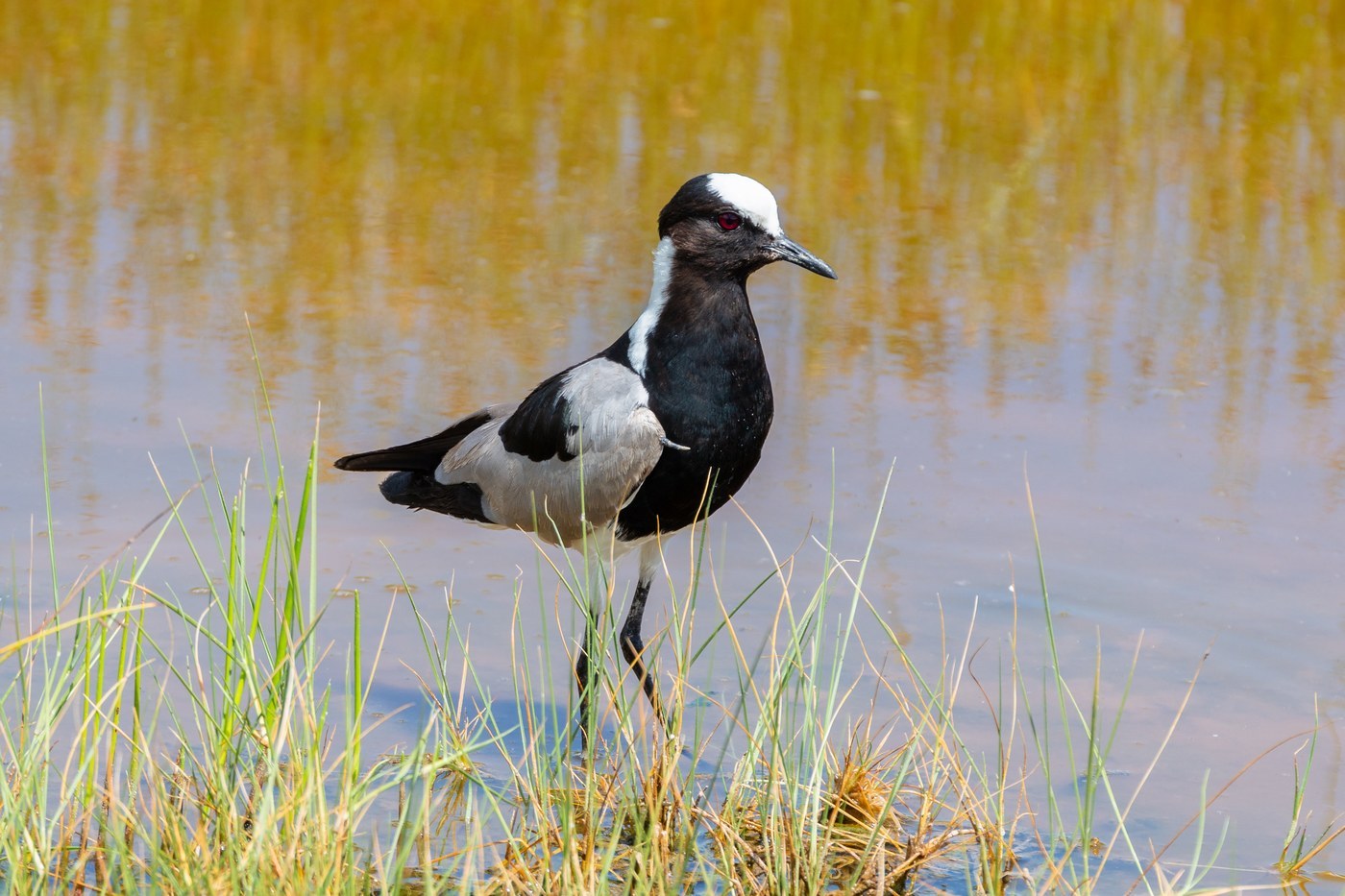
Key Field Marks
- Size & shape: A medium-large, robust plover (about 30 cm) with a stocky body, longish legs, and the upright, alert stance typical of lapwings.
- Plumage: Strikingly patterned in black, white, and gray — black crown, face, and throat continuing into a black breast; a clean white nape and hindneck collar; pale gray back and wing coverts; glossy black flight feathers and wingtips; and a white belly.
- Bare parts: Bright red eyes, a black bill, and long, dark reddish-pink to blackish legs.
- In flight: Shows a bold, high-contrast black-and-white wing pattern that is obvious even at distance.
- Wing spurs: Like other lapwings, it carries small carpal (wrist) spurs used in territorial disputes, though these are rarely visible in the field.
Separating It from Similar Species
- Within its African range, the combination of black head/breast, white collar, and gray back is unique among lapwings — no confusion species shares this exact pattern.
- Crowned Lapwing has a brown back, a black cap ringed by a white "crown" band, and lacks the Blacksmith's white collar and gray back.
- Long-toed Lapwing is smaller, more delicate, with obviously long toes for walking on floating vegetation, and lacks the bold black breast.
Where & When to See It
- Range: Widespread and common resident across sub-Saharan Africa, especially southern and eastern Africa.
- Habitat: Short grass and open ground near water — wetland edges, marshes, dams, riverbanks, flooded pastures, farmland, sports fields, and golf courses. Rarely found far from water.
- Season: A year-round resident throughout most of its range, with local movements tied to water availability rather than long-distance migration.
Behavior & Voice
- Usually seen in pairs or small family groups, often standing sentinel-like near water.
- Extremely vocal and aggressive in defense of nests and chicks, dive-bombing intruders including much larger animals and people.
- The common name comes from its loud, metallic "tink-tink-tink" alarm call, likened to a blacksmith's hammer striking an anvil.
Frequently asked questions
Why is it called the Blacksmith Lapwing?
Its loud, sharp, metallic alarm call — a repeated "tink-tink-tink" — resembles the sound of a blacksmith's hammer striking an anvil.
What habitat does the Blacksmith Lapwing prefer?
Open short grass or bare ground close to water, such as marsh edges, dam margins, flooded fields, and even golf courses and playing fields, almost always near a wetland.
How can I tell a Blacksmith Lapwing from a Crowned Lapwing?
Blacksmith Lapwing has a gray back, a black breast, and a clean white collar, while Crowned Lapwing has a brown back and a black cap ringed by a white band, without the white collar.
Is the Blacksmith Lapwing migratory?
No, it is generally a sedentary resident across sub-Saharan Africa, though individuals may shift locally in response to changing water levels.