
Blackpoll Warbler Identification Guide
A boreal-breeding warbler famed for its long transoceanic migration, identified in fall by pale legs, olive upperparts, and faint streaking.
Read the full Blackpoll Warbler encyclopedia entry →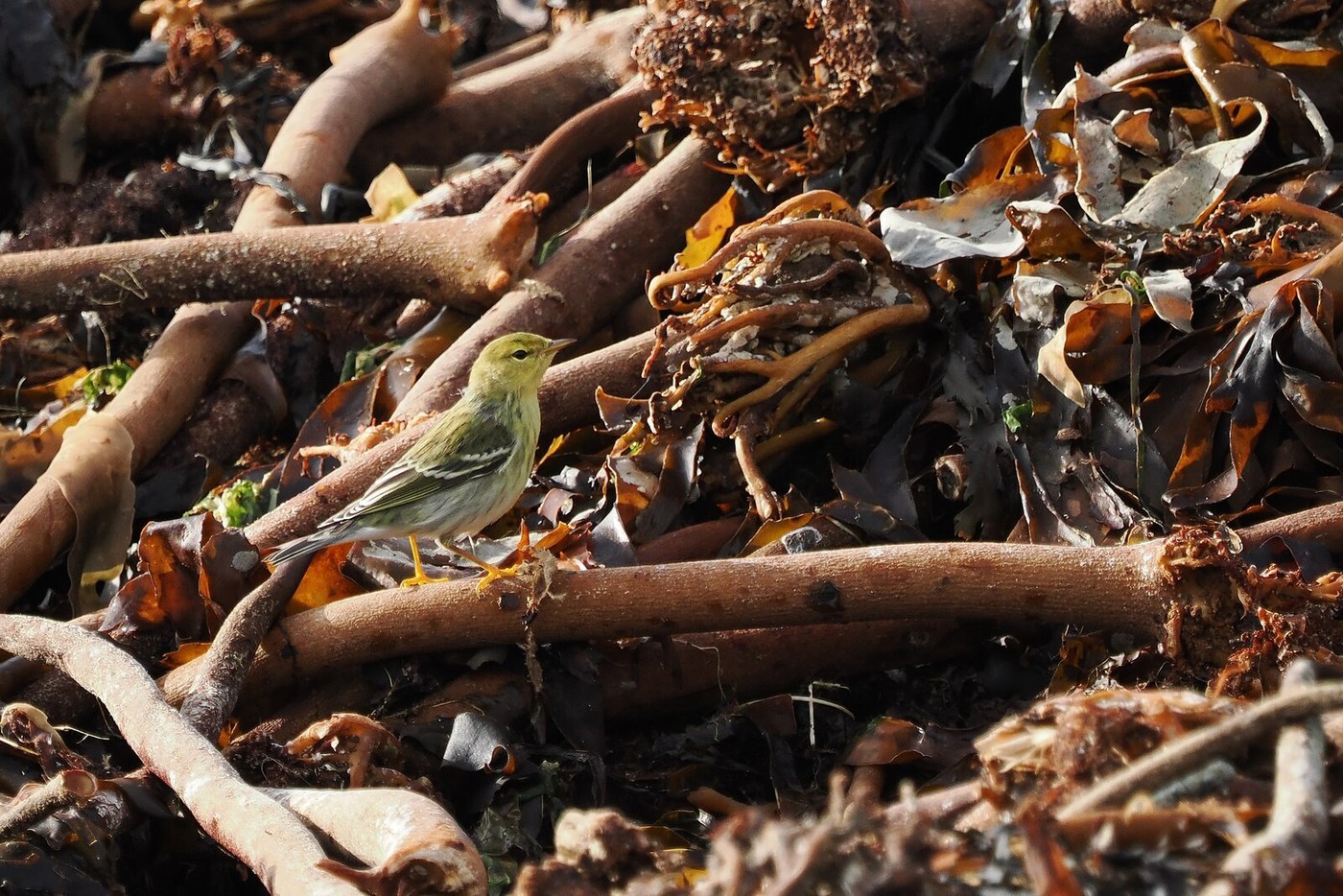
Key Field Marks
- Size & shape: A small, fairly stocky warbler (about 13 cm) with a straight thin bill and a moderately short tail.
- Breeding male: Solid black cap, white cheek, thin black malar (mustache) stripe, black-streaked white underparts, olive-black streaked upperparts, two bold white wing bars, and pale orange-yellow legs and feet.
- Breeding female: A duller version of the male — olive-gray streaked upperparts, whitish underparts with light streaking, and less contrasting head pattern, but the pale legs remain.
- Fall / immature (the "confusing fall warbler"): Olive-green above, pale yellowish wash across the breast fading to a white belly, white undertail coverts, faint streaking on the flanks, two white wing bars, and — the key mark — pale yellowish to greenish legs and feet.
Separating It from Similar Species
- The classic fall confusion species is Bay-breasted Warbler. Separate them by leg color: Blackpoll has pale/yellowish legs, Bay-breasted has dark (blackish) legs. Blackpoll also shows more obvious flank streaking and pure white (not buffy) undertail coverts.
- Pine Warbler in fall is plainer, with a heavier bill, unstreaked or faintly streaked underparts, and lacks the crisp white wing bars combined with pale legs.
- Black-and-white Warbler has bold black-and-white striping over the entire body and creeps along bark, unlike Blackpoll's typical foliage-gleaning.
Where & When to See It
- Breeding range: Boreal spruce forest across Canada and Alaska, including stunted taiga and high-elevation spruce-fir in the northeastern mountains.
- Winter range: Northern and central South America, from Venezuela and Colombia south into the Amazon basin.
- Migration: One of the most remarkable songbird migrants — many fall birds depart from the northeastern U.S. and Atlantic Canada and fly nonstop over open ocean for 2–3 days directly to South America, one of the longest nonstop migratory flights known for a songbird of its size. Spring migration instead takes an overland route.
Voice
- Song is an extremely high-pitched, even-pitched, insect-like series of tsit notes that starts soft, crescendos in the middle, and fades — often written as "tsi-tsi-tsi-tsi-tsi-tsi-tsi". It is pitched so high that many older birders can no longer hear it.
- Call note is a sharp, high chip.
Frequently asked questions
How do I tell a fall Blackpoll Warbler from a Bay-breasted Warbler?
Check the legs: Blackpoll has pale, yellowish legs and feet, while Bay-breasted has dark legs. Blackpoll also shows crisper flank streaking and pure white undertail coverts.
What is distinctive about Blackpoll Warbler migration?
In fall, many Blackpolls fly nonstop for several days over the open Atlantic Ocean from the northeastern U.S. and Canada to South America, one of the longest nonstop flights recorded for a small songbird.
What does a breeding male Blackpoll Warbler look like?
A solid black cap, white cheeks, a black mustache stripe, white underparts streaked with black, and pale orange-yellow legs — sometimes described as "wearing yellow shoes."
Why is the Blackpoll Warbler's song hard to hear?
It is pitched extremely high, near the upper edge of human hearing range, so many birders — especially those with age-related high-frequency hearing loss — cannot detect it at all.