
Blackburnian Warbler Identification Guide
A small canopy warbler best known for the breeding male's blazing orange throat set against a black-and-white face and back.
Read the full Blackburnian Warbler encyclopedia entry →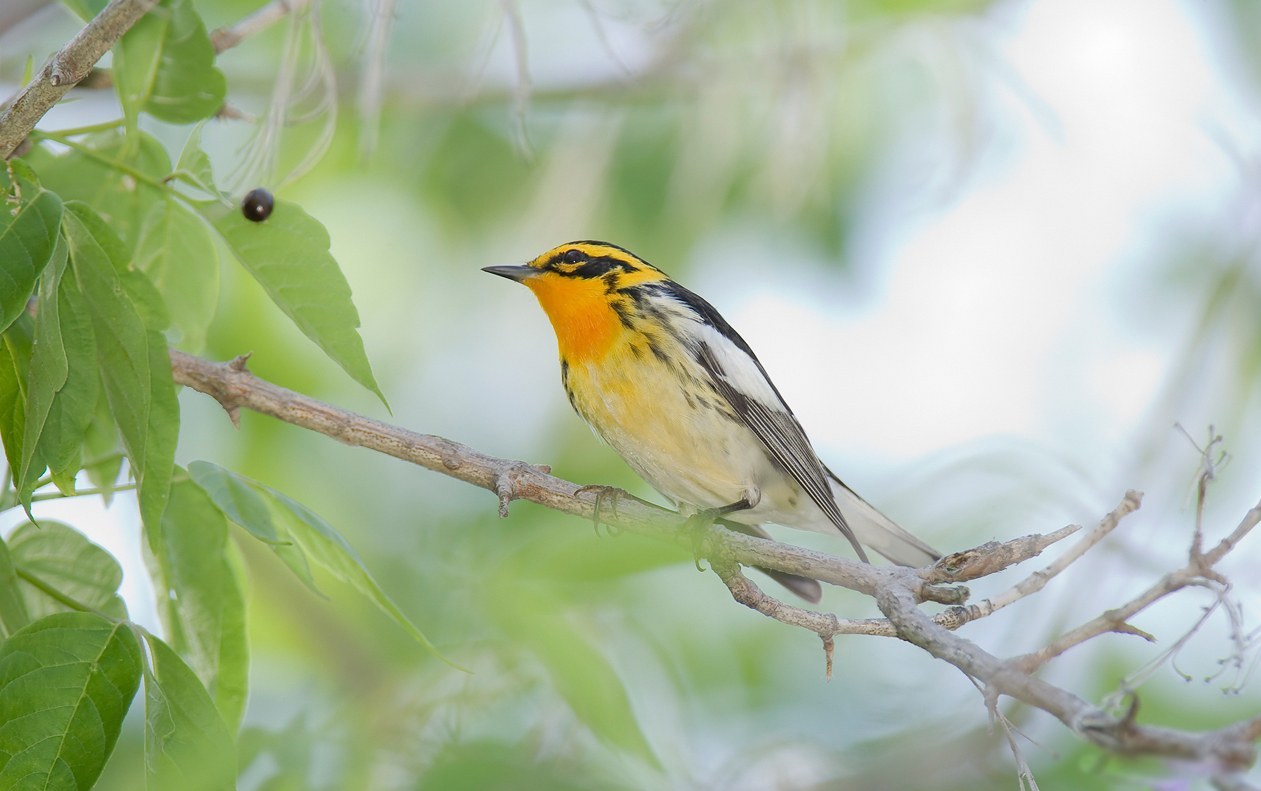
Key Field Marks
- Size & shape: A small, slim warbler (about 11–12 cm) with a thin, sharply pointed bill and a fairly short tail — typical active warbler proportions.
- Breeding male: Unmistakable fiery orange-flame throat and face, bordered by a black crown, black cheek (auricular) patch, and black upperparts streaked with white. Two white wing bars often merge into a bold white wing patch. Underparts are white with black streaking along the flanks.
- Female / nonbreeding / immature: Much duller — the fiery orange is replaced by a pale yellow-orange wash on the throat and face. Look for the same basic face pattern as the male: a dark triangular patch on the ear coverts set off by a pale supercilium (eyebrow) and pale submoustachial area, even though the colors are muted olive-yellow rather than black-and-orange.
- Upperparts: Olive-black with white streaking on the back in all plumages; pale wing bars are present year-round.
Separating It from Similar Species
- No other North American warbler shows true orange on the throat, so breeding males are essentially unmistakable.
- Dull fall/immature birds can be confused with Bay-breasted or Blackpoll Warblers in their drab fall plumages, but Blackburnian retains the distinctive dark triangular ear patch and pale face pattern that those species lack.
- Yellow-throated Warbler has a white (not yellow-orange) throat and a much bolder black-and-white face pattern with a solid black cheek, plus a longer bill.
Where & When to See It
- Breeding range: Mature coniferous and mixed forests (spruce, fir, hemlock) across southern Canada, the northeastern U.S., and south through the Appalachian Mountains at higher elevations. Forages and nests high in the canopy, making it a notoriously neck-craning bird to observe well.
- Winter range: Middle- and upper-elevation Andean forests of Colombia south to Peru and Bolivia, often joining mixed-species foraging flocks in the canopy.
- Migration: Passes through the eastern U.S. in spring (peak early-to-mid May) and fall (August–October); a classic "neck warbler" for migration counts.
Voice
- Song is a very high, thin, ascending series — often rendered as "seetseetseetseetseet-titi-tseeeee" — that climbs and ends on an extremely high note, sometimes near or above the upper limit of human hearing.
- Call note is a thin, high tsip, similar to other Setophaga warblers but easily lost in canopy noise.
Frequently asked questions
What is the easiest field mark for a Blackburnian Warbler?
The breeding male's blazing orange-flame throat and face bordered by black is diagnostic — no other North American warbler shows true orange there.
How do I identify a fall or female Blackburnian Warbler?
Look past the muted yellow-orange color to the face pattern: a dark triangular ear patch set against a pale eyebrow and pale submoustachial stripe, plus white wing bars and streaked upperparts.
Where do Blackburnian Warblers nest?
In mature coniferous or mixed forest, especially spruce, fir, and hemlock stands, across Canada, the northeastern U.S., and the Appalachians, typically foraging and nesting high in the canopy.
Why is the Blackburnian Warbler hard to see even when singing?
It forages and sings from the very top of tall conifers, and its song is extremely high-pitched, so it is often heard as a thin trickle of sound overhead before it is seen.