
Black Vulture Identification Guide
A stocky, short-tailed scavenger with a bare gray-black head and flashing whitish wingtip patches, distinguished from Turkey Vulture by its flatter wings and choppier flight.
Read the full Black Vulture encyclopedia entry →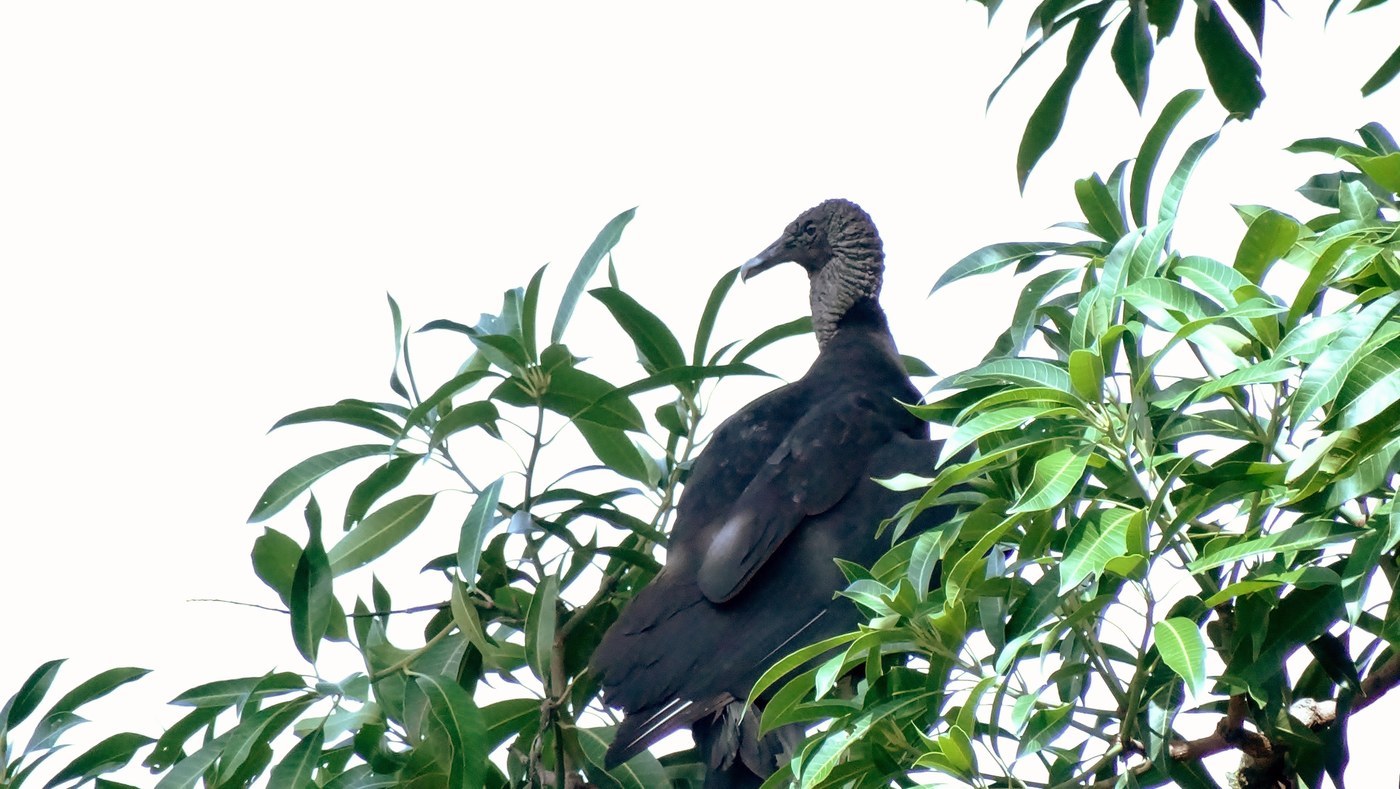
Key Field Marks
- Large, all-black scavenging bird with a bare, wrinkled, grayish-black head and neck (unfeathered, an adaptation for hygiene when feeding)
- Short, square-cut tail that barely extends beyond the trailing edge of the wings in flight
- Broad, fairly short wings compared to Turkey Vulture, with whitish patches near the wingtips (outer primaries) visible from below
- Flight style: several quick, choppy flaps followed by a short glide, with wings held flat or only slightly raised (not in a strong dihedral V)
- Legs often appear whitish due to habitual defecation on them, a distinctive behavior among New World vultures
Similar Species
- Turkey Vulture: longer tail extending well past the wings, a red (adult) or dark gray (juvenile) head, two-toned underwings with pale gray flight feathers along the entire trailing edge, and a distinctive wobbly flight held in a strong V-shaped dihedral with few flaps
- Zone-tailed Hawk: superficially similar dark, teetering flight, but has a feathered head, banded tail, and yellow legs
- California Condor: vastly larger, with white underwing linings and a longer, more rounded tail; range does not overlap with most Black Vulture populations
Habitat & Range
- Found in open country, farmland, forest edges, and increasingly urban and suburban areas near food sources such as roadkill and landfills
- Resident from the southeastern and south-central United States south through Mexico, Central America, and much of South America
- Highly social, often roosting and foraging in large communal groups
Seasonality
- Largely non-migratory (resident) throughout most of its range, though northern populations may shift southward in the coldest months
Voice
- Essentially voiceless in the usual sense, lacking a true vocal syrinx
- Produces low hisses, grunts, and snorting sounds, especially when threatened or interacting at carcasses
Frequently asked questions
What is the fastest way to tell Black Vulture from Turkey Vulture in flight?
Look at the tail and wing shape: Black Vulture has a short tail barely extending past the wings and flat wings with choppy flapping, while Turkey Vulture has a longer tail, holds its wings in a pronounced V, and rocks unsteadily while soaring with few flaps.
Why does Black Vulture have a bare head?
The unfeathered head is a hygienic adaptation shared by New World vultures, reducing bacterial buildup from feeding inside carcasses.
Do Black Vultures have a strong sense of smell like Turkey Vultures?
No — Black Vultures rely primarily on excellent eyesight and by watching the behavior of Turkey Vultures (which do have a strong sense of smell) to locate carrion.
Are Black Vultures found in cities?
Yes, they increasingly forage and roost around towns, farms, and landfills, and are often seen perched in large communal groups on buildings, towers, or dead trees.