
Black-throated Green Warbler Identification Guide
An olive-backed warbler of northern and Appalachian conifer forests, recognized by its bright yellow face and black throat and bib.
Read the full Black-throated Green Warbler encyclopedia entry →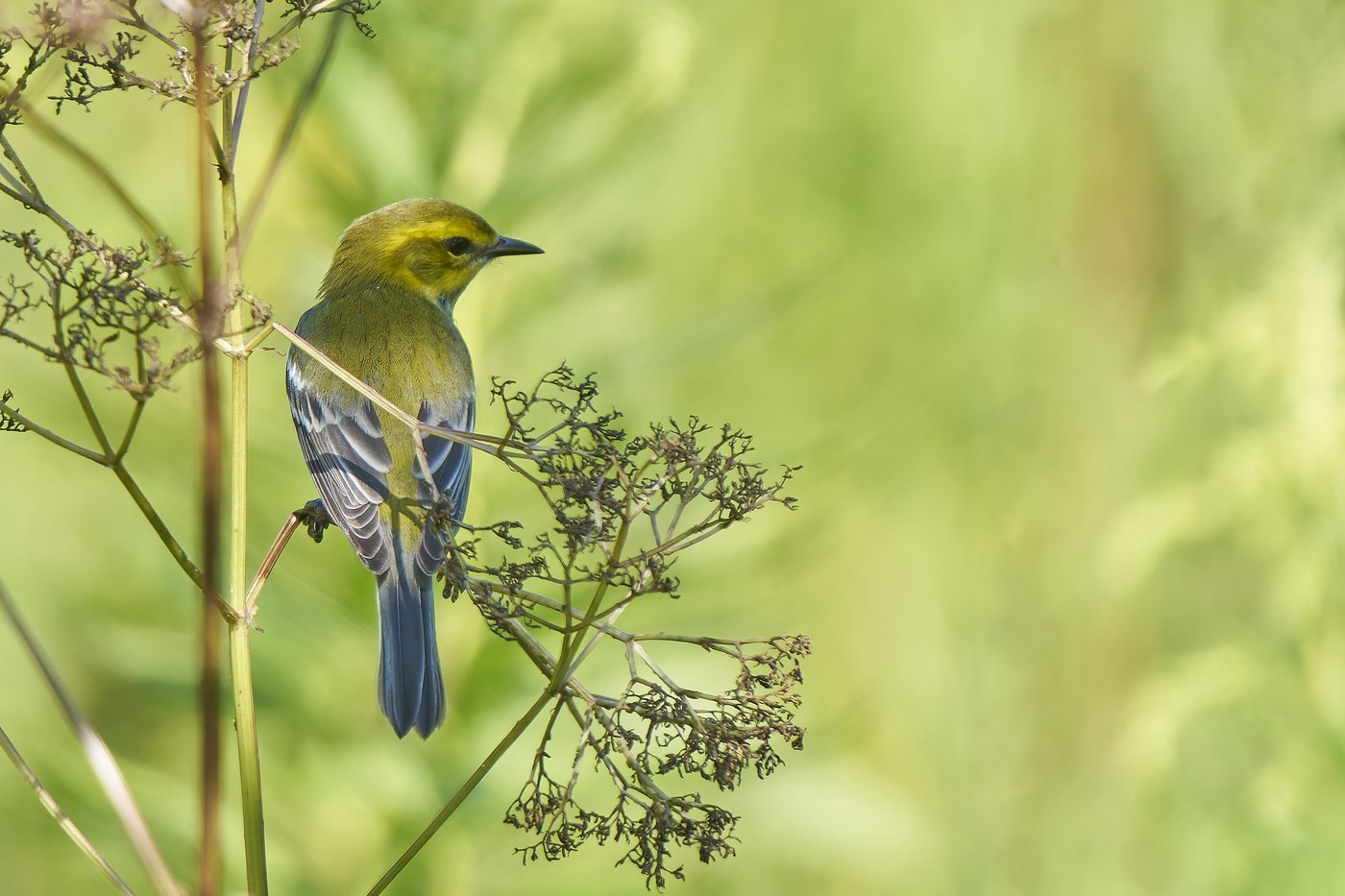
Key Field Marks
- Small warbler, about 12 cm, with olive-green crown and back and a bright yellow face crossed by a dusky olive eye-line and auricular smudge
- Male: extensive solid black throat and upper breast, with black streaking continuing down the flanks; white belly and undertail
- Female and immature: paler, more restricted black on the throat, sometimes reduced to a necklace of dark spotting, but the yellow face and olive back are retained
- Two white wing bars on blackish-olive wings
- White outer tail feathers visible in flight or when the tail is spread
Similar Species
- Golden-cheeked Warbler: has a solid black back (not olive-green) and a more sharply defined yellow face; range restricted to central Texas
- Hermit Warbler: paler gray back, whiter face, and black throat restricted mainly to breeding males; western range with little overlap
- Townsend's Warbler: darker face pattern with a black cap and cheek patch surrounding the yellow, plus yellow (not white) underparts; western range
- Black-throated Gray Warbler: gray, not olive, upperparts and a black-and-white (not yellow) face
Habitat & Range
- Breeds in coniferous and mixed forests, especially where hemlock, spruce, or fir are present, from the boreal forest of Canada south through the northeastern United States and the Appalachian Mountains
- Winters in shrubby second growth, forest edge, and shade coffee plantations in Mexico, Central America, and the Caribbean
Seasonality
- Present on breeding grounds from late spring through summer
- A common migrant through the eastern United States in spring and fall
Voice
- Buzzy song often rendered "zee-zee-zee-zoo-zee" or "trees, trees, murmuring trees," with a distinctive lazy, buzzy quality
- Call note is a flat "chip" similar to other wood-warblers
Frequently asked questions
How do you tell Black-throated Green Warbler from Golden-cheeked Warbler?
Black-throated Green has an olive-green back, while Golden-cheeked Warbler has a solid black back; Golden-cheeked also has a much more restricted range in central Texas.
Does the female Black-throated Green Warbler have a black throat too?
Females typically show reduced black on the throat, sometimes just a scattering of dark spots forming a partial necklace, but they retain the bright yellow face and olive back of the species.
What habitat should I look for this species in during the breeding season?
Mature coniferous or mixed forest, especially stands containing hemlock, spruce, or fir, across the northeastern US, Appalachians, and Canadian boreal forest.
Where does this warbler go in winter?
It winters from Mexico south through Central America and into parts of the Caribbean, often in second-growth woodland and shade-grown coffee farms.