
Black Tern Identification Guide
A small marsh tern that turns from sooty black in breeding plumage to white below with a dark cap and shoulder patch outside the breeding season.
Read the full Black Tern encyclopedia entry →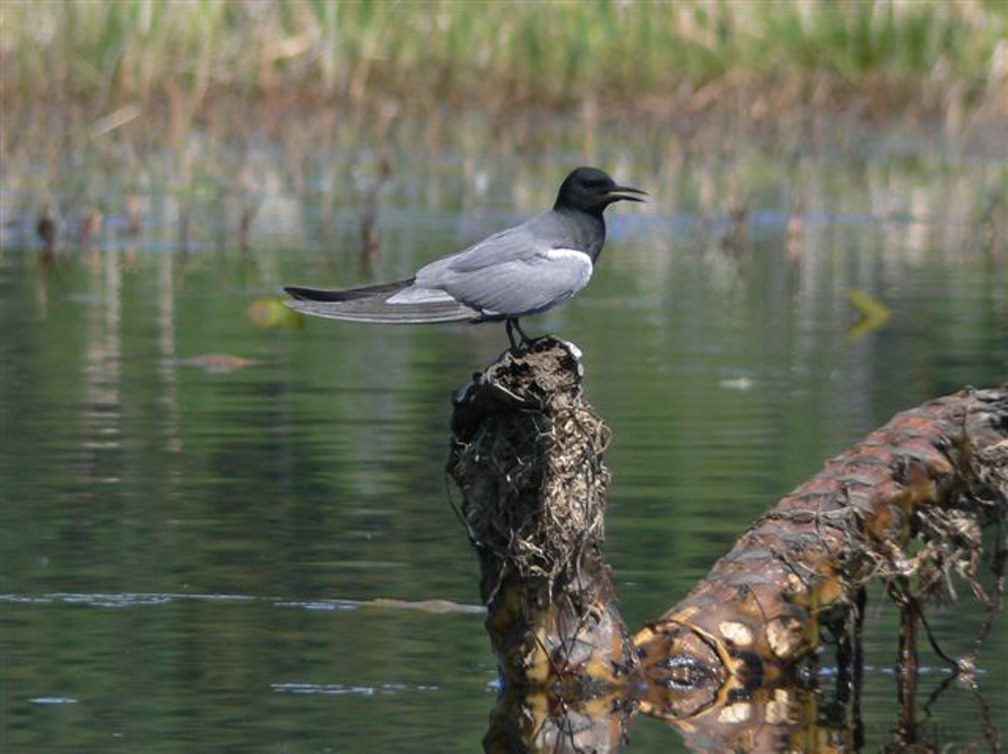
Key Field Marks
- Small, delicate tern, about 24 cm long, with buoyant, graceful flight and a short, only lightly forked tail
- Breeding adult: black head, neck, and underparts; contrasting pale gray wings, back, and tail; white undertail coverts
- Non-breeding and juvenile: white forehead and underparts, dark cap restricted to the crown and nape (not extending below the eye as much as in breeding plumage), gray upperparts, and a distinctive dark smudge on the side of the breast ("shoulder patch")
- Thin, mostly black bill and short reddish-black legs
- Feeds by dipping to the water surface or hawking insects in flight rather than plunge-diving like larger terns
Similar Species
- White-winged Tern: breeding adult shows white wing coverts contrasting with black underwing coverts ("black armpits"); Black Tern's underwings are more uniformly pale gray
- Common/Forster's Tern: much larger, longer-billed, pale overall even in breeding plumage, with deeply forked tails and orange or red bills
- Small size, short tail, and buoyant tern-over-water flight style help separate Black Tern from all larger white terns at a glance
Habitat & Range
- Breeds colonially in freshwater marshes, prairie potholes, and shallow wetlands with emergent vegetation
- On migration and in winter, occurs over coastal waters, bays, and sometimes far offshore
- Breeds across the northern United States and southern Canada, and separately across much of Europe and Asia
- North American breeders winter along the coasts of Central America and northern South America; Old World birds winter mainly in coastal and inland Africa
Seasonality
- Present on breeding wetlands from late spring through summer
- A conspicuous migrant in both spring and especially late summer/early autumn, when flocks move along coastlines and large lakes
Voice
- Short, sharp "kik" or "kreek" calls given in flight, less strident than the harsh calls of larger terns
- Generally quieter overall than Common or Forster's Terns
Frequently asked questions
How does breeding-plumage Black Tern differ from other terns?
It is the only small tern with an entirely black head and underparts paired with pale gray wings and tail — no other regularly occurring tern shows this combination.
How do I identify a non-breeding Black Tern?
Look for the dark cap limited to the crown/nape, white underparts, gray upperparts, and a small dark patch on the side of the breast near the bend of the wing.
Does Black Tern nest on beaches like other terns?
No, it nests on floating or emergent vegetation in freshwater marshes and wetlands rather than on open sand or gravel.
What is the difference between Black Tern and White-winged Tern?
In breeding plumage, White-winged Tern shows contrasting white wing coverts against black underwing coverts, while Black Tern's wings are more evenly pale gray above and below.