
Black-tailed Godwit Identification Guide
A tall, long-legged shorebird with a straight bicolored bill, best known in flight for its bold white wing stripe and black-and-white tail.
Read the full Black-tailed Godwit encyclopedia entry →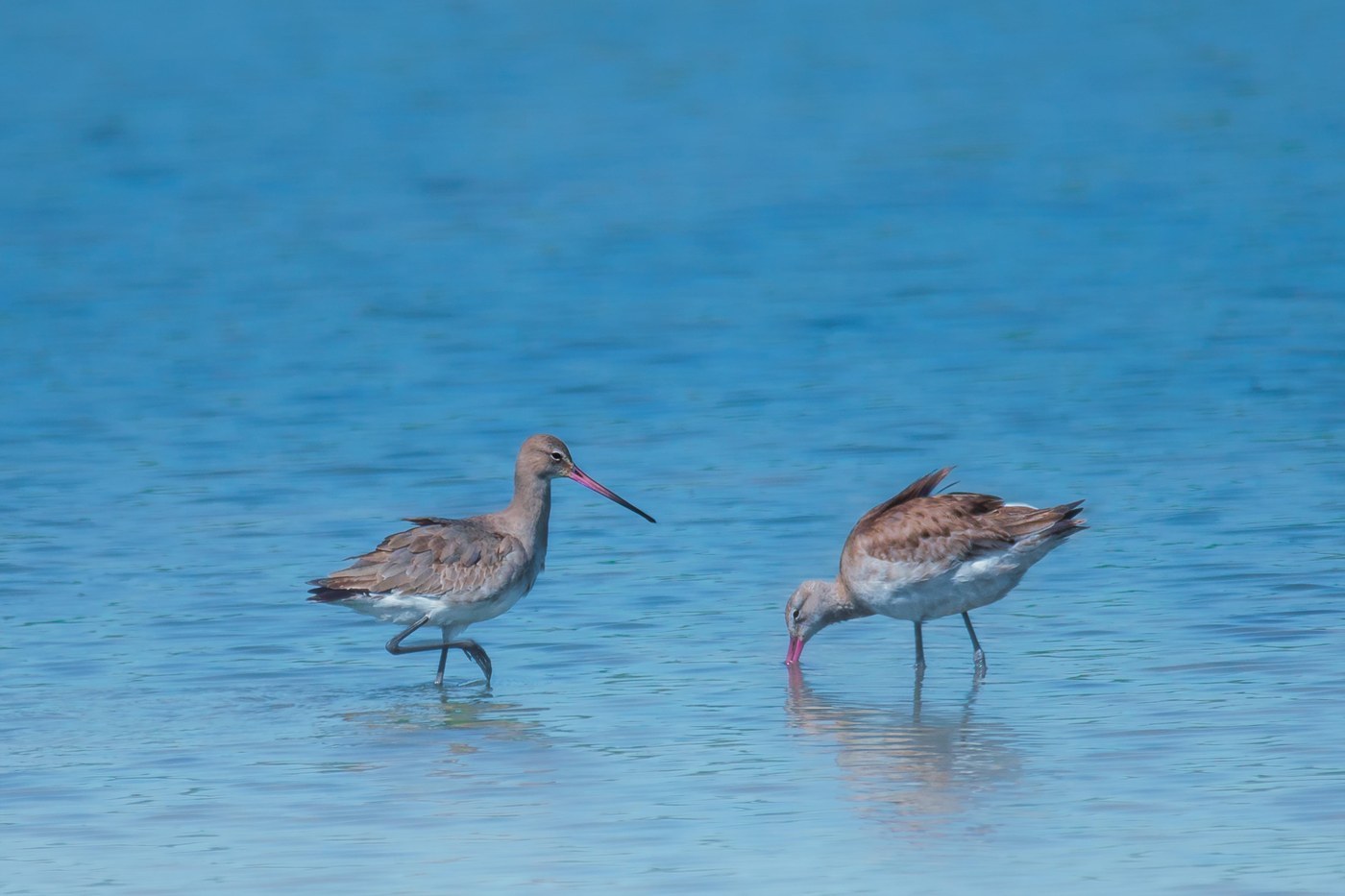
Key Field Marks
- Large, elegant shorebird, about 40 cm long, standing tall on long dark legs
- Long, straight bill, pink or orange-pink at the base and dark at the tip
- Breeding plumage: warm rufous-orange head, neck, and breast, with dark barring on the flanks and belly
- Non-breeding plumage: plain grayish-brown above and pale below, less distinctive without the flight pattern
- In flight, shows a bold white wing stripe running the length of the wing, a black tail band, and a white rump/uppertail base — the single most useful mark for the species
- Long legs trail well beyond the tail tip in flight
Similar Species
- Bar-tailed Godwit: tail is barred (not solidly black-tipped), lacks the bold white wing stripe, and has a subtly upturned bill
- Hudsonian Godwit: similar wing/tail pattern but shows dark (not white) underwing coverts and a narrower white wing stripe; largely a New World species
- Marbled Godwit: overall buffy-brown with no white wing stripe or black tail band, and a bicolored bill that is more strongly upturned
- Curlews: have obviously downcurved bills rather than straight ones
Habitat & Range
- Breeds on wet meadows, damp grasslands, and marshes across Iceland, northern and central Europe, and into parts of Asia
- On migration and in winter, favors mudflats, estuaries, flooded fields, and shallow freshwater or coastal wetlands
- Winters in western Europe, the Mediterranean basin, sub-Saharan Africa, and South and Southeast Asia depending on breeding population
Seasonality
- Present on breeding grounds from spring through mid-summer
- Passage migrant through much of Europe and Asia in spring and autumn; wintering birds present from autumn through early spring in milder regions
Voice
- On breeding territory gives a repeated, urgent "wicka-wicka-wicka" or "grutto grutto" call, the source of its Dutch name
- Flight and flock calls are sharper, shorter contact notes, less musical than the breeding song
Frequently asked questions
What is the single best mark to identify a Black-tailed Godwit in flight?
The broad white wing stripe combined with a black tail band and white rump/tail base — this combination is diagnostic among godwits.
How do you tell Black-tailed Godwit from Bar-tailed Godwit at rest?
Black-tailed Godwit has longer legs, a straighter bill, and a more evenly patterned body, while Bar-tailed Godwit has a shorter-legged, more compact look and a bill that curves slightly upward.
Do male and female Black-tailed Godwits look different?
Females are larger with longer bills and tend to show slightly less rufous in breeding plumage than males, but the difference is subtle in the field.
Where can Black-tailed Godwits be seen in winter?
Large numbers winter on estuaries and wetlands in western Europe (notably the UK, Netherlands, and Iberia), along the West African coast, and across parts of South and Southeast Asia.