
Black Swift Identification Guide
A large, sooty-black swift with long swept-back wings that nests behind waterfalls and forages high overhead in fast, erratic flight.
Read the full Black Swift encyclopedia entry →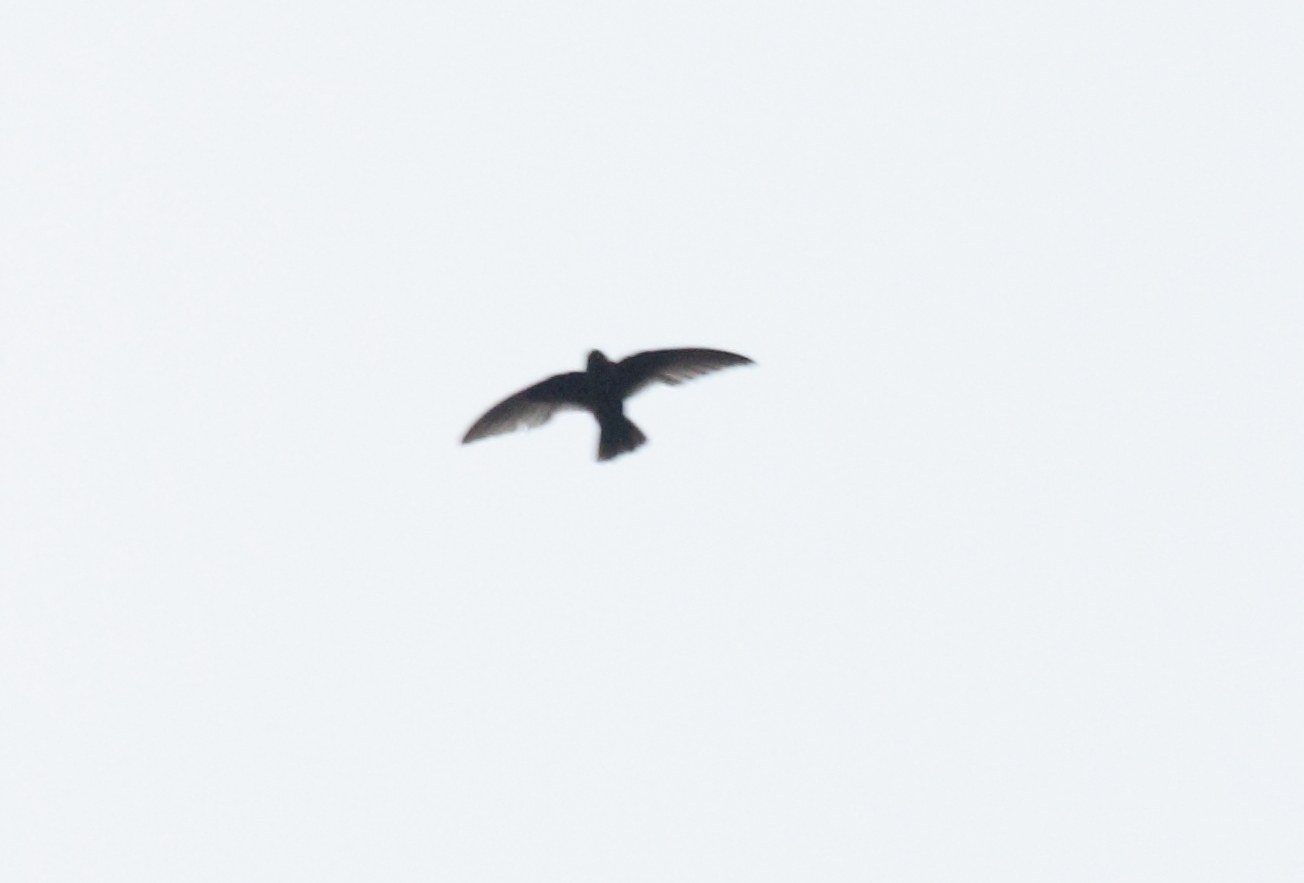
Key Field Marks
- Large swift for North America, about 18 cm long, with long, narrow, scythe-like wings
- Overall blackish-brown plumage; adult males can show a whitish or pale frosted forehead, though this is hard to see in the field
- Slightly forked tail, often held closed and pointed, sometimes fanned briefly in flight
- Flight is powerful and erratic, alternating rapid wingbeats with long glides, often at great height
- Appears entirely dark in flight with no obvious pale throat patch, unlike some other swifts
Similar Species
- Vaux's Swift: noticeably smaller, paler brownish-gray with a pale throat, more fluttery flight, and cigar-shaped body
- Chimney Swift: smaller and browner overall, with a stubbier, more compact silhouette (eastern range, little overlap)
- White-throated Swift: shows bold black-and-white patterning, unlike the uniformly dark Black Swift
- Overall large size, uniform blackish color, and long wings help separate Black Swift from all other regularly occurring swifts
Habitat & Range
- Breeds very locally at dramatic, hard-to-access sites: behind or near waterfalls, on sea cliffs, and in steep canyon walls, always near a source of spray or moisture
- Forages aerially over a wide area, sometimes far from the nest site, including over mountains, forests, and open country
- Breeds locally from Alaska and western Canada south through the western United States and into Mexico and Central America, with a resident population in the Caribbean
- Winters in South America, with the wintering grounds only fully confirmed in recent decades (western Amazon basin)
Seasonality
- Present at North American breeding sites from late spring through early autumn
- Undertakes a long migration to and from South America, arriving on breeding grounds later than most other swifts
Voice
- Gives high, thin, chippering or twittering notes, often in a rapid series
- Calls are typically given in flight and are less frequently heard than the chattering of Chimney or Vaux's Swifts
Frequently asked questions
What is the easiest way to tell Black Swift from Vaux's Swift?
Size and flight style: Black Swift is noticeably larger and darker with longer wings and a more powerful, gliding flight, while Vaux's Swift is small, pale-throated, and flutters more continuously.
Where do Black Swifts nest?
They nest on damp cliff ledges, almost always behind or beside waterfalls or on sea cliffs exposed to spray, sites that are usually inaccessible to predators and people.
Can you identify a Black Swift by its throat color?
Not reliably — unlike some swifts, Black Swift lacks an obvious pale throat patch and appears essentially uniformly dark at any distance.
When and where do Black Swifts winter?
They migrate to South America, primarily the western Amazon basin in Brazil, a wintering range only conclusively tracked in recent research.