
Black Swan Identification Guide
A large all-black waterfowl with a curved neck and red bill, native to Australia and easily told from other swans by its sooty plumage.
Read the full Black Swan encyclopedia entry →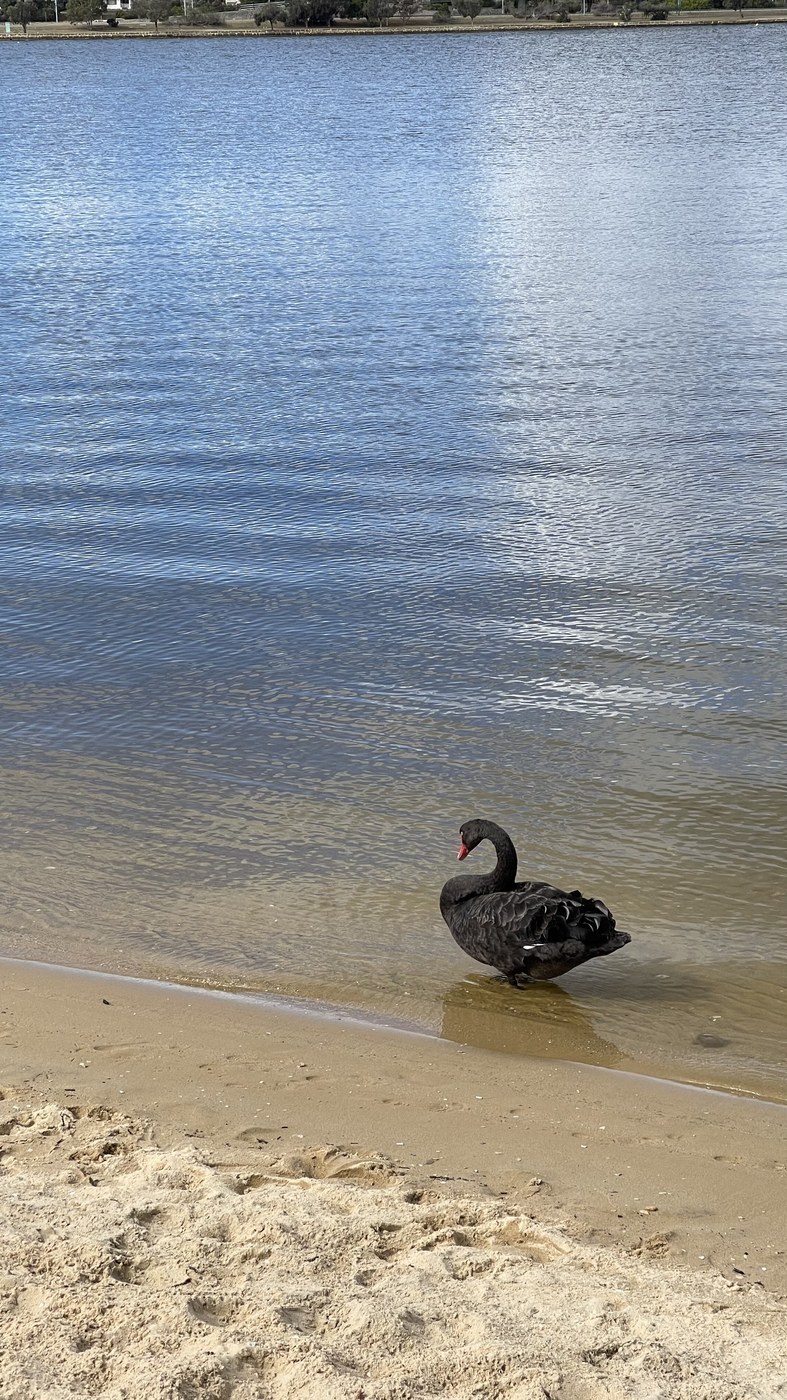
Key Field Marks
- Very large waterbird, 110-140 cm long with a wingspan up to 2 meters
- Entirely sooty-black to dark brownish-black body plumage
- Long, gracefully curved neck, often held in an S-shape while swimming
- Bright red bill crossed by a narrow white or pale band near the tip
- Black legs and feet
- In flight, the white flight feathers (primaries and secondaries) contrast sharply with the black body and coverts — a mark not visible on the water
- Sexes look alike, though males average slightly larger
Similar Species
- Mute Swan: entirely white with an orange bill and black knob at the base; unmistakable when compared side by side
- Trumpeter and Tundra Swans: also white-bodied with black bills; no overlap in plumage color with Black Swan
- Cormorants and geese: smaller-bodied, shorter and straighter necks, and lack the swan's heavy build and curved neck profile
- No other swan species is black-bodied, so confusion is unlikely once size and shape register
Habitat & Range
- Native to Australia, where it is common on lakes, reservoirs, slow rivers, estuaries, and coastal lagoons
- Introduced and established as feral populations in New Zealand
- Escaped or introduced individuals and small feral flocks occur in parts of Europe, the United Kingdom, and North America, usually associated with parks, ponds, and wildfowl collections
- Favors open water with fringing vegetation and grassy margins for grazing
Seasonality
- Largely sedentary in Australia but shows nomadic movements tied to water levels and food availability, sometimes forming large non-breeding flocks of hundreds to thousands of birds
- Breeding can occur at almost any time of year depending on local rainfall, though it peaks after wet periods
Voice
- A musical, far-carrying bugled or trumpeting note, softer and more musical than the honks of true geese
- Also gives soft crooning and gentle hooting notes between paired birds
- Flocks in flight give a bugling chorus audible from a long distance
Frequently asked questions
Are Black Swans native to the same places as white swans?
No. Black Swans are native to Australia, while the familiar white Mute, Trumpeter, and Tundra Swans are native to Eurasia and North America. Any black swan seen outside Australia or New Zealand is typically an escapee or part of an introduced population.
How can you tell a Black Swan from a dark-morph goose?
Black Swans are much larger and heavier-bodied than any goose, with a long curved neck and a bright red bill with a pale band — geese have shorter necks and duller bills.
Do Black Swans show any white plumage?
Yes — the flight feathers are white, visible mainly when the wings are spread in flight or during wing-stretching displays, contrasting with the otherwise black body.
Where is the best place to see wild Black Swans?
Large lakes, wetlands, and estuaries across southern and eastern Australia hold the biggest populations, though they can be found on suitable waters continent-wide.