
Black Stork Identification Guide
A shy, forest-loving stork of Europe and Asia with glossy black upperparts, a white belly, and a bright red bill and legs — the color-reverse of the familiar White Stork.
Read the full Black Stork encyclopedia entry →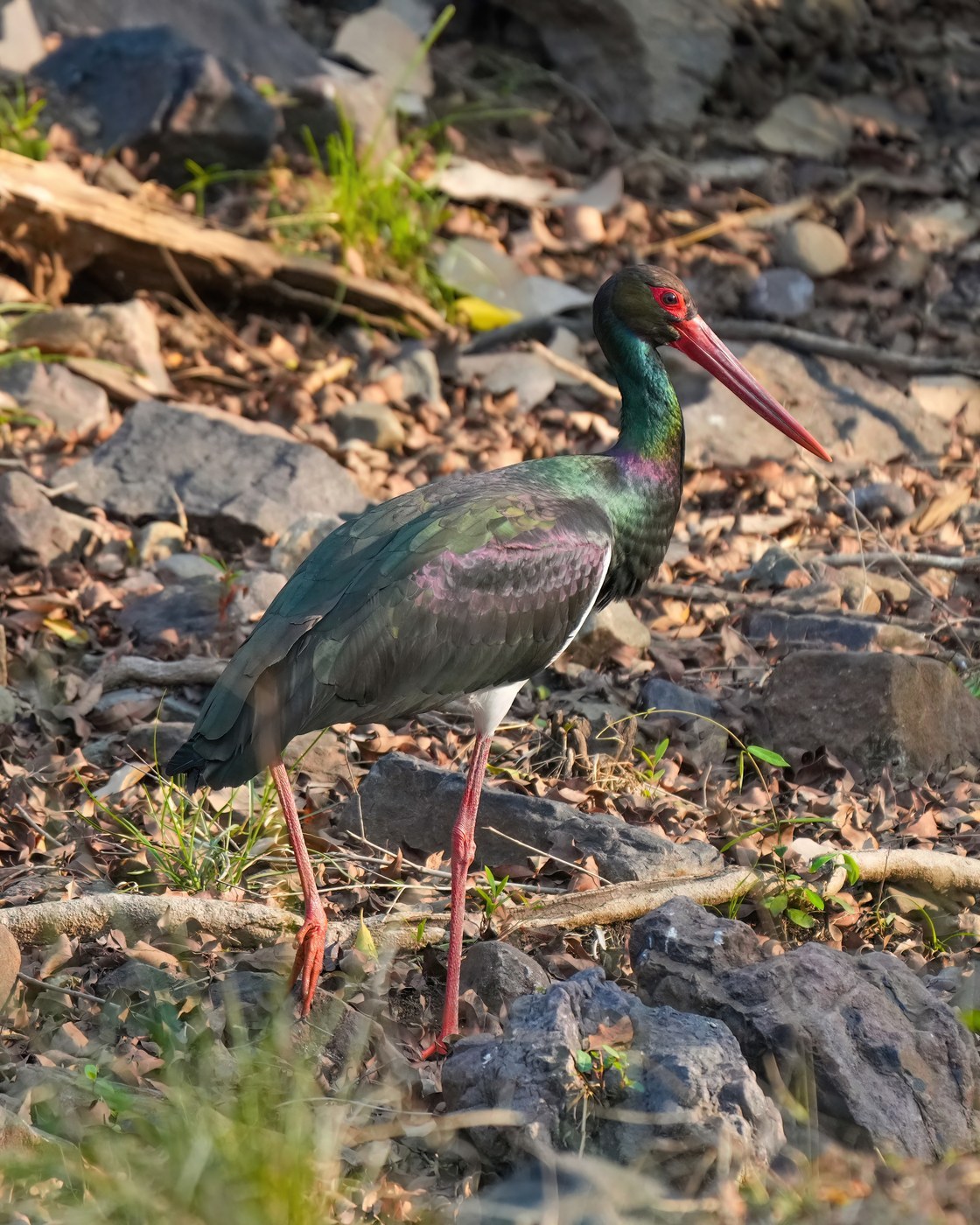
Key Field Marks
- Large stork with glossy black head, neck, and upperparts showing an iridescent green-purple sheen in good light, contrasting sharply with a clean white belly and white underwing coverts.
- Bill and legs are both bright red, standing out boldly against the black-and-white plumage.
- In flight, the white belly and underwing coverts contrast with black flight feathers and a black leading edge, visible from below.
- Juveniles are duller, with brownish-black upperparts, a greenish-gray (not red) bill and legs, maturing to full adult coloration over a couple of years.
Behavior
- Notably shy and wary of humans, unlike the closely related White Stork, and generally avoids nesting near human settlements.
- Nests in large stick nests placed in tall trees within undisturbed forest, or occasionally on cliff ledges, usually near rivers, marshes, or other wetlands.
- Feeds by wading in shallow water for fish, amphibians, and aquatic invertebrates, typically foraging alone or in pairs rather than in large groups.
Separating from Similar Species
- White Stork: essentially the reverse pattern — mostly white body with black flight feathers, red bill and legs, and famously tolerant of humans, often nesting on rooftops and poles in villages, unlike the shy, forest-dwelling Black Stork.
- No other stork within its range combines a glossy black body, white belly, and bright red bill and legs, making adults straightforward to identify once seen well.
- Told from large dark herons (which can show superficially similar dark plumage) by its much larger size, straight heavy bill, and stork flight style (neck extended, not tucked in like a heron).
Habitat & Range
- Breeds across temperate Europe and Asia, favoring large tracts of undisturbed forest near rivers, marshes, and floodplains, with strongholds in eastern Europe and parts of Asia.
- A long-distance migrant; European and central Asian populations winter mainly in sub-Saharan Africa, while some Asian populations winter in South Asia.
- Much more secretive and difficult to observe at the nest than White Stork, reflecting its preference for remote, undisturbed habitat.
Voice
- Generally silent away from the nest; gives occasional hissing notes and loud bill-clattering displays during courtship and at the nest, similar to other storks.
Frequently asked questions
How does the Black Stork differ from the White Stork?
Black Stork has the reverse color pattern of White Stork — glossy black body with a white belly, versus White Stork's mostly white body with black flight feathers — and Black Stork is shy and forest-dwelling while White Stork readily nests near people.
Where does the Black Stork breed?
In large tracts of undisturbed forest near rivers, marshes, and floodplains across temperate Europe and Asia, with major strongholds in eastern Europe.
Why is the Black Stork hard to observe?
It is notably shy and wary of humans, nesting deep in remote forest away from settlements, unlike the much more visible and tolerant White Stork.
Does the Black Stork migrate?
Yes, it is a long-distance migrant; most European and central Asian breeders winter in sub-Saharan Africa, while some Asian populations winter in South Asia.