
Black Skimmer Identification Guide
A coastal waterbird with a unique bill whose lower mandible is longer than the upper, used to skim the water surface for fish in low, graceful flight.
Read the full Black Skimmer encyclopedia entry →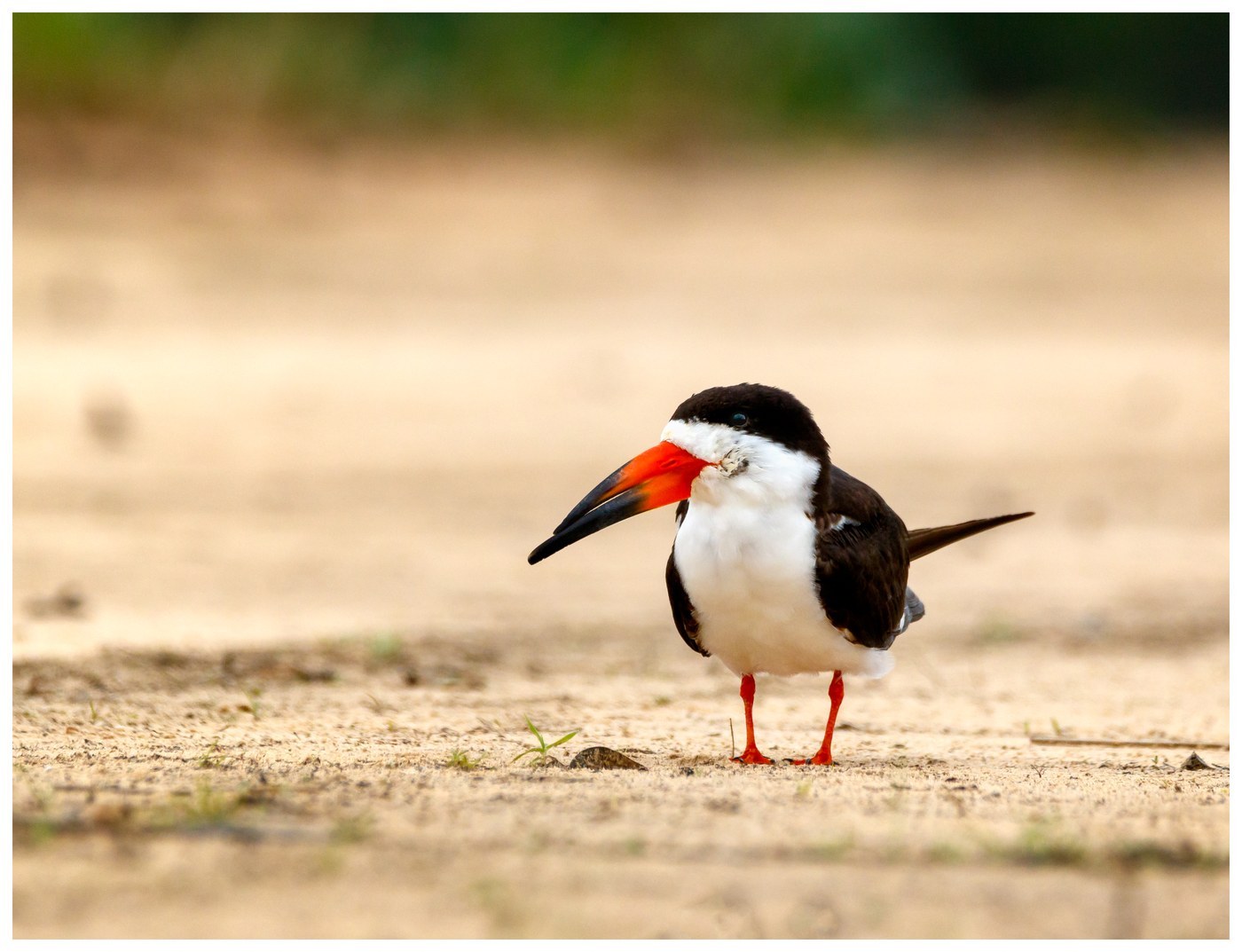
Key Field Marks
- Bill is the defining feature: long, laterally flattened (blade-like), bright orange-red with a black tip, and — uniquely among American birds — the lower mandible is distinctly longer than the upper.
- Upperparts black, forehead and underparts white, giving a bold, high-contrast appearance similar to some terns at rest.
- Legs are short and orange-red; overall build is long-winged and somewhat tern-like but stockier and longer-billed.
- Juveniles show scaly, mottled brown-and-buff upperparts and a shorter, less developed bill overshoot than adults.
Behavior
- Feeds by flying low and fast just above the water surface with the elongated lower mandible slicing through the water, snapping the bill shut the instant it contacts a fish — a foraging method unique among American birds.
- Often forages at dusk, dawn, or even at night, relying on touch rather than sight to detect prey, which lets it feed effectively in dim light.
- Nests colonially in shallow scrapes on open sandy beaches, sandbars, and shell islands, often alongside terns.
Separating from Similar Species
- No other American bird shares the skimmer's uneven, blade-shaped bill, making adults essentially unmistakable once the bill is seen.
- In flight, the low, skimming foraging style over water — bill dipped into the surface while flying — is itself diagnostic and unlike the plunge-diving or surface-dipping behavior of terns.
- Juveniles lacking the full bill overshoot can suggest a tern at a glance, but the stockier build, orange-based bill, and typically scaly juvenile plumage help confirm the identification.
Habitat & Range
- Found along coastal beaches, sandbars, estuaries, and lagoons of the Americas, from the mid-Atlantic and Gulf Coast of the United States south through Central America and much of South America.
- Breeds colonially on open sand or shell beaches and islands with little vegetation, habitat that is increasingly limited by coastal development and disturbance.
- Northern populations migrate south for winter; populations in warmer regions are largely resident.
Voice
- Gives a distinctive low, barking "kaup kaup" or "kow kow" call, often heard from foraging or flying birds, especially around dusk.
Frequently asked questions
What makes the Black Skimmer's bill unusual?
The lower mandible is distinctly longer than the upper — a feature unique among American birds — which lets the bird slice through the water surface in flight to detect and catch fish by touch.
When is the best time to see a Black Skimmer foraging?
They often forage at dawn, dusk, or even at night, since they locate prey by touch rather than sight, allowing effective feeding in low light.
How do I tell a juvenile Black Skimmer from a tern?
Juvenile skimmers have scaly brown-and-buff upperparts, a stockier build, and an orange-based bill that has not yet developed the full lower-mandible overshoot of adults, distinguishing them from young terns.
Where does the Black Skimmer breed?
On open sandy beaches, sandbars, and shell islands along the coasts of the Americas, from the US mid-Atlantic and Gulf Coast south through Central and South America.