
Black Rosy-Finch Identification Guide
A dark, high-alpine finch of the western Great Basin mountains, showing a gray crown patch and rosy-pink wash on the wings, rump, and belly.
Read the full Black Rosy-Finch encyclopedia entry →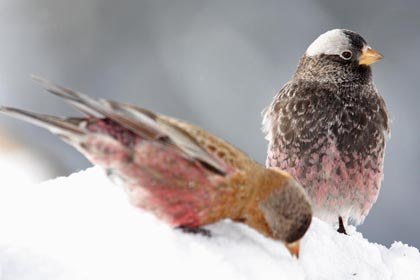
Key Field Marks
- Small finch with overall blackish-brown body plumage, a distinctive gray patch across the crown and nape, and a rose-pink wash on the wings, rump, and belly.
- Bill is small and conical, black in breeding adults and yellow in nonbreeding/winter birds — a useful seasonal clue.
- Overall the darkest of the three North American rosy-finch species, appearing notably blacker than the browner Gray-crowned Rosy-Finch.
- Sexes are similar, though females tend to show slightly less extensive or vivid pink than males.
Behavior
- Highly gregarious, especially outside the breeding season, when it forms large mixed flocks with other rosy-finch species at lower elevations.
- Breeds at very high elevation on cliffs, talus slopes, and rocky ledges above treeline, nesting in rock crevices.
- Forages on the ground, often along the edges of late-season snowfields, picking up wind-blown insects and seeds that accumulate there — a foraging strategy shared by all rosy-finches.
Separating from Similar Species
- Gray-crowned Rosy-Finch: browner and warmer-toned overall (rather than blackish), with a more extensive grayish head patch; ranges overlap in parts of the interior West and mixed winter flocks are common, requiring careful comparison.
- Brown-capped Rosy-Finch: lacks a defined gray crown/nape patch (or shows only a very limited one), is warmer brown overall, and occurs farther south in the central Rockies (mainly Colorado), with limited range overlap.
- The combination of blackish body tone and a well-defined gray crown patch is diagnostic for Black Rosy-Finch where the three species might otherwise overlap.
Habitat & Range
- Breeds at very high elevations in a limited part of the western Great Basin ranges, including mountains in Wyoming, Utah, Nevada, Idaho, and Montana, on alpine cliffs, talus, and snowfields above treeline.
- Descends to lower elevations in winter, often forming mixed flocks with other rosy-finches at feeders, rocky outcrops, and open ground near mountain towns.
- One of the least accessible breeding birds in North America due to its remote, high-altitude nesting habitat.
Voice
- Gives high, sharp chirping calls, often in flight, similar to calls of other rosy-finches; not known for an elaborate song.
Frequently asked questions
How do I tell Black Rosy-Finch from Gray-crowned Rosy-Finch?
Black Rosy-Finch is darker and blacker overall with a more clearly defined gray crown patch, while Gray-crowned Rosy-Finch is browner and warmer-toned; the two can occur together in winter flocks, so careful comparison is needed.
Where does the Black Rosy-Finch breed?
At very high elevations above treeline in a limited number of Great Basin mountain ranges in Wyoming, Utah, Nevada, Idaho, and Montana, on cliffs and talus slopes.
Why do rosy-finches gather on snowfields?
Wind-blown insects and seeds accumulate on the surface of late-season snowfields, and rosy-finches forage there for this concentrated food source.
Does the Black Rosy-Finch's bill color change through the year?
Yes, the bill is black during the breeding season and turns yellow in nonbreeding/winter birds.