
Black Phoebe Identification Guide
A sooty-black, white-bellied flycatcher of western streams and ponds, easily recognized by its habit of constantly pumping its tail while perched.
Read the full Black Phoebe encyclopedia entry →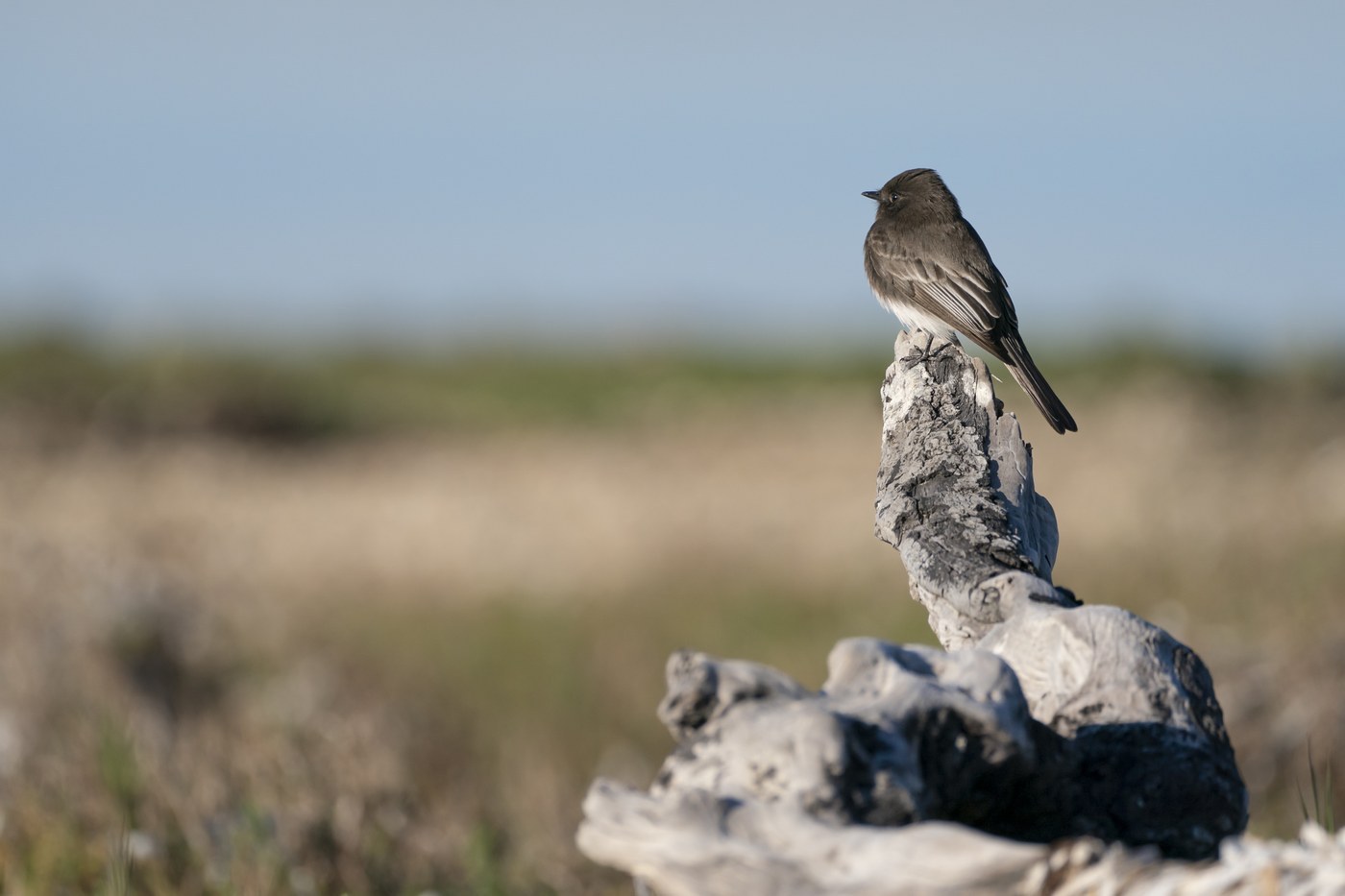
Key Field Marks
- Small flycatcher with sooty-black head, chest, and upperparts sharply contrasting a clean white belly and undertail coverts.
- Tail is black with white outer edges, most visible when fanned or in flight; the bird frequently pumps and wags its tail up and down while perched.
- Bill is small, thin, and black, typical of a flycatcher; overall shape is compact with an upright posture on exposed perches.
- Juveniles show cinnamon-buff wingbars and edging, distinguishing them from the plainer adult plumage.
Behavior
- Almost always found near water, perching on low branches, fence posts, rocks, or structures near streams, ponds, and ditches, sallying out to catch flying insects and returning to the same perch.
- Builds a cup nest of mud and plant material, often plastered to the underside of bridges, culverts, eaves, or other structures near water, and readily uses artificial sites.
- Constant tail-pumping while perched is a strong behavioral clue, shared with other phoebes.
Separating from Similar Species
- Eastern Phoebe: grayish-brown rather than black above, without the sharp black-and-white contrast of Black Phoebe, and found mainly in the eastern half of North America with limited range overlap.
- Say's Phoebe: pale grayish-brown above with a cinnamon-orange belly, quite different from Black Phoebe's white belly and black chest.
- Dark-eyed Juncos and other small dark birds lack the flycatcher's upright perching posture, thin bill, and constant tail-pumping, and are not tied to water the way Black Phoebe is.
Habitat & Range
- Resident from the western United States (California, Arizona, New Mexico, Texas) south through Mexico and Central America into much of South America.
- Closely tied to water: found along streams, rivers, ponds, lakes, canals, and even suburban yards with fountains or pools, especially where bridges or eaves provide nest sites.
- Largely non-migratory, holding territories year-round in most of its range.
Voice
- Call is a thin, sharp "tsip." Song is a repeated, slightly rising-then-falling "pee-wee, pee-weet" phrase, often given from a favored perch near water.
Frequently asked questions
What is the easiest way to recognize a Black Phoebe?
Look for a sooty-black head and chest sharply contrasting a white belly, combined with the habit of constantly pumping its tail while perched near water.
How do I tell Black Phoebe from Eastern Phoebe?
Black Phoebe is sharply black above with a white belly, while Eastern Phoebe is grayish-brown above without that strong black-and-white contrast, and the two species have largely separate ranges.
Why is the Black Phoebe almost always near water?
It forages for flying insects over streams, ponds, and similar wet habitats and builds its mud nest on structures like bridges and culverts near water.
Does the Black Phoebe migrate?
Most populations are non-migratory, holding the same territory near water throughout the year.