
Black Oystercatcher Identification Guide
An entirely sooty-black shorebird of Pacific rocky shorelines, unmistakable thanks to its long orange-red bill and pale yellow eye.
Read the full Black Oystercatcher encyclopedia entry →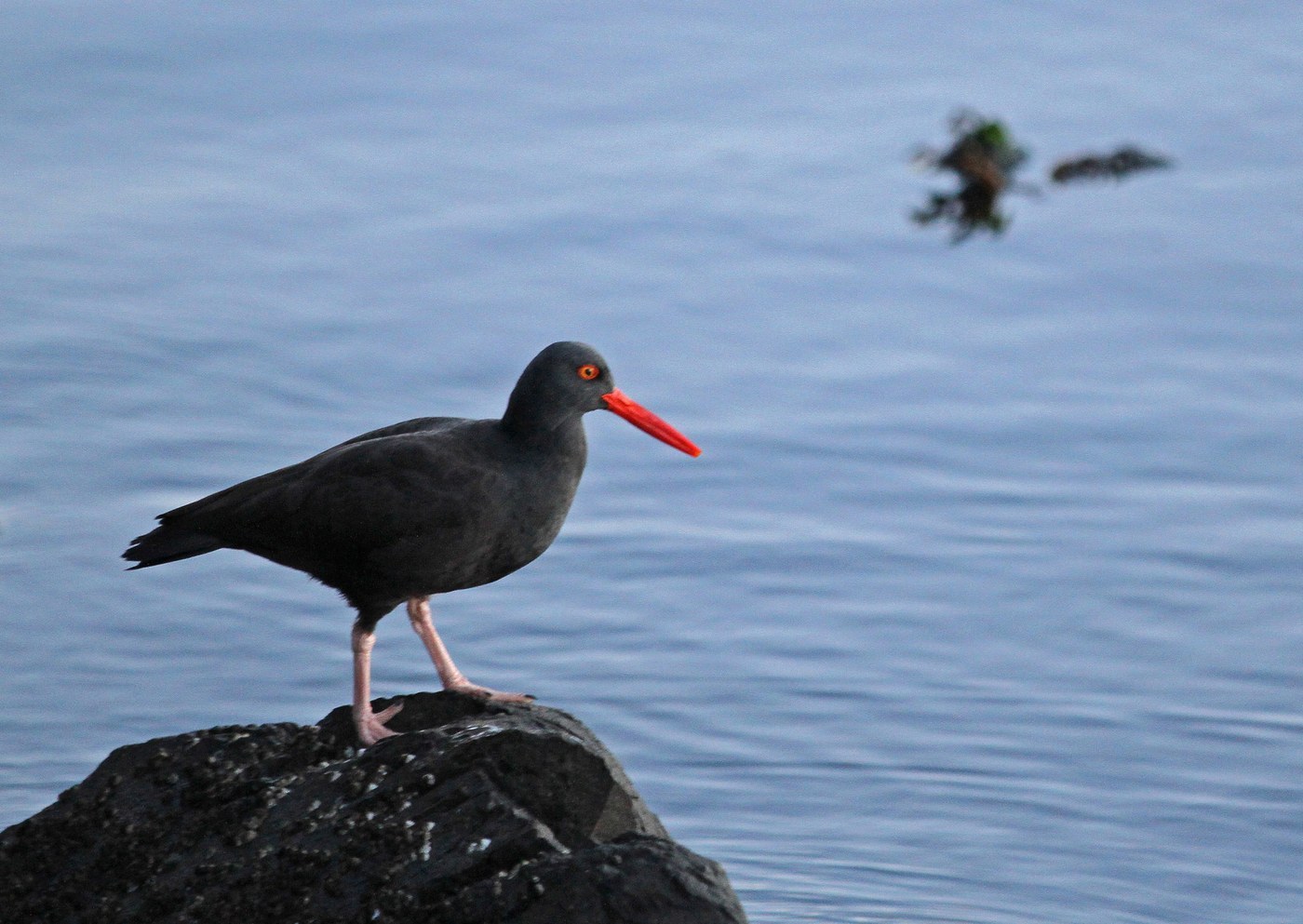
Key Field Marks
- Large, stocky shorebird with entirely sooty-black to dark brownish-black plumage over the whole body — no white anywhere, unlike its close relative the American Oystercatcher.
- Bill is long, straight, and bright orange-red, used to pry and hammer open mussels, limpets, and other shellfish.
- Eye is pale yellow, surrounded by a narrow orange-red eye-ring, standing out against the dark plumage and stout head.
- Legs are dull pink, and the build is heavy-bodied and long-billed compared to most other shorebirds sharing its habitat.
Behavior
- Almost exclusively found on rocky shorelines, rarely straying onto sandy beaches, feeding by prying loose and hammering open mussels, limpets, and chitons at low tide.
- Highly territorial, defending rocky feeding and nesting areas with loud piercing calls and aggressive chases.
- Pairs are typically monogamous and often stay on the same territory year-round, as the species is largely non-migratory.
Separating from Similar Species
- American Oystercatcher: shows a white belly and underparts contrasting with a black head/upper body, unlike the entirely black plumage of Black Oystercatcher.
- Where the two species' ranges meet in Baja California, occasional hybrids show intermediate white markings on an otherwise mostly dark body.
- No other North American shorebird combines an entirely black body with a long orange-red bill, making identification straightforward once seen well.
Habitat & Range
- Resident along the rocky Pacific coast of North America, from the Aleutian Islands of Alaska south through British Columbia, Washington, Oregon, and California to Baja California.
- Restricted almost entirely to rocky intertidal shorelines, jetties, and offshore rocky islets — rarely found on sand or mud unless adjacent to rocky habitat.
- Non-migratory, with pairs generally holding the same territory throughout the year.
Voice
- Gives loud, sharp, piercing "wheep" or "kleep" calls, often repeated in a fast, excited series during territorial disputes or when disturbed.
Frequently asked questions
How do I tell a Black Oystercatcher from an American Oystercatcher?
Black Oystercatcher is entirely sooty-black with no white on the body, while American Oystercatcher has a white belly and underparts contrasting with its black head and upperparts.
What habitat does the Black Oystercatcher prefer?
It is almost always found on rocky shorelines, jetties, and rocky islets along the Pacific coast, rarely straying onto sandy beaches.
Does the Black Oystercatcher migrate?
No, it is largely non-migratory, with pairs typically holding the same rocky coastal territory throughout the year.
What does a Black Oystercatcher eat?
It feeds mainly on mussels, limpets, chitons, and other shellfish and invertebrates found in the rocky intertidal zone, prying and hammering them open with its strong bill.