
Black-necked Stork Identification Guide
A huge, striking stork of South Asian and Australian wetlands with a glossy black-and-white body, massive black bill, and long red legs.
Read the full Black-necked Stork encyclopedia entry →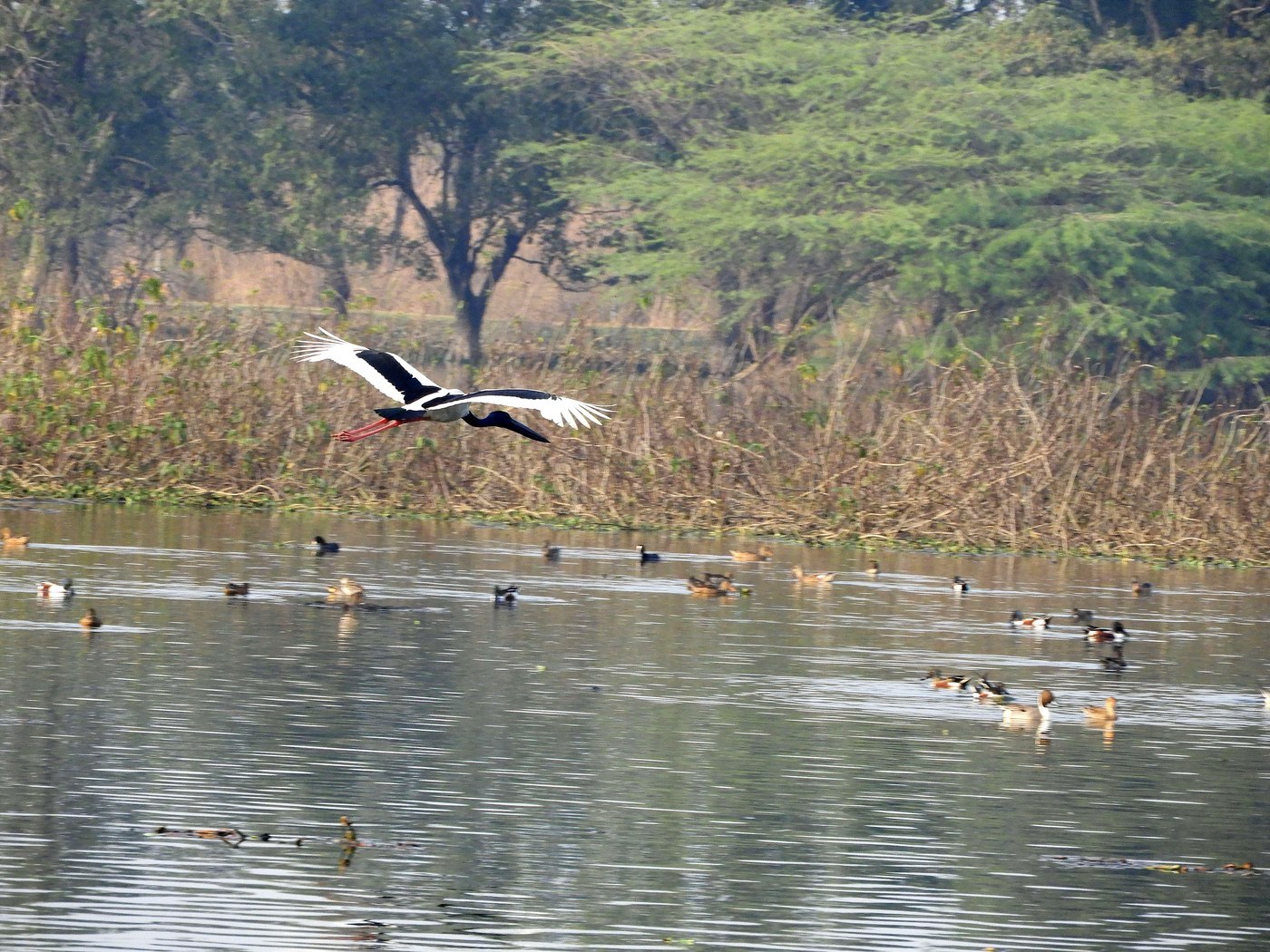
Key Field Marks
- Very large stork, standing about 130-150 cm (4.3-5 feet) tall, with a glossy black head, neck, and wings showing iridescent green-purple sheen in good light, contrasting with a white body and inner wing.
- Bill is massive, straight to very slightly upturned, and entirely black — one of the largest bills of any stork.
- Legs are long and bright coral-pink to red, adding to the bird's striking, tall silhouette.
- Sexes can be told apart at close range by eye color: males have a dark brown eye, while females have a bright yellow eye.
Behavior
- Typically seen singly or in pairs rather than in flocks, wading slowly through shallow water while hunting fish, frogs, reptiles, and large invertebrates.
- Builds a large stick nest high in a tree near wetlands, used by the same pair over multiple years.
- Largely silent, communicating mainly through loud bill-clattering displays at the nest rather than vocal calls.
Separating from Similar Species
- Painted Stork: has a white (not black) neck, pink tertial plumes, and a yellow, downcurved bill, quite different from the black-necked, black-billed Black-necked Stork.
- Saddle-billed Stork (Africa, no range overlap): shows a similar black-and-white body but has a boldly patterned red, black, and yellow bill with a yellow frontal "saddle," unlike the uniformly black bill of Black-necked Stork.
- Size, the solid black bill, and the black head/neck against a white body are diagnostic within its range.
Habitat & Range
- Found in South Asia (India, Nepal, Sri Lanka, and parts of Southeast Asia) and, as a distinct population, across northern and eastern Australia, where it is often called "Jabiru" (though the true Jabiru is an unrelated South American stork).
- Inhabits freshwater wetlands, flood plains, rivers, marshes, and wet grasslands, generally avoiding densely forested areas.
- Non-migratory, holding large territories around wetlands year-round.
Voice
- Mostly silent away from the nest; communicates chiefly through loud, rattling bill-clattering displays rather than calls.
Frequently asked questions
How can I tell a male from a female Black-necked Stork?
Males have a dark brown eye while females have a bright yellow eye; otherwise the sexes look alike.
Is the Australian 'Jabiru' the same bird as the South American Jabiru?
No, the Australian bird nicknamed Jabiru is actually the Black-necked Stork; the true Jabiru is a separate, unrelated stork species found in the Americas.
How do I separate Black-necked Stork from Painted Stork?
Black-necked Stork has a black head and neck with an all-black bill, while Painted Stork has a white neck, pink plume feathers, and a yellow downcurved bill.
Where does the Black-necked Stork live?
In wetlands, flood plains, and rivers across South Asia and Southeast Asia, plus a separate population across northern and eastern Australia.