
Black-legged Kittiwake Identification Guide
A small, pelagic gull with a clean white head, solid black 'dipped-in-ink' wingtips, and short black legs, rarely seen far from open ocean.
Read the full Black-legged Kittiwake encyclopedia entry →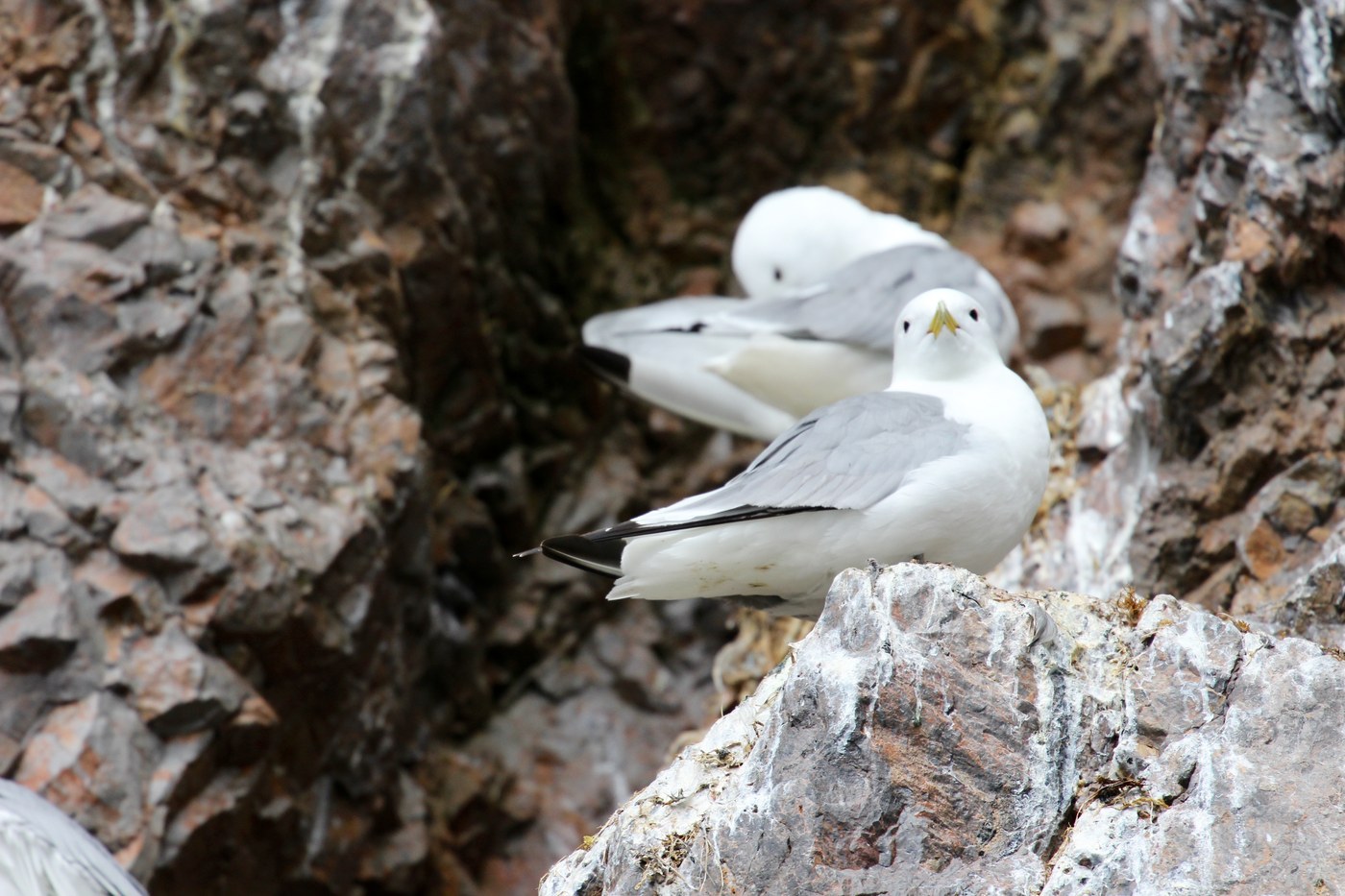
Key Field Marks
- Small, delicate gull, about 16-18 inches (40-46 cm) long, with a pure white head and underparts and a pale gray mantle and upperwing.
- Wingtips are solidly black with no white spots or "mirrors" — often described as looking dipped in ink — a key mark separating it from similar-sized gulls.
- Legs are short and black (unlike the pink, yellow, or greenish legs of most other gulls its size); bill is unmarked yellow-green in adults.
- Juveniles show a bold black "M" pattern across the open wings in flight, a black half-collar on the hindneck, and a black band at the tip of the tail.
- Flight is light, buoyant, and almost tern-like, reflecting its highly pelagic lifestyle.
Behavior
- The most oceanic of the world's gulls, spending the nonbreeding season far out at sea and rarely venturing onto land or inland waters outside the breeding season.
- Breeds colonially in dense, noisy colonies on narrow ledges of sheer coastal cliffs, building compact nests cemented to the rock with mud and vegetation.
- Feeds mainly by picking small fish and invertebrates from at or near the sea surface, often in loose flocks over productive water.
Separating from Similar Species
- Ring-billed Gull / Mew Gull: both show white spots ("mirrors") in the black wingtips and have yellow or greenish legs, not short black legs.
- Bonaparte's Gull: much smaller, with a black (breeding) or dark ear-spot (nonbreeding) head pattern and orange-red legs, plus a different, more triangular wing pattern.
- Juvenile kittiwakes are sometimes confused with juvenile Sabine's Gull, but Sabine's shows a more triangular, tricolored wing pattern and a notched tail rather than a plain black tail band.
Habitat & Range
- Breeds on sea cliffs around the North Atlantic and North Pacific, including Arctic and subarctic coastlines of North America, Europe, and Asia.
- Spends winter far offshore over open ocean, sometimes visible from land during storms or from pelagic boat trips, but otherwise rarely seen from shore.
- Nearly always found over or near saltwater; inland or freshwater records are notable rarities.
Voice
- Named for its call, a nasal, strident "kitti-waaake, kitti-waaake," given constantly and loudly at breeding colonies.
Frequently asked questions
What is the easiest way to identify a Black-legged Kittiwake?
Look for solid black wingtips with no white spots, short black legs, and a clean white head — a combination not shown by similar-sized gulls like Ring-billed or Mew Gull.
Where can I see a Black-legged Kittiwake?
At breeding colonies on sea cliffs around the North Atlantic and North Pacific in summer, or well offshore over open ocean during the nonbreeding season; it is rarely seen inland.
How is the kittiwake's name related to its call?
It comes directly from its loud, nasal breeding-colony call, which sounds like 'kitti-waaake, kitti-waaake.'
How do I tell a juvenile Black-legged Kittiwake from other young gulls?
Look for a bold black 'M' pattern across the open wings, a black half-collar on the nape, and a black band at the tip of the tail.