
Black-headed Gull Identification Guide
A small, common Eurasian gull with a chocolate-brown (not black) hood in summer, a red bill and legs, and white leading wing edges.
Read the full Black-headed Gull encyclopedia entry →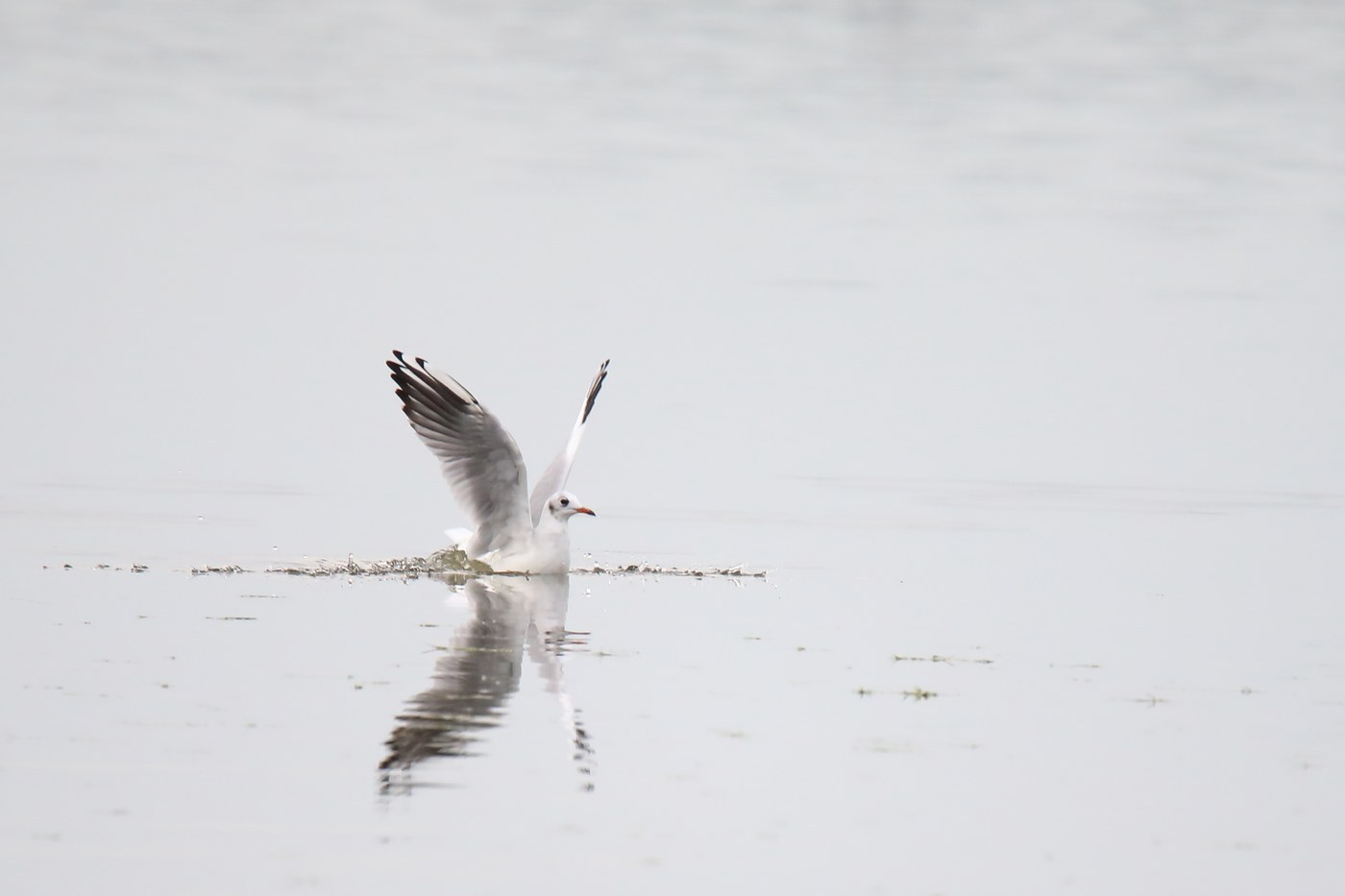
Key Field Marks
- Small, slender gull with a light, buoyant flight and a red bill and red legs.
- Breeding adult has a chocolate-brown hood (despite the name, not truly black) that does not extend down the nape, with white crescents around the eye.
- Non-breeding adult loses the hood, showing a white head with a small dark spot behind the eye.
- Pale grey mantle and back; in flight, adults show a distinctive white leading edge ("white wedge") on the outer wing, visible from both above and below, a key flight identification feature.
- Immatures show brown mottling on the wings and a black terminal tail band.
Separating It From Similar Species
- Bonaparte's Gull (North America) is smaller and daintier with a black (not red) bill and a more delicate build; the white wing wedge is similar in shape but Bonaparte's overall structure is more tern-like.
- Mediterranean Gull has a true black hood extending further down the neck, a thicker deep-red bill, and white (not dark-tipped) wingtips, quite different from Black-headed Gull's brown hood and dark wingtips.
- The combination of red bill/legs, brown (not black) hood, and white leading wing edge reliably separates Black-headed Gull from similar small gulls across its range.
Where and When to See It
- Breeds widely across Europe and temperate Asia in colonies on inland lakes, marshes, and coastal wetlands.
- Highly adaptable in winter, found on coastlines, reservoirs, farmland, parks, and even urban areas, often far from water, scavenging readily around people.
- One of the most numerous and familiar gulls across its range, present year-round in many areas due to short-distance migration and wintering flocks from further north.
Voice and Behavior
- Vocal and noisy, especially at breeding colonies, giving a harsh, laughing "kwarr" or "kree-ar" call.
- Gregarious at all seasons, often forming large mixed flocks with other gulls at feeding sites, landfills, and agricultural fields.
- Omnivorous, taking insects, worms, fish, and readily scavenging human food scraps.
Frequently asked questions
Is the Black-headed Gull's hood actually black?
No — despite the name, the breeding hood is chocolate-brown, not black; true black-hooded gulls like Mediterranean Gull look quite different.
How do you identify a non-breeding Black-headed Gull?
Look for a white head with a small dark smudge behind the eye, a red bill and legs, and the diagnostic white leading edge on the outer wing in flight.
How do you tell Black-headed Gull from Bonaparte's Gull?
Black-headed Gull has a red bill and legs and is slightly larger and bulkier, while Bonaparte's Gull has a black bill and a daintier, more tern-like build.
Where can Black-headed Gulls be found in winter?
Almost anywhere with food or water — coastlines, reservoirs, farm fields, parks, and urban areas — as it is one of the most adaptable and widespread small gulls.