Black-headed Grosbeak Identification Guide
A chunky western North American finch with a thick bill, the male showing a black head and cinnamon-orange body, both sexes rich songsters.
Read the full Black-headed Grosbeak encyclopedia entry →
Key Field Marks
- Large, thick-billed finch with a heavy, conical, pale bill well suited to cracking seeds.
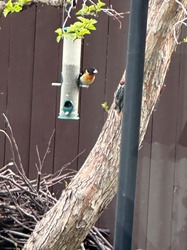
- Breeding male has a black head, black-and-white patterned wings, and a rich cinnamon-orange body, with orange extending across the breast, collar, and rump.
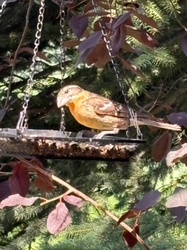
- Female and immature males are streaked brown above with a bold buffy-white eyebrow stripe, buffy underparts, and a large pale bill — a much subtler pattern than the male.
- In flight, males show flashes of yellow under the wing.
Separating It From Similar Species
- Rose-breasted Grosbeak, the eastern counterpart, has a black-and-white male plumage with a rose-red breast patch rather than orange-cinnamon body coloring; females of the two species are very similar and best separated by range, though the two species hybridize where ranges overlap in the Great Plains.
- Female Black-headed Grosbeak can resemble a large sparrow but is readily told apart by its oversized, pale conical bill and yellow wing linings visible in flight.
- Male Bullock's Oriole shares orange tones but has a much thinner, pointed bill and different head pattern (orange face with black eyeline, not an all-black head).
Where and When to See It
- Breeds across western North America, from British Columbia south through the western U.S. into Mexico, in open deciduous and mixed woodland, riparian corridors, and forest edges.
- A long-distance migrant, wintering primarily in Mexico.
- Best looked for in spring and summer at woodland edges, orchards, and streamside groves within its breeding range.
Voice and Behavior
- Song is a rich, rapid, robin-like warbling, often described as sweeter and more musical than a robin's, delivered from a high perch.
- Call is a sharp, distinctive "eek" or squeaky note, useful for locating birds in dense foliage.
- Diet includes seeds, insects, and fruit; notably one of the few birds known to regularly eat toxic monarch butterflies on their wintering grounds in Mexico.
Frequently asked questions
How do you identify a male Black-headed Grosbeak?
Look for a black head, black-and-white wings, and a warm cinnamon-orange body — plus a large, pale, heavy bill typical of grosbeaks.
How is female Black-headed Grosbeak different from a sparrow?
She is larger with a much heavier, pale conical bill, a bold buffy eyebrow stripe, and yellow wing linings visible in flight, all features sparrows lack.
How do you tell Black-headed Grosbeak from Rose-breasted Grosbeak?
Males differ clearly: Black-headed has an orange-cinnamon body versus Rose-breasted's black-and-white body with a rose-red breast patch. Females are very similar and best separated by range, since the species hybridize where they meet.
What does a Black-headed Grosbeak sound like?
Its song is a fast, rich, warbling series reminiscent of an American Robin but more musical, and its call is a sharp squeaky 'eek.'
Black-headed Grosbeak identified by the community
Recent Black-headed Grosbeak sightings identified with Bird Identifier.