
Black-footed Albatross Identification Guide
A large, dark seabird of the North Pacific with long, narrow wings held stiffly outstretched over open ocean.
Read the full Black-footed Albatross encyclopedia entry →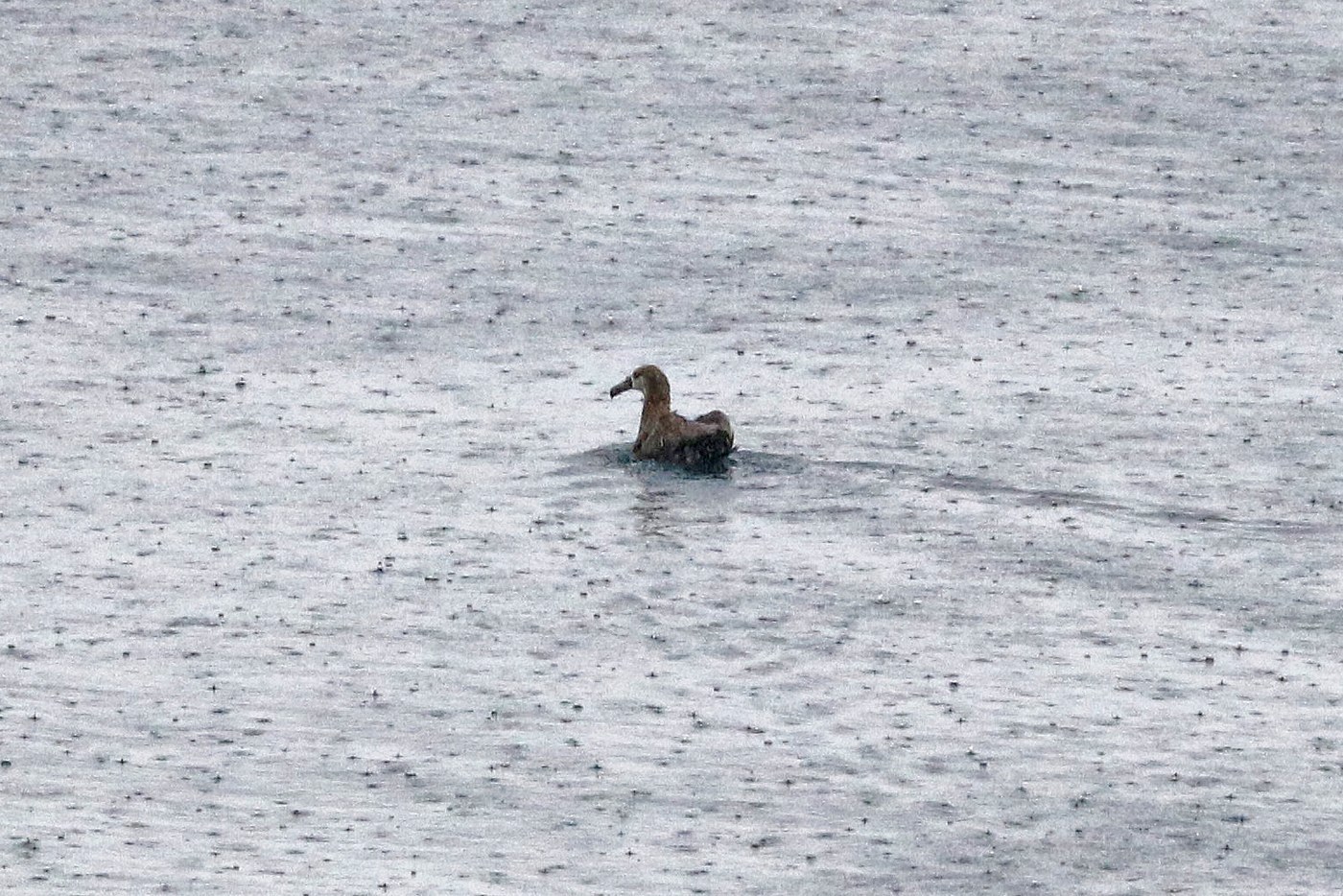
Key Field Marks
- Large albatross with long, narrow, stiffly held wings adapted for dynamic soaring low over ocean swells.
- Plumage is almost entirely sooty dark brown to blackish, with a paler, whitish area at the base of the bill and sometimes a whitish patch around the base of the tail/undertail coverts.
- Older adults often show white feathering developing around the base of the bill and eye over successive years.
- Bill is dark and hooked at the tip; feet are black.
- Flight is characterized by long glides on flat, rigid wings low over the water, with only occasional slow wingbeats.
Separating It From Similar Species
- Laysan Albatross, its close relative and frequent companion at breeding colonies, is easily told apart by its white head and underparts contrasting with dark upperwings — Black-footed Albatross looks uniformly dark by comparison.
- Short-tailed Albatross is much larger with a massive bubblegum-pink bill; adults are mostly white-bodied, while immatures are dark brown like Black-footed Albatross but show a pale bill and pink-based bill that Black-footed lacks.
- Overall dark, fairly uniform plumage combined with dark feet (visible when perched or in flight against a pale background) helps confirm the identification.
Where and When to See It
- Breeds colonially on remote islands, primarily in the Hawaiian archipelago (notably Midway and Laysan), with smaller colonies off Japan.
- Highly pelagic outside the breeding season, ranging widely across the North Pacific, including productive waters off California, Oregon, Washington, Alaska, and Japan.
- Regularly seen on pelagic birding trips off the U.S. West Coast, especially over deep water and near fishing vessels.
Voice and Behavior
- Largely silent at sea; at breeding colonies, gives whinnying calls and engages in elaborate bill-clacking and head-bobbing courtship displays typical of albatrosses.
- Feeds on fish eggs, squid, and other marine organisms taken from or near the surface, and readily follows fishing boats for scraps and bycatch.
- Like other albatrosses, mates for long-term pair bonds and returns to the same nesting island year after year.
Frequently asked questions
How do you tell Black-footed Albatross from Laysan Albatross?
Black-footed Albatross is almost uniformly dark brown/blackish, while Laysan Albatross has a white head and underparts contrasting sharply with dark upperwings.
Where can you see Black-footed Albatross from land or a boat?
It is a regular sight on pelagic birding trips off the U.S. West Coast (California, Oregon, Washington) and around Alaska and Japan, especially over deep offshore waters.
What color are a Black-footed Albatross's feet?
Black, matching its overall dark plumage, which helps distinguish it from paler-footed relatives.
Does Black-footed Albatross ever look pale?
Older adults can develop whitish feathering around the bill base and sometimes near the tail, but the body remains predominantly dark brown throughout life.