
Black-faced Spoonbill Identification Guide
An endangered East Asian wading bird, white overall with a spoon-shaped bill and a distinctive black facial mask around the eyes.
Read the full Black-faced Spoonbill encyclopedia entry →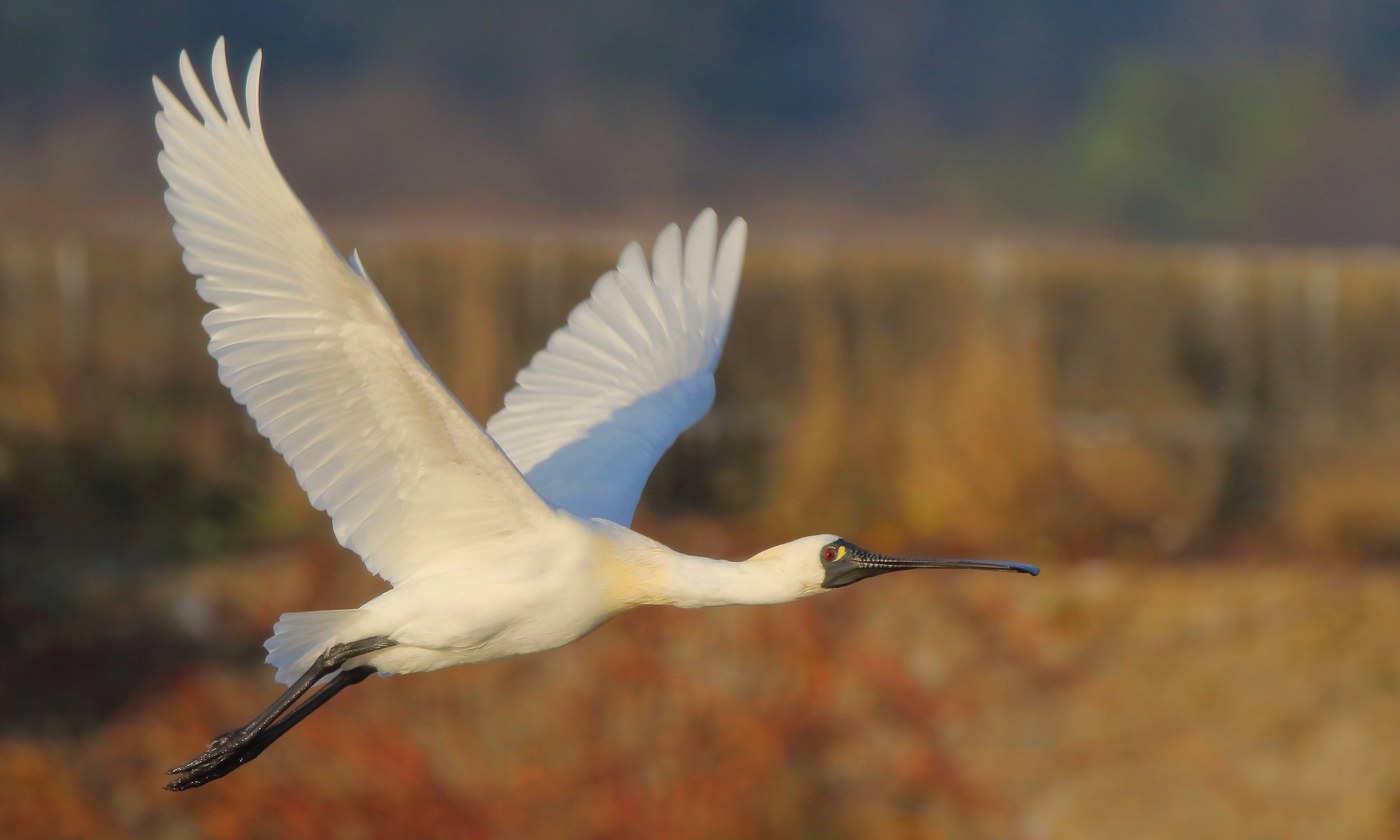
Key Field Marks
- Large, all-white wading bird with a long, flattened, spoon-shaped bill held level or slightly downward while feeding.
- Bare black facial skin extends from the base of the bill around the eyes, forming a continuous black "mask" that is the species' defining feature.
- Legs and bill are black; in breeding plumage, adults develop a shaggy yellowish crest at the back of the head and a pale yellow-buff wash across the upper breast.
- Flies with neck and legs fully extended, distinguishing spoonbills from herons and egrets, which fly with the neck retracted.
Separating It From Similar Species
- Eurasian Spoonbill is very similar but has more white facial skin (the black is largely restricted to the bill and a small area around the eye, not a full mask), a pale-tipped bill, and a different, more western/central Eurasian range.
- Royal Spoonbill (Australasia) has an all-black bill and face but lacks the smoothly continuous mask shape and occurs in a different region.
- Black-faced Spoonbill is also considerably rarer than Eurasian Spoonbill, and range/location is a strong supporting clue — it is essentially restricted to East Asian coasts.
Where and When to See It
- One of the world's rarest waterbirds, with a small breeding population on a handful of islets off the west coast of the Korean Peninsula and nearby areas of China.
- Winters along the coasts of Taiwan, Hong Kong, mainland China, Vietnam, and Japan, favoring estuaries, tidal mudflats, and shallow coastal wetlands, often forming tight roosting flocks.
- Highly site-faithful in winter, with a few key estuaries (such as Tainan's Cigu wetlands in Taiwan) holding a significant share of the world population.
Voice and Behavior
- Generally silent away from breeding colonies; may give low grunting or croaking notes at nesting sites.
- Feeds by wading through shallow water while sweeping its open bill side to side, detecting small fish and crustaceans by touch.
- Roosts communally, often standing on one leg with the bill tucked into the back feathers, packed closely with other spoonbills at high tide.
Frequently asked questions
What is the key field mark of a Black-faced Spoonbill?
A continuous black facial mask that wraps from the bill base around the eyes, combined with an all-white body and a black, spoon-shaped bill.
How do you tell Black-faced Spoonbill from Eurasian Spoonbill?
Black-faced Spoonbill has a much more extensive black facial mask around the eyes, while Eurasian Spoonbill shows more white on the face and a pale tip to the bill.
Why is Black-faced Spoonbill considered endangered?
It has a very small global population concentrated in just a few breeding islets and wintering estuaries in East Asia, making it highly vulnerable to habitat loss.
Where is the best place to see Black-faced Spoonbill in winter?
Major wintering estuaries in Taiwan (such as the Cigu wetlands), Hong Kong's Mai Po marshes, and coastal Vietnam are among the most reliable sites.