
Black-faced Bunting Identification Guide
A small East Asian bunting with an olive-grey head, dark streaked back, and yellowish underparts, found in scrub and farmland.
Read the full Black-faced Bunting encyclopedia entry →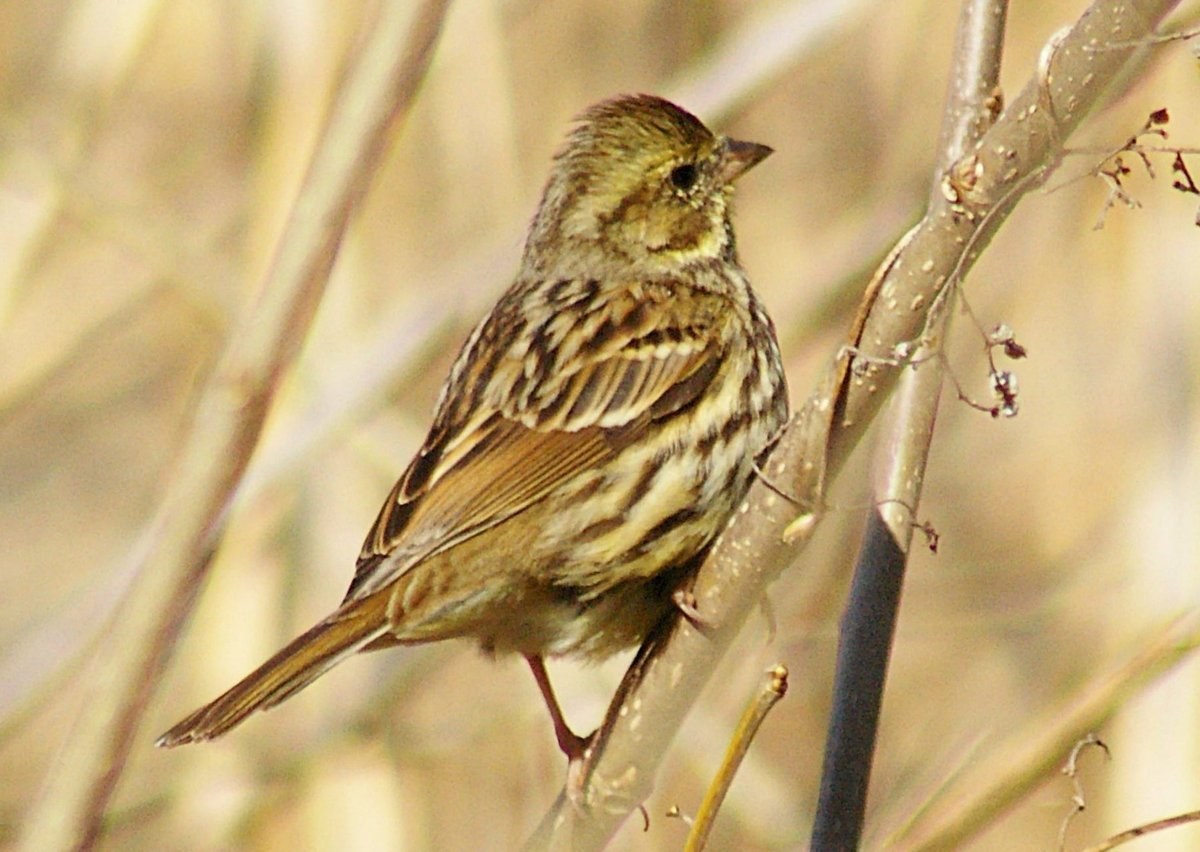
Key Field Marks
- Small, sparrow-sized bunting with a conical bill typical of the genus Emberiza.
- Breeding male has an olive-grey to blackish-grey head and throat, a yellowish-olive breast washed with grey, and a yellow belly with fine dark streaking on the flanks.
- Female and non-breeding male are duller, with a brownish-olive head, pale eyebrow and throat, and more diffuse streaking, making them less distinctive than the male.
- Back and wings are brown with dark streaking; two narrow whitish wingbars may be visible.
- Legs are pale pinkish; bill is dull pink-brown.
Separating It From Similar Species
- Female and winter birds can resemble other streaky Emberiza buntings such as Yellow-throated Bunting or Grey Bunting; the combination of an olive-toned head, yellowish underparts, and lack of strong facial markings helps narrow it down.
- Breeding males are fairly distinctive due to the dark, almost blackish face and throat contrasting with the yellow belly, a pattern not closely matched by co-occurring buntings.
- Chestnut Bunting and other yellow-bellied Asian buntings have brighter rufous or chestnut tones on the upperparts that Black-faced Bunting lacks.
Where and When to See It
- Breeds across a broad swath of eastern Siberia, Mongolia, northern China, Korea, and Japan, typically in scrubby forest edge, thickets, and riparian vegetation.
- Winters in southern China, Taiwan, and parts of Southeast Asia, favoring farmland edges, reedbeds, scrub, and gardens, often in loose flocks with other buntings and sparrows.
- A regular but scarce vagrant well outside its normal range in some years.
Voice and Behavior
- Call is a sharp, thin "tzip" or "tsic," often given as flocks move through low cover.
- Song is a simple, buzzy, repetitive series of notes delivered from a low perch during the breeding season.
- Feeds mostly on the ground and in low vegetation, taking seeds and, especially in the breeding season, insects.
Frequently asked questions
How can I identify a male Black-faced Bunting?
Look for an olive-grey to blackish head and throat contrasting with a yellow belly and streaked flanks — the darker face is the key feature separating it from similarly yellow-bellied buntings.
Are female Black-faced Buntings hard to identify?
Yes, females are duller and browner with less contrast, so range, habitat, and close comparison with other Emberiza buntings are often needed for confirmation.
Where does Black-faced Bunting spend the winter?
Southern China, Taiwan, and parts of Southeast Asia, typically in scrub, farmland edges, and reedbeds, sometimes in mixed flocks with other buntings.
What does the Black-faced Bunting's call sound like?
A sharp, thin 'tzip' or 'tsic' note, often the first clue to a bird's presence in low scrub or reeds.